Discussion Overview
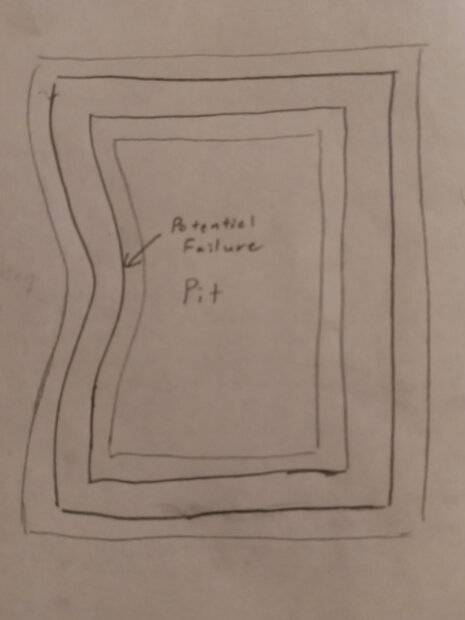
The discussion focuses on the design considerations for a retaining wall surrounding an enclosed pit, examining whether standard checks for sliding and overturning are applicable in this specific configuration. Participants explore the implications of the wall being a continuous structure versus separate walls and the potential failure modes that need to be assessed.
Discussion Character
- Technical explanation
- Debate/contested
- Conceptual clarification
Main Points Raised
- Some participants suggest that standard checks for sliding and overturning may not apply in the same way for a continuous retaining wall around an enclosed area, as the entire wall's weight counters moments differently than separate walls.
- Others argue that the calculations for overturning and sliding should still be relevant but applied to the entire box rather than individual walls, especially considering the potential for the entire structure to tip if conditions are unfavorable.
- A participant raises the concern that even if the box is not narrow, localized tipping or deformation of a section of the wall could still occur, warranting checks for force per length.
- There is a discussion about treating each wall as a flat plate supported at two ends, with varying boundary conditions affecting the analysis.
- Some participants emphasize the importance of checking for caving in of the walls, which remains less defined in terms of methodology.
- One participant mentions the need for additional structural supports or bracing to enhance stability, although specifics about the pit's dimensions and contents are not provided.
Areas of Agreement / Disagreement
Participants generally agree that standard checks for overturning and sliding are relevant but differ on how they should be applied in the context of a continuous wall versus separate walls. The discussion remains unresolved regarding the specific methodologies for checking caving in of the walls and the implications of localized failures.
Contextual Notes
Limitations include a lack of specific dimensions and conditions of the enclosed pit, which may affect the analysis. The discussion also highlights the complexity of boundary conditions and the varying pressures that could influence wall stability.
Who May Find This Useful
Engineers and designers involved in structural and geotechnical engineering, particularly those working on retaining wall designs and stability assessments for enclosed areas.