Detailed solution of an envelopes example in a math book

  • Context: Undergrad 
  • Thread starter Thread starter vgarg
  • Start date Start date
  • Tags Tags
    solution
Click For Summary

Discussion Overview

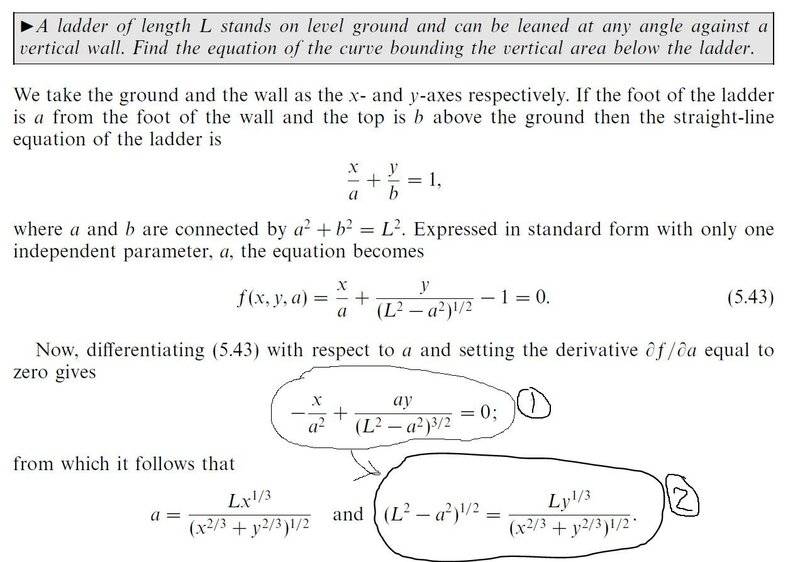
The discussion revolves around a mathematical problem related to an example from a textbook, specifically focusing on the steps involved in transitioning from one equation to another in the context of an envelope problem. The scope includes mathematical reasoning and clarification of equations.

Discussion Character

  • Technical explanation, Mathematical reasoning

Main Points Raised

  • One participant requests clarification on the steps from one equation to another.
  • Another participant suggests that by replacing variables ##x \leftrightarrow y## and ##a \leftrightarrow b##, one can derive the last equation from the previous one.
  • A participant identifies the textbook in question as "Riley et al." and emphasizes the importance of citing both the book title and authors for clarity.
  • A further clarification is provided regarding the symmetry of the problem, proposing an alternative equation for ##b## and suggesting substitution into the first equation using the relation ##a^2 + b^2 = L^2##.
  • A participant expresses gratitude for the assistance and acknowledges the need to properly cite the author in future discussions.

Areas of Agreement / Disagreement

Participants do not reach a consensus on the specific steps or methods to solve the problem, as multiple approaches and clarifications are presented without resolution.

Contextual Notes

The discussion includes assumptions about variable substitutions and the symmetry of the problem, which may not be universally applicable without further context.
vgarg
Messages
11
Reaction score
0
TL;DR
I am looking for steps for the solution of an envelopes example in Mathematical Methods for Physics and Engineering book
Can someone please show me the steps from circled equation 1 to 2?
Envelopes.JPG

Thank you.
 
Last edited:
Physics news on Phys.org
If you replace ##x \leftrightarrow y## and ##a \leftrightarrow b## in the previous equation, you get the last equation.
 
Last edited:
  • Like
Likes   Reactions: vgarg, DrClaude and Orodruin
I believe the author of your text book? @Orodruin
 
  • Like
Likes   Reactions: vgarg
erobz said:
I believe the author of your text book? @Orodruin
No. There are several textbooks with that or similar names. This is from Riley et al. I believe.

@vgarg This is why you should never just quote the name of the book, but also the author(s).
 
  • Like
Likes   Reactions: erobz
Hill said:
If you replace ##x \leftrightarrow y## and ##a \leftrightarrow b## in the previous equation, you get the last equation.
To clarify: By the symmetry of the problem, you could have solved it for ##b## to get
$$
b = \frac{L y^{1/3}}{(x^{2/3} + y^{2/3})^{1/2}}
$$
instead of
$$
a = \frac{L x^{1/3}}{(x^{2/3} + y^{2/3})^{1/2}}
$$

Then simply substitute ##b## in the first equation using ##a^2 + b^2 = L^2##.
 
Last edited:
  • Like
Likes   Reactions: vgarg and Hill
Thank you very much for your help. I will sure list the author of the book in any future post.
 

Similar threads

  • · Replies 1 ·
Replies
1
Views
2K
  • · Replies 4 ·
Replies
4
Views
3K
  • · Replies 3 ·
Replies
3
Views
3K
  • · Replies 2 ·
Replies
2
Views
3K
  • · Replies 9 ·
Replies
9
Views
2K
  • · Replies 5 ·
Replies
5
Views
4K
  • · Replies 0 ·
Replies
0
Views
2K
  • · Replies 19 ·
Replies
19
Views
3K
  • · Replies 1 ·
Replies
1
Views
2K