Determine time after which 4 persons meet in given scenario

Join the discussion
Registration is free. Ask a follow-up in this thread, or start your own.
14 replies · 1K views
vcsharp2003
Messages
915
Reaction score
179
Homework Statement
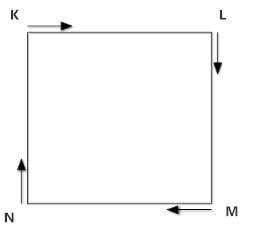
Four persons K, L, M, N are initially at the four corners of a square of side d. Each person now moves with a uniform speed v in such a way that K always moves directly towards L, L directly towards M, M directly towards N and N directly towards K. The four persons will meet after how much time?
Relevant Equations
v= d/t i.e. velocity = displacement/time
Relative velocity of A wrt B = velocity of A - velocity of B
The point of confusion is deciding the direction each persons sets out in i.e. velocity direction of each person. Knowing this will probably help in getting the solution.

At t=0, I can say that velocity of each person is as shown in diagram below.
Kinematics Problem Diagram.jpg
 
Last edited:
Physics news on Phys.org
Vanadium 50 said:
I don't see an attempt, so I will give you one word - which is one more than I should. Symmetry.
It seems they would meet at the center of the square, but then direction of velocity of each person would be changing every instant. In such a dynamically changing situation, how would I calculate the time? The direction of ## \vec v ## would be changing in direction all the time. If each person traveled a curved path to the center, then determining total distance would be difficult. If I knew that distance then I could use the simple equation of velocity = distance/time.
 
Last edited:
vcsharp2003 said:
It seems they would meet at the center of the square, but then direction of velocity of each person would be changing every instant. In such a dynamically changing situation, how would I calculate the time? The direction of ## \vec v ## would be changing in direction all the time. If each person traveled a curved path to the center, then determining total distance would be difficult. If I knew that distance then I could use the simple equation of velocity = distance/time.
What do you think happens to the distance between K and L if K moves towards L and L moves at right-angles to this direction?
 
  • Like
Likes   Reactions: hutchphd
PeroK said:
What do you think happens to the distance between K and L if K moves towards L and L moves at right-angles to this direction?
Distance between K and L should decrease with time. Initial distance is d between them and it finally reduces to 0.
 
vcsharp2003 said:
Distance between K and L should decrease with time. Initial distance is d between them and it finally reduces to 0.
We can all see that. What is the initial reduction in distance (initial relative speed)? Can you calculate that using trigonometry?
 
PeroK said:
We can all see that. What is the initial reduction in distance (initial relative speed)? Can you calculate that using trigonometry?
Below is velocity of K relative to L.
16181568798241455716345160515227.jpg
 
vcsharp2003 said:
Below is velocity of K relative to L.
That's not what I asked you to calculate. I asked you to calculate the rate at which the distance between K and L is decreasing.

The magnitude of the relative velocity is something else.
 
PeroK said:
That's not what I asked you to calculate. I asked you to calculate the rate at which the distance between K and L is decreasing.

The magnitude of the relative velocity is something else.
I think the initial distance between them is d which gradually becomes zero and also point K would be approaching point L at velocity v always, so time taken to meet should be d/v.

Is that right?
 
vcsharp2003 said:
I think the initial distance between them is d which gradually becomes zero and also point K would be approaching point L at velocity v always, so time taken to meet should be d/v.

Is that right?
We all know that. Can you really not calculate the rate at which the distance initially reduces between K and L?
 
PeroK said:
We all know that. Can you really not calculate the rate at which the distance initially reduces between K and L?
If we take K and L, then velocity of K is always going to be perpendicular to velocity of L, no matter what path they take. This means the velocity of approach between K and L will always be v since K has no component along the perpendicular. So my answer to your question is v, which is the velocity of approach between K and L.
 
vcsharp2003 said:
If we take K and L, then velocity of K is always going to be perpendicular to velocity of L, no matter what path they take. This means the velocity of approach between K and L will always be v since K has no component along the perpendicular. So my answer to your question is v, which is the velocity of approach between K and L.
If you can justify that, then you've got the answer.