Kaspelek
- 26
- 0
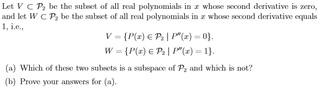
Hi guys, back again...Any help on this question would be appreciated.
Thanks in advance :)View attachment 803
The discussion focuses on determining whether certain subsets of polynomials form a linear subspace. The key criteria for a subset to be a subspace include closure under vector addition and scalar multiplication. Participants analyze polynomials whose second derivative is zero, concluding that the set of all such polynomials does not form a subspace, while the set of polynomials of the form $$P(x) = \frac{x^2}{2} + bx + c$$ does meet the criteria for being a subspace. The conversation emphasizes the importance of testing both conditions for subspace verification.
PREREQUISITESStudents and educators in mathematics, particularly those focusing on linear algebra, as well as anyone interested in the properties of polynomial functions and their applications in vector spaces.
The test for a subspace is that if it contains $x$ and $y$ then it also contains $x+y$ and $cx$ (where $c$ is any constant). Apply that test to each of those two subsets.Kaspelek said:Hi guys, back again...Any help on this question would be appreciated.
Thanks in advance :)View attachment 803
Opalg said:The test for a subspace is that if it contains $x$ and $y$ then it also contains $x+y$ and $cx$ (where $c$ is any constant). Apply that test to each of those two subsets.
ZaidAlyafey said:First find all polynomials whose second derivative is 0 , do you know how to do that ?
Kaspelek said:Doesn't it have to be a second degree polynomial?
I know that for the one where derivative = 1 1/2(x^2) '' = 1
ZaidAlyafey said:Start by the general form $$P(x)=ax^2+bx+c$$ then try to find the constants , what do you get ?
There is no second degree polynomial that yields a second derivative =0?Kaspelek said:So if you double differentiate, 2a=0 for the second derivative to yield 0?
I'm not trying to leech here, I'm just legitimately confused.ZaidAlyafey said:you can use integration
$$p''(x)=1$$
$$p'(x)= x +b$$
$$p(x)= \frac{x^2}{2} +bx+c$$
$$p''(x)=0$$
$$p'(x)= a$$
$$p(x)= ax+c$$
Now test each one to see whether it forms a subspace .
Does this correctly answer the question?Test if subsets are closed under multiplication.a*($$ \frac{x^2}{2} +bx+c$$)d^2/dx^2(a*($$ \frac{x^2}{2} +bx+c$$) = aTherefore since a*p(x) does not equal p''(x) not closed. Hence not a subspace.Kaspelek said:I'm not trying to leech here, I'm just legitimately confused.
So I'm thinking of testing if its closed under multiplication first.Am i correct in saying (assume a=alpha)
a* $$p(x)= \frac{x^2}{2} +bx+c$$ does not equal a*p''(x) ?
How do i correctly show this proof?
Both methods make sense to me, cheers for the help guys!ZaidAlyafey said:You can use the method Oplag illustrated or you can do the following
we have proved that all the polynomials of degree 2 that satisfy the conditions must be of the form
$$P(x) = \frac{x^2}{2}+bx+c$$ were $$b$$ and $$c$$ are arbitrary numbers .
So the set contains only second degree polynomials with a leading coefficient $$=\frac{1}{2}$$ .
Now , if we choose two polynomials in the set ,say, $$R(x) = \frac{x^2}{2}+x+1$$ and $$Q(x) = \frac{x^2}{2}+x+2$$
We know by definition that a subspace must be closed under addition . Now, if we add the two polynomials , do we get a polynomial that is still in the set ?