Determining Force and Directions on Truss with Pulley

  • Context: Engineering 
  • Thread starter Thread starter trusshelp148
  • Start date Start date
  • Tags Tags
    Force Pulley Truss
Click For Summary
SUMMARY

The discussion focuses on determining forces and directions on a truss system involving pulleys at points D and E. Users employed methods of joints to analyze forces but faced challenges in calculating reactions at points A and B due to the presence of pulleys. Key insights include treating both pulleys as a single entity and recognizing that tension in the cable remains constant throughout. The analysis reveals that links 4 and 5 are in compression, while link 1 is also under compression, and link 2 is under tension.

PREREQUISITES
  • Understanding of static equilibrium principles
  • Familiarity with methods of joints in truss analysis
  • Knowledge of Free Body Diagrams (FBD)
  • Basic concepts of tension and compression in structural elements
NEXT STEPS
  • Study the application of Free Body Diagrams (FBD) for complex truss systems
  • Learn about static equilibrium equations for trusses with pulleys
  • Explore the effects of tension and compression in structural analysis
  • Investigate the role of pulleys in mechanical systems and their impact on force distribution
USEFUL FOR

Structural engineers, mechanical engineers, and students studying statics or structural analysis will benefit from this discussion, particularly those working with truss systems and pulley mechanisms.

trusshelp148
Messages
4
Reaction score
1
Homework Statement
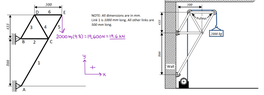
I am struggling to figure out if I did this problem correctly. I am supposed to determine the forces acting on all of the links, as well as whether they are in tension or compression. There is an image included below.
Relevant Equations
∑Fx=0
∑Fy=0
∑M=0
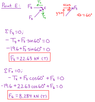
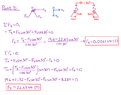
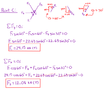
So far I have used methods of joints to determine the forces at point E, D, and C. However, there is also a pulley attached to point D and E which I included in the sum of forces, but I'm not sure if that's the correct way to apply them. Every force I've calculated so far has also been in tension, which does not seem right. I'm also unsure of how to calculate the reactions at A and B with the pulley involved. Any help would be much appreciated.
 

Attachments

  • diagram.png
    diagram.png
    21.2 KB · Views: 260
  • Point E.png
    Point E.png
    13.1 KB · Views: 233
  • Point D.png
    Point D.png
    22.6 KB · Views: 207
  • Point C2.png
    Point C2.png
    17.9 KB · Views: 209
Physics news on Phys.org
Welcome, @trusshelp148 !

My old eyes can barely distinguish anything in that image that you have included.
Could you improve it?
 
Lnewqban said:
Welcome, @trusshelp148 !

My old eyes can barely distinguish anything in that image that you have included.
Could you improve it?
Thank you! And of course, sorry for the blurry view. I've attached some more photos that I hope are more viewable.
 
Thank you! :smile:
I would treat both pulleys as one.
The tension in the cable is the same everywhere.
Are those 2000 kg-mass or kg-force?
That weight is your tension, pushing D and E down and compressing link 6 from both ends.

Please, see:
https://www.ecourses.ou.edu/cgi-bin/ebook.cgi?topic=st&chap_sec=03.2&page=case_sol

Links 4 and 5 must be in compression, transferring that load down to node C, link 1 and pivot A.
Link 1 must be in compression, while ling 2 is pulling hard from pivot B.
Link 3 is not doing much, at least in theory.
 
Lnewqban said:
Thank you! :smile:
I would treat both pulleys as one.
The tension in the cable is the same everywhere.
Are those 2000 kg-mass or kg-force?
That weight is your tension, pushing D and E down and compressing link 6 from both ends.

Please, see:
https://www.ecourses.ou.edu/cgi-bin/ebook.cgi?topic=st&chap_sec=03.2&page=case_sol

Links 4 and 5 must be in compression, transferring that load down to node C, link 1 and pivot A.
Link 1 must be in compression, while ling 2 is pulling hard from pivot B.
Link 3 is not doing much, at least in theory.
It is 2000 kg-mass, yes. How would I go about treating the pulley as one? Since it's the same cable going through D and E, do I not need to apply it to the links multiple times?
 
trusshelp148 said:
It is 2000 kg-mass, yes. How would I go about treating the pulley as one? Since it's the same cable going through D and E, do I not need to apply it to the links multiple times?
Doing a FBD for each pulley, you will see that two compression forces go down the two links that meet at each.
Treat the cable as in equilibrium (Tin = Tout)
 
Lnewqban said:
Doing a FBD for each pulley, you will see that two compression forces go down the two links that meet at each.
Treat the cable as in equilibrium (Tin = Tout)
Thank you! I understand now.
 
  • Like
Likes   Reactions: Lnewqban
Triangle CDE is loading node C with (19.6 x 2) kN (straight down).
Calculating moments about pivots A, and then B, you can determine how much vertical and horizontal forces each is loaded with.
Only then, you will be able to visualize how each link is working.
 

Similar threads

Replies
3
Views
2K
  • · Replies 2 ·
Replies
2
Views
2K
  • · Replies 1 ·
Replies
1
Views
2K
Replies
3
Views
5K
  • · Replies 2 ·
Replies
2
Views
3K
  • · Replies 1 ·
Replies
1
Views
2K
  • · Replies 4 ·
Replies
4
Views
2K
  • · Replies 1 ·
Replies
1
Views
2K
  • · Replies 1 ·
Replies
1
Views
3K
  • · Replies 5 ·
Replies
5
Views
2K