Determining optimum flywheel dimensions

Click For Summary
SUMMARY

The discussion focuses on optimizing the dimensions of a flanged free-spinning flywheel to maximize the moment of inertia while minimizing mass, specifically for a gyroscope design project. The equations used include the moment of inertia formula I=1/2[m1(r12+r22)+m2(r22+r32)] and mass calculation M=πρ[h1(r22-r12)+h2(r32-r22)], with specific constraints on dimensions and materials, such as brass with a density of 8400 kg/m³. The user employed Excel for iterative calculations and identified that an optimal radius r2 of 42.5 mm yields a maximum spin time of approximately 460 seconds, while a radius of 28 mm results in 550 seconds. The discussion also touches on the impact of bearing specifications on performance.

PREREQUISITES
  • Understanding of moment of inertia and its calculation for composite shapes
  • Familiarity with calculus for optimization problems
  • Proficiency in using Excel for iterative calculations and data plotting
  • Knowledge of material properties, specifically for brass in mechanical applications
NEXT STEPS
  • Research optimization techniques in mechanical design, focusing on flywheel applications
  • Learn advanced calculus methods for maximizing functions in engineering contexts
  • Explore the effects of different bearing types on rotational dynamics and performance
  • Investigate the relationship between mass distribution and moment of inertia in composite structures
USEFUL FOR

Mechanical engineers, design engineers, and students working on gyroscopic systems or flywheel design optimization will benefit from this discussion.

motoxYogi
Messages
11
Reaction score
0
Hello all,

I am currently doing a design project on gyroscopes.
My question concerns the flywheel design, specifically trying to determine the dimensions of a flanged free-spinning flywheel to maximize the moment of inertia while trying to minimize the mass, given certain design constraints.
I've treated the flanged flywheel as two separate hollow cylinders and as far as I understand it, the moment of inertia about the axis of rotation is
I=1/2[m1(r12+r22)+m2(r22+r32)]
The mass is
M=πρ[h1(r22-r12)+h2(r32-r22)]
Due to design constraints r3=0.05m and h2 has a maximum size of 0.04m, due to the bearing I will be using r1 = 0.011 m and h1=0.007m. So the only variable is r2.
The material that i have been using is brass, ρ=8400kg/m3
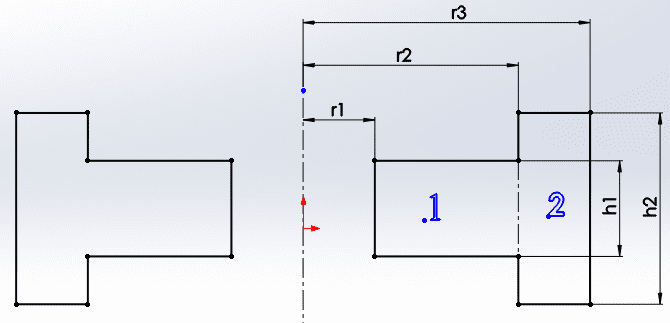
1.png


I know I should be able to use calculus to solve it but I've never been able to apply it well, I've been chasing myself round in circles for days and just keep drawing blanks.
Any help or suggestions is greatly appreciated.
 
Engineering news on Phys.org
I've been using Excel to perform iterative calculations and then plotted the MOI and mass against r2.
resulting in this graph
2.png

I then tried to approximate where the slope of MOI dropped off significantly compared to the the slope of the mass.
Would this be an acceptable approximation?
 
Plot MOI/Mass vs R2.

Also you can use a subtraction to delete mass (ie lightning it) from the MOI and mass calcs. Assume that all the force acts on the radius of the COM of the deleted segment.
 
Last edited:
Hmmm...
I tried the MOI/mass vs. r2. The maximum point on the curve corresponded to r2 = 42.5 mm.
I then got the bearing resistances for that mass and MOI and plugged it into another excel spreadsheet to determine the maximum spin time it would achieve given initial velocity 1047 rad/sec.
It worked out at approximately 460 seconds. The values I approximated (r2 = 28 mm) worked out at about 550 seconds. When I initially wrote the equations for spin time I was trying to select a bearing, I used a best guess for r2 = 30 mm and it gives me a spin time of 700 sec!
Maybe I should have mentioned the fact that I'm using hybrid bearings, I was just reading through the manufacturers brochure again and realized that it called for a minimum radial load of 16.4 N (1.67kg) for my purposes.
The mass at r2 = 42.5 mm worked out as 1 kg. Would that make a big difference?
Also what did you mean by subtracting the mass?
 

Similar threads

  • · Replies 4 ·
Replies
4
Views
16K
  • · Replies 18 ·
Replies
18
Views
2K
Replies
3
Views
4K
  • · Replies 63 ·
3
Replies
63
Views
16K
  • · Replies 6 ·
Replies
6
Views
3K
  • · Replies 9 ·
Replies
9
Views
3K
  • · Replies 7 ·
Replies
7
Views
2K
  • · Replies 15 ·
Replies
15
Views
2K
  • · Replies 11 ·
Replies
11
Views
4K
  • · Replies 35 ·
2
Replies
35
Views
11K