Determining the resistivity of intrinsic Germanium

  • Thread starter Thread starter jisbon
  • Start date Start date
  • Tags Tags
    Resistivity
Click For Summary
SUMMARY

The discussion focuses on determining the resistivity of intrinsic Germanium, specifically addressing the calculation of conductivity using the formula involving temperature and the Boltzmann constant. A participant attempts to calculate conductivity using the reciprocal of resistivity (1/0.455) but encounters issues with the validity of the constant C and the ratio of conductivities at different temperatures. Key insights include the importance of maintaining proper algebraic ratios and ensuring unit consistency, particularly between the Boltzmann constant (1.38 x 10⁻²³ J/K) and the energy band gap in eV.

PREREQUISITES
  • Understanding of semiconductor physics, particularly intrinsic Germanium
  • Familiarity with resistivity and conductivity calculations
  • Knowledge of the Boltzmann constant and its application in semiconductor equations
  • Basic algebra skills for manipulating equations and ratios
NEXT STEPS
  • Research the relationship between resistivity and temperature in semiconductors
  • Learn about the significance of the Boltzmann constant in semiconductor physics
  • Study the derivation and application of the conductivity formula for intrinsic semiconductors
  • Explore common pitfalls in unit conversions and dimensional analysis in physics
USEFUL FOR

Students and professionals in physics and electrical engineering, particularly those focusing on semiconductor materials and their properties.

jisbon
Messages
475
Reaction score
30
Homework Statement
At room temperature (300 K), the bandgap energy and resistivity of
intrinsic germanium is 0.67 eV and 0.455 ohm/m, respectively.
Determine the resistivity of the intrinsic germanium at 150 °C. Assume
that, at room temperature, the electron and hole mobilities are 0.14 and
0.05, respectively. The bandgap is insensitive to the temperature.
Relevant Equations
Shown below.
Hi.
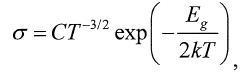
Since,
1580648252211.png

I can find conductivity by taking the reciprocal of resistivity, in this case, 1/0.455
Hence, I will end up with:
##\frac{1}{0.455}=C(300)^{-3/2}e^{(\frac{-0.67}{2(1.38*10^{-23})(300)})}##
However, my C value seems to be invalid in this case.
May I know what may went wrong here? Thanks
 
Physics news on Phys.org
take the ratio of the conductivities at the two twmperatures and the constant will drop out...
 
Dr Transport said:
take the ratio of the conductivities at the two twmperatures and the constant will drop out...
The ratio seems to be undefined too:
1580650920626.png
 
Not only that, but you should really do the ratio algebraically first before plugging in all those numbers. Give σ and T different subscripts, while everything else is common to both.

It is easier to deal with, and it is why we try to teach the students to do at the General Physics level.

Zz.
 
Dr Transport said:
look at the magnitude of your exponent...
The formula states that it has a negative sign though. Is the formula wrong in this case..? Sorry
 
jisbon said:
The formula states that it has a negative sign though. Is the formula wrong in this case..? Sorry
\approx 10^{23}
 
Isn't the Boltzmann constant 10 to the power of - 23?
Dr Transport said:
\approx 10^{23}
 
  • #10
your Boltzmann constant is in JK^{-1} and your band gap is in eV.
 

Similar threads

Replies
14
Views
3K
Replies
9
Views
1K
  • · Replies 3 ·
Replies
3
Views
1K
  • · Replies 1 ·
Replies
1
Views
2K
  • · Replies 2 ·
Replies
2
Views
2K
Replies
2
Views
1K
  • · Replies 3 ·
Replies
3
Views
2K
  • · Replies 2 ·
Replies
2
Views
666
  • · Replies 1 ·
Replies
1
Views
754
  • · Replies 5 ·
Replies
5
Views
679