Differential Equation to Difference Equation

Click For Summary
SUMMARY

This discussion focuses on the conversion of differential equations (DE) to difference equations (DE) and the implications for chaotic systems. It confirms that it is possible to derive difference equations from differential equations, with an emphasis on maintaining numerical stability to avoid exponential error accumulation. The Lorenz system and Baker's map are mentioned as examples, highlighting the importance of testing for chaotic characteristics in the discretized solutions. The conversation underscores that the finite difference methods, such as Euler and leapfrog, are critical in ensuring that the discrete model retains the essential features of the original DE.

PREREQUISITES
  • Understanding of differential equations and their properties
  • Familiarity with numerical methods, specifically finite difference methods
  • Knowledge of chaotic systems and their characteristics
  • Basic concepts of dynamical systems
NEXT STEPS
  • Research "Euler finite difference method" for basic numerical integration techniques
  • Explore "leapfrog finite difference method" for advanced stability in numerical solutions
  • Study the "Lorenz system" to understand chaotic behavior in differential equations
  • Investigate methods for testing chaos in discrete systems through varying initial conditions
USEFUL FOR

Students and researchers in mathematics, physics, and engineering, particularly those focused on dynamical systems, chaos theory, and numerical analysis of differential equations.

ebangosh
Messages
2
Reaction score
0
Hi all,

I am a bit new in this, am trying to learn DE, dynamical systems, & chaos. I am looking into some answers for the following questions:

1) Is it always possible to derive a difference equation for every differential equation, and if so how do we do that?

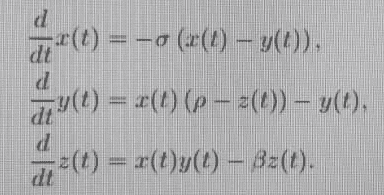
2) Consider Lorenz system:
upload_2018-11-29_10-9-12.png


Where does Lorenz map/discrete version coming from, was it derived from Lorenz system?

3) I heard about Baker's map but I couldn't figure if Baker's map was also derived from a system of linear differential equation too?

4) If the original system of differential eqns exhibits chaotic characteristic, will this characteristic remains in difference equation?

Thanks for your helps.
 

Attachments

  • upload_2018-11-29_10-9-12.png
    upload_2018-11-29_10-9-12.png
    22.6 KB · Views: 989
Physics news on Phys.org
It's possible to form many kinds of difference equations from any DE or PDE. Some of them are better, some worse. The goal is to find a difference equation that is not numerically unstable, i.e. doesn't produce a solution where the numerical error accumulates exponentially with increasing ##t##.

Any characteristic of the original DE, including chaos, should remain in the discrete solution if the numerical scheme is any good. Actually, the small numerical errors in a discretized solution can often initiate chaos even if the initial conditions are carefully set to produce an (unstable) periodic trajectory.
 
Thank you for your answers. I am trying to absorb them. When you mention 'some of them are better, some worse', did you mean numerically stable and unstable respectively?

How do we test whether the difference equation still own the chaotic characteristics?

If we are modelling real world phenomena, initially using DE/PDE, then after we transform into difference equation, is the model still valid? Is there any sort of threshold on any parameter telling such a thing?

Thank you.
 
The methods differ in both stability and in how short finite difference ##\Delta t## has to be used in the place of ##dt## to get reasonable accuracy. Try to google some info about Euler and "leapfrog" finite difference methods as an example.

Chaos is tested by doing several calculations with slightly different initial conditions.

The finite difference integration should reproduce the most important features of the original differential equation. For instance, when integrating the time dependent Schrödinger equation, the norm of the wave function should remain constant (unitary time evolution).
 

Similar threads

  • · Replies 3 ·
Replies
3
Views
1K
  • · Replies 6 ·
Replies
6
Views
2K
  • · Replies 2 ·
Replies
2
Views
3K
  • · Replies 1 ·
Replies
1
Views
3K
  • · Replies 25 ·
Replies
25
Views
3K
  • · Replies 3 ·
Replies
3
Views
2K
  • · Replies 3 ·
Replies
3
Views
3K
  • · Replies 1 ·
Replies
1
Views
2K
  • · Replies 2 ·
Replies
2
Views
4K
  • · Replies 4 ·
Replies
4
Views
2K