Differential equations and numerical methods questions

Click For Summary

Discussion Overview

The discussion revolves around understanding differential equations and numerical methods, particularly focusing on the relationship between instantaneous rates of change and approximations of functions. Participants explore how to derive functions from given rates of change and the implications of numerical approximations.

Discussion Character

  • Exploratory
  • Technical explanation
  • Conceptual clarification
  • Debate/contested
  • Mathematical reasoning

Main Points Raised

  • One participant questions if the approximation of instantaneous rates of change can be represented by specific function values at small intervals.
  • Another participant confirms that replacing the derivative with a finite difference is indeed an approximation.
  • A participant seeks clarification on how to rewrite differential equations for numerical approximations.
  • Some participants discuss the necessity of initial conditions to solve differential equations and the role of integration constants.
  • There is confusion expressed about the relationship between the function values obtained and the original function that describes the instantaneous rate of change.
  • Participants present different types of differential equations and their respective solutions, emphasizing the distinction between equations dependent on x and those dependent on y.
  • One participant highlights the importance of understanding the numerical approach and the difference between exact solutions and approximated function values.

Areas of Agreement / Disagreement

Participants express varying levels of understanding regarding the relationship between instantaneous rates of change and function values. There is no consensus on the interpretation of the results or the next steps in utilizing the function values obtained.

Contextual Notes

Some participants note the importance of initial conditions in solving differential equations, while others express uncertainty about how to proceed with the function values derived from numerical methods. The discussion reflects a range of assumptions and interpretations regarding the mathematical concepts involved.

awholenumber
Messages
200
Reaction score
10
i have few doubts about differential equations and numerical methods ...
in a differential equation question ... you are given an instantaneous rate of change...
and you are supposed to find the function that gives , this instantaneous rate of change
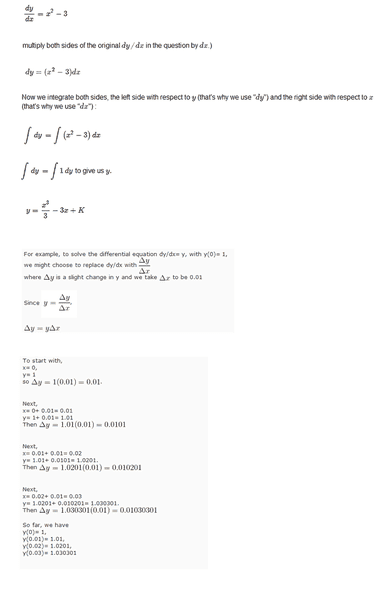
Numerical methods approximate the "instantaneous rate of change" with "the rate of change over a small interval".

maths_5.png


is this same as ...

f(0)=1,
f(0.01)=1.01,
f(0.02)=1.0201,
f(0.03)= 1.030301

??
 
Physics news on Phys.org
Yes. Note that replacing ##\ dy\over dx\ ## by ##\ \Delta y\over \Delta x\ ## is an approximation...
 
thanks ...

maths_3.png


does anyone know how to re write this equation for numerical approximations ??
 
No approximation needed: you have solved the equation...
 
i am trying to understand some things in plain english ...
in a differential equation question,you are given an instantaneous rate of change of an object
The gradient of the curve dy/dx is the instantaneous change of y with respect to x ,the rate at which y is changing as x is changing
and you are supposed to find the function that gives , this instantaneous rate of change

maths_5.png


and this is same as ...

f(0)=1,
f(0.01)=1.01,
f(0.02)=1.0201,
f(0.03)= 1.030301

??wasn't i supposed to find the function that gives ,this instantaneous rate of change ??
The answer is the function that has that rate of change
The answer is a function that has the instantaneous rate of change that you were given ...now i have four functions and four instantaneous rate of change ??
what does this mean ??
does it mean that i have four functions that has the instantaneous rate of change that i was given

??
 
You have two equations with a different character: one (##{dy\over dx}=x^2-3##) is of the type ## y'= f(x) ## and the other is of the type ##y'= f(y)## (I use the abbreviation ##y'## for the derivative ##{dy\over dx}## ).

## y'= f(x) ## is solved if you can find a primitive of f : a function ##F(x)## for which ##F'= f##.

There is the small matter of the integration constant: If you know your rate of change but you don't know where you start, then you can not determine where you will be next.

In other words: With every differential eqiuation you need something to deal with the integration constant (one for every "quote") . For example a function value at x = 0 (or a function value at any other point).

Your first equation isn't accompanied by such a condition, so you can't get further than ## y = F(x) = x^3/3-3x + K##.

Your second differential equation does have a condition: ##y(0) = 1##. You solve numerically by approaching y(0) as a linear function for a small step:$$y(0+\Delta x) \approx y(0) + \Delta x {dy\over dx}$$ when all you really know is $$ \lim_{h\downarrow 0} { y(0+h) - y(0) \over h } = {dy\over dx} \ .$$
When you take a few steps you get a sequence of approximated function values, but not a function (in the sense of an exact prescription what to do with x to get y).

So for ##\ y'= y\ \ \& \ \ y(0) = 1 \ ## you have found four function values, not four functions.
 
Last edited:
BvU said:
You have two equations with a different character: one (##{dy\over dx}=x^2-3##) is of the type ## y'= f(x) ## and the other is of the type ##y'= f(y)## (I use the abbreviation ##y'## for the derivative ##{dy\over dx}## ).

## y'= f(x) ## is solved if you can find a primitive of f : a function ##F(x)## for which ##F'= f##.

There is the small matter of the integration constant: If you know your rate of change but you don't know where you start, then you can not determine where you will be next.

In other words: With every differential eqiuation you need something to deal with the integration constant (one for every "quote") . For example a function value at x = 0 (or a function value at any other point).

Your first equation isn't accompanied by such a condition, so you can't get further than ## y = F(x) = x^3/3-3x + K##.

Your second differential equation does have a condition: ##y(0) = 1##. You solve numerically by approaching y(0) as a linear function for a small step:$$y(0+\Delta x) \approx y(0) + \Delta x {dy\over dx}$$ when all you really know is $$ \lim_{h\downarrow 0} { y(0+h) - y(0) \over h } = {dy\over dx} \ .$$
When you take a few steps you get a sequence of approximated function values, but not a function (in the sense of an exact prescription what to do with x to get y).

So for ##y'= y & y(0) = 1 ## you have found four function values, not four functions.

BvU ,

thanks a lot .. there is so much good information in that post ... i have already learned a lot from your post ... now i think its just a matter of googling the proper words from your post ..
even differential equation is kind of getting interesting ...

few more basic questions ...

i don't understand this properly ...

most of the time , the original question is ...

find the function that gives ,this instantaneous rate of change
maths_5.png


which is same as this ..

f(0)=1,
f(0.01)=1.01,
f(0.02)=1.0201,
f(0.03)= 1.030301

for ##y'= y & y(0) = 1 ## you have found four function values, not four functions.

what is the next thing you do with these function values... you plug it into the equations ??

i really thought the answer is a function ..that has that rate of change

i mean this is how a question really starts ...

find the function that gives ,this instantaneous rate of change

<Mod note: Irrelevant image deleted>if answer is a function that has that rate of change ...

what are these four function values ...

?
 
Last edited by a moderator:
Nice picture; taken from inside the book ? (I recognize Rotterdam, though...)

Seems to me you still have trouble understanding what you did for ##y'=y## so let's step back and treat ##y'= x^2-3## the same way. Add initial condition y(0) = 0 so it yields a unique solution.

##x = 0 \rightarrow y(0) = 0##

##x = 0.1 \rightarrow y(0.1) = 0 + (0.01 - 3)* 0.1 = -0.299 \ ## exact solution ##y(0.1) = 0.001 - 3 = -0.299 \ ## hurray.

etc. etc. we get:
upload_2016-7-22_16-21-54.png


upload_2016-7-22_16-44-51.png


So the exact solution is a function ##y = x^3/3-3x## and the numerical approach is a table of aproximated function values.

(I took steps of 0.1 so the difference between exact and numerical becomes visible).

In fact, for your other equation ##y'=y## and ##y(0)=1## an exact solution can also be found. Use the same method (everything with y on one side gives ##{dy\over y}=dx##, then integrate and apply the initial condition). But you'll learn that one soon enough.
 

Attachments

  • upload_2016-7-22_16-22-7.png
    upload_2016-7-22_16-22-7.png
    4.1 KB · Views: 609
let me re arrange a few things ...so that i can understand this properly ...ok , there are two questions in this one ...

find the function that gives, this instantaneous rate of change ...
maths_5.png
which is same as this ..

f(0)=1,
f(0.01)=1.01,
f(0.02)=1.0201,
f(0.03)= 1.030301
BvU said:
You have two equations with a different character: one (##{dy\over dx}=x^2-3##) is of the type ## y'= f(x) ## and the other is of the type ##y'= f(y)## (I use the abbreviation ##y'## for the derivative ##{dy\over dx}## ).

## y'= f(x) ## is solved if you can find a primitive of f : a function ##F(x)## for which ##F'= f##.

There is the small matter of the integration constant: If you know your rate of change but you don't know where you start, then you can not determine where you will be next.

In other words: With every differential eqiuation you need something to deal with the integration constant (one for every "quote") . For example a function value at x = 0 (or a function value at any other point).

Your first equation isn't accompanied by such a condition, so you can't get further than ## y = F(x) = x^3/3-3x + K##.

Your second differential equation does have a condition: ##y(0) = 1##. You solve numerically by approaching y(0) as a linear function for a small step:$$y(0+\Delta x) \approx y(0) + \Delta x {dy\over dx}$$ when all you really know is $$ \lim_{h\downarrow 0} { y(0+h) - y(0) \over h } = {dy\over dx} \ .$$
When you take a few steps you get a sequence of approximated function values, but not a function (in the sense of an exact prescription what to do with x to get y).

So for ##\ y'= y\ \ \& \ \ y(0) = 1 \ ## you have found four function values, not four functions.

for ##y'= y & y(0) = 1 ## you have found four function values, not four functions.

for ##f(x)=y & f(0) = 1 ## you have found four function values, not four functions.

f(0)=1,
f(0.01)=1.01,
f(0.02)=1.0201,
f(0.03)= 1.030301

BvU said:
Seems to me you still have trouble understanding what you did for ##y'=y## so let's step back and treat ##y'= x^2-3## the same way. Add initial condition y(0) = 0 so it yields a unique solution.

##x = 0 \rightarrow y(0) = 0##

##x = 0.1 \rightarrow y(0.1) = 0 + (0.01 - 3)* 0.1 = -0.299 \ ## exact solution ##y(0.1) = 0.001 - 3 = -0.299 \ ## hurray.

etc. etc. we get:
View attachment 103655

View attachment 103661

So the exact solution is a function ##y = x^3/3-3x## and the numerical approach is a table of aproximated function values.

(I took steps of 0.1 so the difference between exact and numerical becomes visible).

In fact, for your other equation ##y'=y## and ##y(0)=1## an exact solution can also be found. Use the same method (everything with y on one side gives ##{dy\over y}=dx##, then integrate and apply the initial condition). But you'll learn that one soon enough.

BvU ,

thanks for the reply ...

its from a book called "numerical methods for ordinary differential equations " ...i did a horizontal flip of that image with ms paint ..
Mod note: Why? How does that add any information to your question? Also, you have posted an image of a bridge twice, which also adds nothing of substance to what you're asking.
few more re arrangements in a way that i can understand this ...

Seems to me you still have trouble understanding what you did for ##f(x)=y## so let's step back and treat ##f(x)= x^2-3## the same way. Add initial condition f(0) = 0 so it yields a unique solution.

##x = 0 \rightarrow f(0) = 0##

##x = 0.1 \rightarrow f(0.1) = 0 + (0.01 - 3)* 0.1 = -0.299 \ ## exact solution ##f(0.1) = 0.001 - 3 = -0.299 \ ##

etc .. etc .. we get ..

upload_2016_7_22_16_21_54.png


upload_2016_7_22_16_44_51.png


So the exact solution is a function ##f(x) = x^3/3-3x## and the numerical approach is a table of aproximated function values.

(I took steps of 0.1 so the difference between exact and numerical becomes visible).

In fact, for your other equation ##f(x)=y## and ##f(0)=1## an exact solution can also be found. Use the same method (everything with y on one side gives ##{dy\over y}=dx##, then integrate and apply the initial condition). But you'll learn that one soon enough

upload_2016-7-22_16-22-7-png.103656.png
i am going to take a little bit of time to read and re read this ...

there is so much good information again on this one ...

let me see what i can learn from this , and i don't know where to move to from here ...

again , thanks a lot ...

if i have more doubts i will come back and post more ...
 
Last edited by a moderator:

Similar threads

  • · Replies 7 ·
Replies
7
Views
2K
  • · Replies 3 ·
Replies
3
Views
2K
  • · Replies 25 ·
Replies
25
Views
4K
  • · Replies 3 ·
Replies
3
Views
3K
  • · Replies 14 ·
Replies
14
Views
3K
  • · Replies 8 ·
Replies
8
Views
2K
  • · Replies 8 ·
Replies
8
Views
4K
  • · Replies 2 ·
Replies
2
Views
2K
  • · Replies 20 ·
Replies
20
Views
3K
  • · Replies 1 ·
Replies
1
Views
2K