Dipole axis alignment in polar coordinates

2 replies · 2K views · last reply
DaraRychenkova
Messages
1
Reaction score
0
Homework Statement
- Determination of the dipole (p=ql). Find the dipole potential at a distance r much larger than the size of the dipole itself. Calculate the field of the dipole using the relationship between the potential and the field.


1. Solve the problem of finding the dipole field using the expression for the potential obtained in the previous problem in polar coordinates
Relevant Equations
Dipole, electrostatic
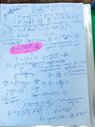
I don't know how to get the result referring to the previous task. Is my decision correct?
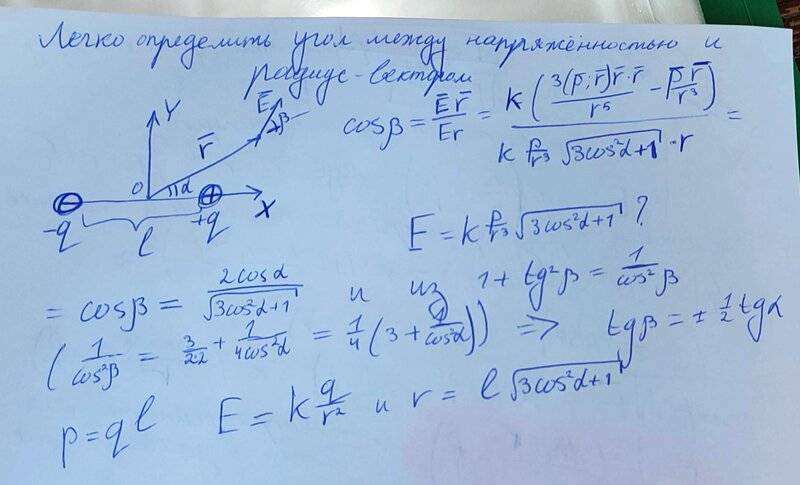
Handwritten physics derivation: a dipole diagram with charges -q and +q separated by distance l on the x-axis, a position vector r at angle alpha, and the field vector E at angle beta; below are formulas including cos beta = 2cos alpha / sqrt(3cos^2 alpha + 1), p = ql, E = kq/r^2 and r = l sqrt(3cos^2 alpha + 1).
 
Attachments
  • Handwritten physics derivation on lined paper: dipole potential expanded for large r, with the far-field field E = k(3(p·r)r/r^5 - p/r^3) boxed in pink, a Cartesian diagram with charges +q and -q, and polar-coordinate relations for a field line r = const·sin^2(θ).
    IMG_20230317_145621.jpg
    46.5 KB · Views: 142
The potential in the "previous problem" is probably something like $$V=\frac{1}{4\pi\epsilon_0}\frac{\mathbf{p}\cdot\mathbf{r}}{r^3}.$$ If it is in some other form, use that. What do you think "the relationship between the potential and the field" is?
 
  • Like
Likes   Reactions: MatinSAR, vanhees71 and PhDeezNutz
I can't make sense of the posted scan. Obviously you've given the electric field in coordinate-free notation,
$$\vec{E}=\frac{1}{4 \pi \epsilon_0 r^5}(3 \vec{r} \vec{r} \cdot \vec{p}-r^2 \vec{p}).$$
Now first think about, how to choose your polar axis. With the right choice, it's very quickly solved!