Direction Fields and Isoclines

  • Context: Undergrad 
  • Thread starter Thread starter Kakashi
  • Start date Start date
Click For Summary
SUMMARY

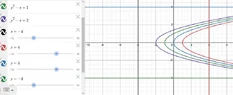
This discussion focuses on the construction and analysis of isoclines for the ordinary differential equation (ODE) represented by $$ y^2 - x = 2 $$, specifically for the values of $$ m = -1, 0, 1, 2 $$. The existence and uniqueness theorem confirms that a unique differentiable function exists for any point on the isocline within the defined square region R of $$ -4 \leq x \leq 4 $$ and $$ -4 \leq y \leq 4 $$. The behavior of the solution curve can be approximated by analyzing the slope at specific points, such as (-2,0), where the slope is determined to be 2, indicating an increasing function as x increases.

PREREQUISITES
  • Understanding of ordinary differential equations (ODEs)
  • Familiarity with isoclines and slope fields
  • Knowledge of the existence and uniqueness theorem in differential equations
  • Basic graphing skills for visualizing functions and slopes
NEXT STEPS
  • Study the construction of slope fields for various ODEs
  • Learn how to sketch isoclines for different values of m in ODEs
  • Explore the implications of the existence and uniqueness theorem in more complex scenarios
  • Investigate methods for determining the behavior of solution curves in ODEs
USEFUL FOR

Mathematics students, educators, and anyone interested in the graphical analysis of ordinary differential equations and their solutions.

Kakashi
Messages
14
Reaction score
0
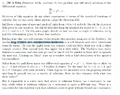
I sketched the isoclines for $$ m=-1,0,1,2 $$. Since both $$ \frac{dy}{dx} $$ and $$ D_{y} \frac{dy}{dx} $$ are continuous on the square region R defined by $$ -4\leq x \leq 4, -4 \leq y \leq 4 $$ the existence and uniqueness theorem guarantees that if we pick a point in the interior that lies on an isocline there will be a unique differentiable function (solution) passing through that point. I understand that a solution exists but I unsure how to actually sketch it. For example, consider a point (-2,0) which lies on the isocline $$ y^2-x=2 $$. At this point the slope is 2 so the differentiable function passing through it is increasing as x increases. How do I determine the approximate behavior of the solution curve for other points? How can I tell the solution will cross other isoclines and thus understand how the slope changes?
 

Attachments

  • 1756604005800.webp
    1756604005800.webp
    98 KB · Views: 32
  • 1756636941937.webp
    1756636941937.webp
    17 KB · Views: 23
Physics news on Phys.org
Kakashi said:
How do I determine the approximate behavior of the solution curve for other points? How can I tell the solution will cross other isoclines and thus understand how the slope changes?
ODE | Slope fields and isoclines example
 

Similar threads

  • · Replies 5 ·
Replies
5
Views
3K
  • · Replies 1 ·
Replies
1
Views
3K
  • · Replies 5 ·
Replies
5
Views
3K
  • · Replies 5 ·
Replies
5
Views
4K
  • · Replies 1 ·
Replies
1
Views
3K
  • · Replies 1 ·
Replies
1
Views
3K
  • · Replies 3 ·
Replies
3
Views
1K
  • · Replies 1 ·
Replies
1
Views
2K
  • · Replies 7 ·
Replies
7
Views
4K
  • · Replies 5 ·
Replies
5
Views
3K