Direction of E field and propagation of wave in a conductor

Click For Summary
SUMMARY

The discussion centers on the propagation of electric fields (E fields) in cylindrical conductors, specifically addressing the skin effect and its implications for current flow. It is established that the E field propagates along the length of the conductor while attenuating radially, reaching 1/e of its initial strength at the skin depth. The conversation clarifies that while the E field exists on the surface, the bulk of energy flows along the conductor, with two modes of wave propagation: the transverse electromagnetic (TEM) mode and the single-wire mode. The skin effect causes current to primarily travel near the surface, influenced by inductive reactance in the conductor's core.

PREREQUISITES
  • Understanding of skin depth in conductors
  • Familiarity with electromagnetic wave propagation
  • Knowledge of cylindrical conductor geometry
  • Concept of inductive reactance in electrical circuits
NEXT STEPS
  • Study the skin effect in conductors and its mathematical derivation
  • Learn about transverse electromagnetic (TEM) mode and its applications
  • Explore the concept of inductive reactance and its impact on current flow
  • Investigate the behavior of electromagnetic waves in cylindrical geometries
USEFUL FOR

Electrical engineers, physicists, and students studying electromagnetic theory, particularly those interested in the behavior of electric fields in conductors and the implications for current flow and signal integrity.

iVenky
Messages
212
Reaction score
12
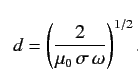
We know that skin depth in a conductor is found using the following expression,

upload_2018-12-23_19-1-20.png

upload_2018-12-23_19-1-31.png

(Credits: http://farside.ph.utexas.edu/teaching/315/Waves/node65.html)

Basically, as the wave propagates in a conductor, it's electric field strength reduces and reaches 1/e of it's initial value at the skin depth distance.
I was initially thinking that the direction of wave is along the length of the conductor (shown below), but that would mean the wave attenuates along the length of the conductor and not inwards towards the center of the conductor.
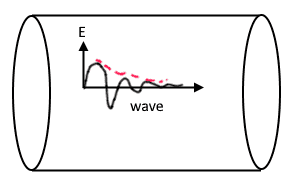
upload_2018-12-23_19-7-29.png

Then, I realized if the wave direction is actually perpendicular to the length of the conductor (shown below), then it makes sense. So the E field is actually along the length of the conductor. Is this correct way of interpreting this?
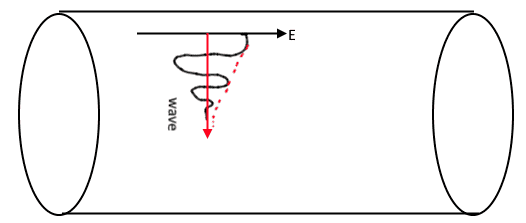
upload_2018-12-23_19-5-6.png

Given that Electric field resides on the surface for a conductor, it makes perfect sense that current only travels on the surface, as the E field attenuates from the top.
 

Attachments

  • upload_2018-12-23_19-1-2.png
    upload_2018-12-23_19-1-2.png
    2.8 KB · Views: 489
  • upload_2018-12-23_19-1-20.png
    upload_2018-12-23_19-1-20.png
    1.1 KB · Views: 830
  • upload_2018-12-23_19-1-31.png
    upload_2018-12-23_19-1-31.png
    679 bytes · Views: 855
  • upload_2018-12-23_19-4-57.png
    upload_2018-12-23_19-4-57.png
    679 bytes · Views: 441
  • upload_2018-12-23_19-5-6.png
    upload_2018-12-23_19-5-6.png
    3.4 KB · Views: 650
  • upload_2018-12-23_19-7-29.png
    upload_2018-12-23_19-7-29.png
    2.3 KB · Views: 669
  • Like
Likes   Reactions: Delta2
Physics news on Phys.org
Both cases make sense from a theoretical point of view.

It is just that if we have a cylindrical conductor that its length is long compared to its radius, it is more likely that it will be oriented in space in such a way that case in second scheme is the one that happens.
 
Last edited:
Delta2 said:
Both cases make sense from a theoretical point of view.

It is just that if we have a cylindrical conductor that its length is long compared to its radius, it is more likely that it will be oriented in space in such a way that case in second scheme is the one that happens.

But wouldn't case 1 mean that E field can't propagate through the length of the cable at all after distance=skin depth? That means you can never have electric current through a wire, which doesn't make sense..What's that I am missing here?
 
iVenky said:
But wouldn't case 1 mean that E field can't propagate through the length of the cable at all after distance=skin depth? That means you can never have electric current through a wire, which doesn't make sense..What's that I am missing here?

I thought we were talking about the case of an external EM-wave as it meets the surface of a cylindrical conductor.

You are talking about the case where we have a voltage (or current source) that creates a current through the axis of the cylindrical conductor. This case is different. I think the voltage source forces some sort of longitudinal EM-wave along the axis of the cylindrical conductor. The skin depth now applies in direction perpendicular to the direction of this longitudinal EM wave, that is in the radial direction of the cylindrical conductor.

EDIT: Maybe my explanation is not satisfactory. I ll just mention @CWatters and @Charles Link and maybe they can explain better.
 
  • Like
Likes   Reactions: iVenky
If electrons are moving back and forth longitudinally on the surface of the conductor, then they will radiate waves at right angles to the wire, both outward going and also into the wire.
Of course, the bulk of our energy flows along the wire, and is not radiated. There are two modes by which a wave travels along a wire: the TEM mode, where the electric field links to a neighbouring conductor, and the single-wire mode, where the electric field links to positions half a wavelength along the same wire.This mode is more common than is generally supposed, and results in a surface wave traveling along the surface of the wire, with another small wave propagating into the wire to satisfy the losses, as you have described.
 
Thanks. Your statement that
tech99 said:
If electrons are moving back and forth longitudinally on the surface of the conductor, then they will radiate waves at right angles to the wire, both outward going and also into the wire.

is the one that results in E field along the length of the cable, right? What confusing me now if I assume flow of electrons through the inner core of the conductor (than outer surface), then we would still have E field inside, as it dissipates towards the border like shown below,
upload_2018-12-24_11-45-39.png

What's the flaw in this logic.
 

Attachments

  • upload_2018-12-24_11-45-39.png
    upload_2018-12-24_11-45-39.png
    6.6 KB · Views: 836
Last edited:
iVenky said:
Thanks. Your statement thatis the one that results in E field along the length of the cable, right? What confusing me now if I assume flow of electrons through the inner core of the conductor (than outer surface), then we would still have E field inside, as it dissipates towards the border like shown below,
View attachment 236310
What's the flaw in this logic.
E-field along the conductor: I had in mind the applied driving E-field. When the electrons accelerate in response to this, they radiate at right angles.
Regarding the current flowing near the surface, the traditional explanation is that electrons in the centre of the wire are surrounded by more magnetic flux lines, so experience more inductive reactance opposing their flow.
 
tech99 said:
E-field along the conductor: I had in mind the applied driving E-field. When the electrons accelerate in response to this, they radiate at right angles.
Regarding the current flowing near the surface, the traditional explanation is that electrons in the centre of the wire are surrounded by more magnetic flux lines, so experience more inductive reactance opposing their flow.
Exactly, now I understand, yes I do agree with the skin effect behavior due to eddy currents that reduces the current in the core. Thanks a lot
 

Similar threads

  • · Replies 4 ·
Replies
4
Views
3K
  • · Replies 3 ·
Replies
3
Views
2K
  • · Replies 3 ·
Replies
3
Views
2K
  • · Replies 6 ·
Replies
6
Views
2K
  • · Replies 9 ·
Replies
9
Views
2K
  • · Replies 9 ·
Replies
9
Views
3K
  • · Replies 14 ·
Replies
14
Views
2K
  • · Replies 18 ·
Replies
18
Views
3K
  • · Replies 21 ·
Replies
21
Views
4K
  • · Replies 1 ·
Replies
1
Views
1K