Direction of magnetic field and force in current wires

Click For Summary
SUMMARY

The discussion centers on the relationship between the direction of current, magnetic field (B), and magnetic force (F) in parallel current-carrying wires. Participants conclude that knowing the direction of the current allows one to determine the direction of the magnetic field it generates, and vice versa, in accordance with Newton's third law. The right-hand rule is emphasized as a critical tool for deducing the direction of the magnetic field and force vectors. Additionally, the application of Maxwell's equations is highlighted as essential for computing the magnetic fields produced by the currents.

PREREQUISITES
  • Understanding of Newton's Third Law of Motion
  • Familiarity with the right-hand rule for magnetic fields
  • Basic knowledge of electromagnetism principles
  • Proficiency in vector algebra, particularly the cross product
NEXT STEPS
  • Study the application of Maxwell's equations in electromagnetism
  • Learn about the right-hand rule and its applications in magnetic fields
  • Explore the magnetic field produced by a straight wire using the Biot-Savart Law
  • Investigate the interactions between parallel current-carrying wires and their forces
USEFUL FOR

Students and professionals in physics, electrical engineering, and anyone interested in understanding the principles of electromagnetism and magnetic interactions in current-carrying conductors.

Fluxxx
Messages
29
Reaction score
0
I read this example in a book and I'm thinking about what is the "determining factor" of the directions of the magnetic field vector B and the magnetic force vectors F.
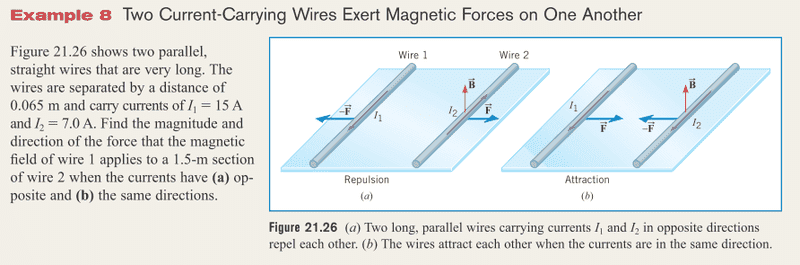
image.png


If we start by looking at wire 1 in picture (a), if we only know the direction of the current (we call this "v"), can we really say anything about the direction of F and B? I would say no. We need to know the directions at least two of the vectors v, B and F in order to find the direction of the third vector. Here we know v only. So which of the other, B or F, do we also know from the start? Is it in this case, determined simply Newtons third law, so that the two wires, will always direct their B and F so that the forces oppose each other? Is that the only thing which is "constant", so to speak?

If we compare (a) and (b) we can see that the magnetic field vector created in wire 1 must change direction, since the force vector changes direction but the current direction remains the same. So the B-vector in wire 1 in (b) must be directed downwards. But why does changing direction of the current in wire 2 change the direction of the magnetic field in wire 1? The only explanation I can find is that the directions of B and F in two wires are always directed in a way that Newtons third law holds.

Am I correct in concluding that Newtons third law is the "determining factor" of the directions of B and F?
 

Attachments

  • c.png
    c.png
    32.2 KB · Views: 699
Physics news on Phys.org
If you know the direction of a current, then you know the direction of the field it generates. The field resulting in a force on conductor 2 is generated by the current in conductor 1 and vice versa. That the field is not shown at conductor 1 in the figure does not mean you cannot find out by applying the right-hand rule. (How do you think they deduced the direction of the field at conductor 2 in the first place?)

But also, yes, in magnetostatics the forces are a Newton action-reaction pair.
 
Orodruin said:
If you know the direction of a current, then you know the direction of the field it generates. The field resulting in a force on conductor 2 is generated by the current in conductor 1 and vice versa. That the field is not shown at conductor 1 in the figure does not mean you cannot find out by applying the right-hand rule. (How do you think they deduced the direction of the field at conductor 2 in the first place?)

But also, yes, in magnetostatics the forces are a Newton action-reaction pair.
Of course I can find the field from the illustration, I was talking generally, you need two vectors to find the third.

So actually ignore the illustration, and just think of two parallel current-carrying wires next to each other. The only thing known is the direction of the currents. Is this enough information to find the directions of the B and F vectors?
 
If you are given the currents you are given the very same information as the image gives you so I do not understand why you think it would make a difference to have the information on the currents instead of the image.
 
Fluxxx said:
The only thing known is the direction of the currents. Is this enough information to find the directions of the B and F vectors?
Yes.
 
So let's say you have two parallel wires with currents in opposite directions. If you have a force vector pointing downwards in the left wire, and the force pointing upwards in the right wire, then Newtons 3rd law would still hold. So how do you know how much of the force component from one wire is in the direction of the other wire?
 
You have to compute the magnetic field due to the other wire, this field will determine the force.
 
Fluxxx said:
So how do you know how much of the force component from one wire is in the direction of the other wire?

As Orodruin noted, you can calculate the directions of the fields and forces, given the geometry of the currents. Have you studied vector algebra yet, in particular the "cross product" of two vectors (as in e.g. ##\vec F = I \vec l \times \vec B##)?
 
  • #10
Yes I know the cross product.

Orodruin said:
You have to compute the magnetic field due to the other wire, this field will determine the force.
But the magnetic field due to the other wire is not known. The only thing known is the direction of the currents, and that the wires are parallel. So how can you from only this info determine the directions?
 
  • #12
Fluxxx said:
Yes I know the cross product.But the magnetic field due to the other wire is not known. The only thing known is the direction of the currents, and that the wires are parallel. So how can you from only this info determine the directions?
If you know the currents you can compute the fields. This is half the point of electromagnetism, computing how the currents influence the fields (the other point being how the fields influence the currents).
 
  • #14
Orodruin said:
If you know the currents you can compute the fields. This is half the point of electromagnetism, computing how the currents influence the fields (the other point being how the fields influence the currents).
Ok, but how do you compute them if you only know the current directions?
 
  • #15
Fluxxx said:
Ok, but how do you compute them if you only know the current directions?
Generally: You apply Maxwell's equation.
In this case the solution for a long straight conductor is already well known and you can also take that solution from memory if you remember it.
 
  • #16
Fluxxx said:
Why do you write something that is already answered in the original post, and not even something I asked?
Because you keep asking it. The answer doesn't change. If the currents are parallel then the force is attractive. If the currents are anti parallel then the force is repulsive. You can determine that using the cross product, as has been pointed out over and over.

If you don't want a repetitive answer then don't ask a repetitive question.
 
  • #17
Orodruin said:
Generally: You apply Maxwell's equation.
In this case the solution for a long straight conductor is already well known and you can also take that solution from memory if you remember it.
Maxwell's euqation? As far as I know there are four, so which one are you referring to?

Anyway maybe you can write what this "well known" solution is, that applies in this case?
 
  • #18
Please read the hyperphysics links provided. They explain exactly how to determine the direction.

This thread is closed.
 
  • Like
Likes   Reactions: davenn

Similar threads

  • · Replies 1 ·
Replies
1
Views
2K
  • · Replies 4 ·
Replies
4
Views
1K
  • · Replies 22 ·
Replies
22
Views
2K
  • · Replies 1 ·
Replies
1
Views
2K
  • Sticky
  • · Replies 0 ·
Replies
0
Views
4K
  • · Replies 7 ·
Replies
7
Views
2K
  • · Replies 2 ·
Replies
2
Views
2K
  • · Replies 14 ·
Replies
14
Views
2K
  • · Replies 9 ·
Replies
9
Views
1K
  • · Replies 7 ·
Replies
7
Views
2K