Discover the Definition of a Square - Explained Simply

  • Thread starter Thread starter bobsmith76
  • Start date Start date
  • Tags Tags
    Definition Square
Click For Summary
SUMMARY

The discussion centers on the geometric definition of a square, specifically addressing the properties of its diagonals. Participants confirm that the diagonals of a square intersect at their midpoints, forming right triangles. The conversation also explores the implications of drawing equal-length, perpendicular line segments and the resulting quadrilateral when the square is removed. The consensus is that the diagonals of a square are essential to understanding its structure and properties.

PREREQUISITES
  • Basic understanding of geometric shapes and properties
  • Familiarity with the concept of diagonals in polygons
  • Knowledge of right triangles and their characteristics
  • Ability to visualize geometric transformations
NEXT STEPS
  • Study the properties of quadrilaterals, focusing on squares and rectangles
  • Learn about the Pythagorean theorem and its application in right triangles
  • Explore geometric transformations and their effects on shapes
  • Investigate the relationship between diagonals and area in various polygons
USEFUL FOR

Students of geometry, educators teaching basic geometric concepts, and anyone interested in understanding the properties of squares and their diagonals.

bobsmith76
Messages
336
Reaction score
0
i think the answer is a, my book says it's e. this has got to be a typo
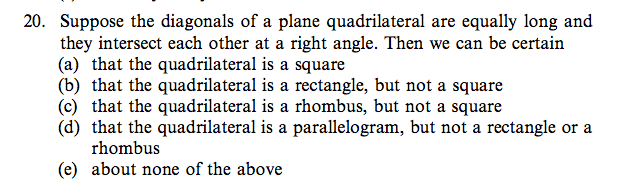
Screenshot2011-09-17at72810PM.png
 
Physics news on Phys.org
Does it say the diagonals intersect at their midpoints?
 
I can't imagine how it's possible that the diagonals are equal and form a right triangle and they NOT intersect at the midpoint.
 
Trapezoid?

Try to draw 2 line segments of equal length and perpendicular.
And make them not intersect in the middle.
What's the resulting quadrilateral?
 
Same idea as I like Serena:

Start with a square and draw it diagonals. Now erase the square, leaving only the diagonals. Now erase about half of each diagonal above the point where they intersect. Of what figure are they the diagonals?
 
Thanks, I got it.
 

Similar threads

  • · Replies 4 ·
Replies
4
Views
2K
  • · Replies 2 ·
Replies
2
Views
3K
  • · Replies 2 ·
Replies
2
Views
4K
  • · Replies 8 ·
Replies
8
Views
2K
  • · Replies 20 ·
Replies
20
Views
4K
  • · Replies 2 ·
Replies
2
Views
1K
  • · Replies 3 ·
Replies
3
Views
2K
  • · Replies 3 ·
Replies
3
Views
3K
  • · Replies 9 ·
Replies
9
Views
1K
  • · Replies 27 ·
Replies
27
Views
6K