vizakenjack
- 57
- 4
User informed about mandatory use of the homework template.
Assume that the Earth is spherical and recall that latitudes range from 0° at the Equator to 90° N at the North Pole. Consider Dubuque, Iowa (42.50° N latitude), and Guatemala City (14.62° N latitude). The two cities lie on approximately the same longitude. Do not neglect the curvature of the Earth in determining the following.
(c)
Here's the visual representation of the problem:
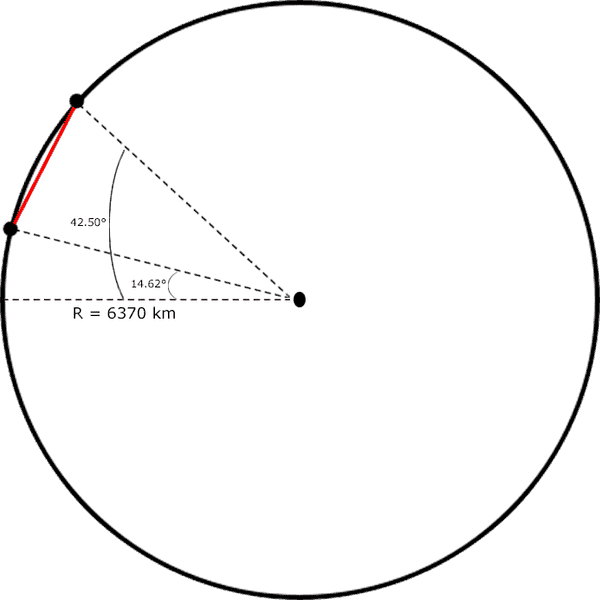 For simplicity sake, we take a look at the Earth when the two cities are about to disappear from our field of view, so they kinda lie on the left edge of the earth... (I don't know how to say it better).
Anyhow,
I need to find the length of the red line, right?
I know what the correct formulas are:
R * (ΔΘ * pi/180), in other words radius times the difference between the angles in radians.
2nd formula to finding the answer is:
2 * R * sin(ΔΘ/2)
I kinda get the second formula, but why is the 1st formula correct?
Doesn't it find the arc length? Since ΔΘ is converted to radians?
Or did I draw the positions of the two cities incorrectly? Should the second city, Guatemala, be located exactly below Dubuque? But in that case, they would have different length from the center of the circle. So I really doubt they should be drawn in the same vertical axis.Let's plug in some values into the 2nd formula.
ΔΘ = 42.50°- 14.62° = 27.88° is the angle of a formed isosceles triangle with the red line as the base.
However, we don't need the whole angle of this newly formed triangle because it's easier to divide the triangle into two parts, and then find the missing side (x/2).
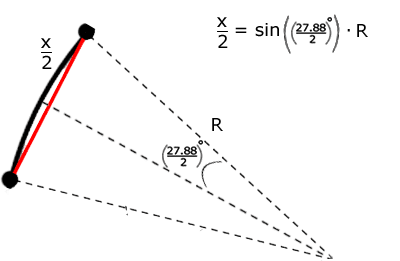 in which case, x = sin(27.88°/2) * R * 2
(c)
Here's the visual representation of the problem:
Anyhow,
I need to find the length of the red line, right?
I know what the correct formulas are:
R * (ΔΘ * pi/180), in other words radius times the difference between the angles in radians.
2nd formula to finding the answer is:
2 * R * sin(ΔΘ/2)
I kinda get the second formula, but why is the 1st formula correct?
Doesn't it find the arc length? Since ΔΘ is converted to radians?
Or did I draw the positions of the two cities incorrectly? Should the second city, Guatemala, be located exactly below Dubuque? But in that case, they would have different length from the center of the circle. So I really doubt they should be drawn in the same vertical axis.Let's plug in some values into the 2nd formula.
ΔΘ = 42.50°- 14.62° = 27.88° is the angle of a formed isosceles triangle with the red line as the base.
However, we don't need the whole angle of this newly formed triangle because it's easier to divide the triangle into two parts, and then find the missing side (x/2).