Divide ABCDE into two parts with equal area
  • Context:
  • Thread starter Thread starter Albert1
  • Start date Start date
  • Tags Tags
    Area parts
Join the discussion
Registration is free. Ask a follow-up in this thread, or start your own.
6 replies · 3K views
Albert1
Messages
1,221
Reaction score
0
ABCDE is a pentagon,please construct a line (passing

through point A),and divide ABCDE into two parts with equal

area
 
Mathematics news on Phys.org
Is this a general pentagon, or a particular pentagon?
 
For a regular pentagon, just construct the midpoint of $CD$, call if $F$, and draw the segment $AF$. This splits the pentagon in two equal pieces.
 
Prove It said:
Is this a general pentagon, or a particular pentagon?
A general pentagon(convex)
 
Albert said:
ABCDE is a pentagon,please construct a line (passing

through point A),and divide ABCDE into two parts with equal

area
http://www.mathhelpboards.com/attachments/f28/998d1373594278-change-pentagon-into-triangle-equal-area-pentagon.jpg

Referring to Albert's beautiful solution to the problem in http://www.mathhelpboards.com/f28/change-pentagon-into-triangle-equal-area-5486/, if $M$ is the midpoint of $PQ$ then the line $AM$ will do the job, provided that $M$ lies between $C$ and $D$. I imagine that this must necessarily be the case, but I don't see how to prove it.
 
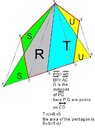
In my opinion the best proof is "a proof without words"
so again I construct a diagram and let it explain the solution
View attachment 1033
and AG is what we need as written by Opalg
"if [FONT=MathJax_Math]M is the midpoint of [FONT=MathJax_Math]P[FONT=MathJax_Math]Q then the line [FONT=MathJax_Math]A[FONT=MathJax_Math]M will do the job"
 

Attachments

  • pentagon02.jpg
    pentagon02.jpg
    19.3 KB · Views: 124
Last edited:
Opalg said:
Referring to Albert's beautiful solution to the problem in http://www.mathhelpboards.com/f28/change-pentagon-into-triangle-equal-area-5486/, if $M$ is the midpoint of $PQ$ then the line $AM$ will do the job, provided that $M$ lies between $C$ and $D$. I imagine that this must necessarily be the case, but I don't see how to prove it.
The statement M lies between C and D is not always true
in fact M and C (or M and D)may coincide
May M also lie between D and E ?(if the length of CD is very small)
M may also lie between B and C.
(we may check this using various diagram)
 
Last edited: