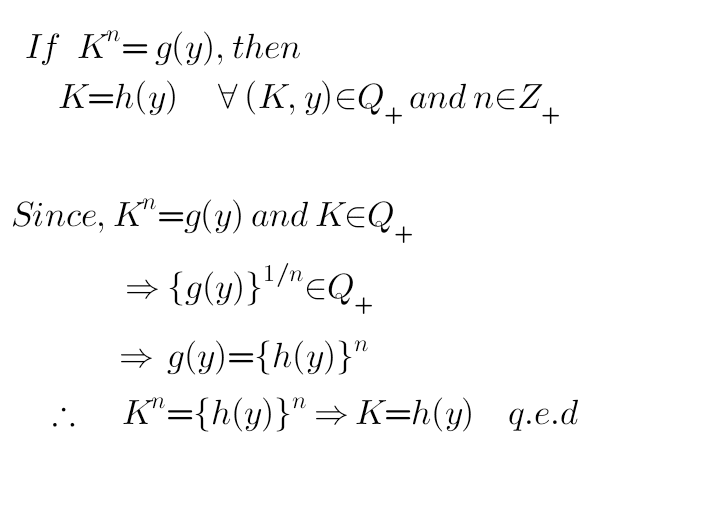
Vibhukanishk Messages 2 Reaction score 0 Thread starter Aug 8, 2022 #1 What to say about this? Is the logic used in the solution supports the statement?
TeethWhitener Science Advisor Gold Member Messages 2,630 Reaction score 2,244 Aug 8, 2022 #2 No. You just asserted that ##g(y)=h(y)^n## with no justification.
fresh_42 Staff Emeritus Science Advisor Homework Helper Insights Author 2025 Award Messages 20,819 Reaction score 28,467 Aug 8, 2022 #3 There is quite a bit of information missing. E.g., there is no quantifier on ##h(y)## in the initial statement.
There is quite a bit of information missing. E.g., there is no quantifier on ##h(y)## in the initial statement.
Vibhukanishk Messages 2 Reaction score 0 Aug 8, 2022 #4 TeethWhitener said: No. You just asserted that ##g(y)=h(y)^n## with no justification.
TeethWhitener Science Advisor Gold Member Messages 2,630 Reaction score 2,244 Aug 8, 2022 #5 If you define ##g(y)## as ##h(y)^n##, then of course it's true, but there's also nothing to prove; it's all definitions.
If you define ##g(y)## as ##h(y)^n##, then of course it's true, but there's also nothing to prove; it's all definitions.