Does Electromagnetic wave qualifies to become a particle?

Click For Summary
SUMMARY

Electromagnetic waves (EMW), including ultraviolet (UV) and infrared (IR) frequencies, exhibit wave-particle duality, a fundamental concept in quantum mechanics. All frequencies of electromagnetic radiation share similar quantum mechanical behaviors, affirming their dual nature. However, the concept of wave-particle duality is increasingly viewed as misleading within modern quantum mechanics. Additionally, detecting low-energy photons, such as those in the microwave and radio-wave bands, presents significant challenges due to their low energy and the need for extremely sensitive detectors operating at ultra-low temperatures.

PREREQUISITES
  • Quantum Mechanics fundamentals
  • Understanding of Electromagnetic Wave properties
  • Familiarity with Wien's Displacement Law
  • Knowledge of detector technology for low-energy photons
NEXT STEPS
  • Research advanced concepts in Quantum Mechanics and their implications on wave-particle duality
  • Explore Wien's Displacement Law applications in thermal radiation
  • Investigate technologies for detecting low-energy electromagnetic radiation
  • Study the challenges of measuring cosmic microwave background radiation
USEFUL FOR

Physicists, quantum mechanics students, researchers in electromagnetic theory, and engineers developing sensitive detection technologies for low-energy photons.

Ronie Bayron
Messages
146
Reaction score
23
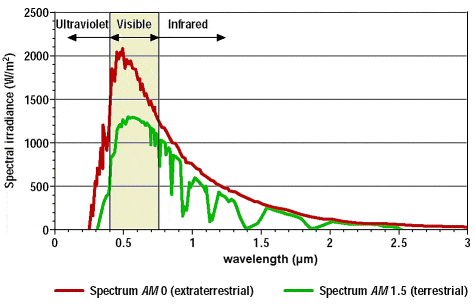
Hi, light as an EM wave attributes wave-particle duality. In general, are the other bandwidths of EMW (UV & IR for example) qualifies the same duality? How? Why and why not?
figure1.gif
 
Physics news on Phys.org
All frequencies of electromagnetic radiation share the same basic quantum mechanical behavior, so the quick answer to your question is "yes".

However, you should also be aware that the entire concept of "wave-particle duality" is of dubious value. It's not exactly wrong, but it is inconsistent with the way we've formulated QM since the early days, and it can easily mislead.
 
  • Like
Likes   Reactions: bhobba and vanhees71
Also, as an interesting side point, the reason you don't really hear much about low energy microwave and radio-wave photons in the scientific literature (especially compared to Infra-red and all higher energies) is because their energies are so low that we just don't have detectors that are both sensitive enough to register individual clicks at that energy, and that would be cold enough to not emit too much blackbody radiation a the same wavelength it's trying to detect.

Using Wien's displacement law, we can find the temperature of a blackbody whose frequency spectrum has a given peak value.
For example, a blackbody emitting photons whose peak frequency is about 10 gigahertz (microwave-band) would correspond to a temperature of about 0.2 Kelvins, which is quite cold, but we can cool a body to these sorts of temperatures with cutting edge technology ( I think the current record for a bulk object is about a hundredth of this).
To go further into the radio-band (say 1 megahertz), you could need to cool your detector to about 0.02 milli-Kelvins, which is beyond current technological capabilities. We can cool clouds of gas much more, but this is beyond what we can (currently) do for solid objects.
To go to the really low end of the radio-band (say 1 kilohertz) you would need to cool your detector to about 0.02 micro-Kelvins, which is barely within what we can do even with Bose-Einstein Condensates, and far far colder than what we can do for bulk objects.

If you consider that the cosmic microwave background radiation has a temperature of the order 2 Kelvins, trying to detect radio-band photons without being overwhelmed by other sources of radiation is a problem that remains to be solved.
 
  • Like
Likes   Reactions: vanhees71 and Nugatory

Similar threads

  • · Replies 36 ·
2
Replies
36
Views
9K
  • · Replies 38 ·
2
Replies
38
Views
6K
  • · Replies 2 ·
Replies
2
Views
2K
  • · Replies 24 ·
Replies
24
Views
2K
  • · Replies 2 ·
Replies
2
Views
3K
  • · Replies 1 ·
Replies
1
Views
2K
  • · Replies 6 ·
Replies
6
Views
2K
  • · Replies 13 ·
Replies
13
Views
2K
  • · Replies 11 ·
Replies
11
Views
3K
  • · Replies 7 ·
Replies
7
Views
3K