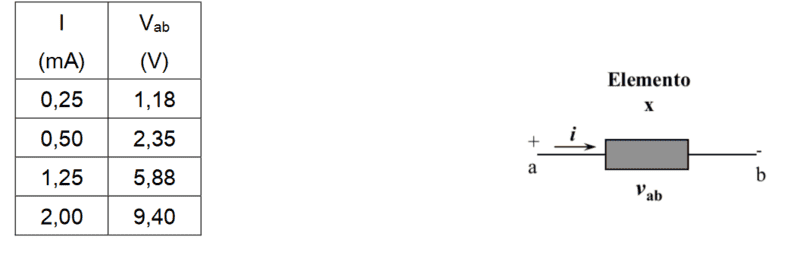
Does element x present a linear resistance?

Join the discussion
Ask a follow-up here, or get your own question answered by working scientists, mathematicians and engineers — people, not an autocomplete.
Real named experts · corrections over time · the nuance an AI answer skips
3 replies · 1K views
Purpleshinyrock
Messages
27
Reaction score
6
Homework Statement
Consider the element X represented in the figure, for which
know the voltage and current values indicated in the following table:
Relevant Equations
V=RI, R=V/I
ANSWER: element x does not present a linear resistance because it isn't constant as i and v increases.
Screenshot 2021-11-07 at 18-09-20 Microsoft Word - IC_EX_CAP1 - Exer_Cap1 pdf.png
Is my answer correct?
 
Reply
  • Like
Likes   Reactions: berkeman
on Phys.org
It's close, but one of the readings is a bit off (to the 3 significant figures shown in the measurements). To be sure, it would be nice if they specified an accuracy for those measurements, IMO. It looks like the one flier measurement is only off by about 0.4%...
 
Reply
  • Like
Likes   Reactions: Purpleshinyrock
Perhaps you could show us your calculations of resistance at these various points? I find it easiest to graph these in a spreadsheet, myself. This will help us see if you are understanding the concept of resistance better than a simple yes/no response.
 
Reply
  • Like
Likes   Reactions: Steve4Physics, phinds and Purpleshinyrock
The term ‘linear resistance’ doesn’t seem appropriate. Is this a translation from another language or maybe part of a longer question? Maybe ‘constant resistance’ is what is intended.

The data supplied are given to only 2 or 3 significant figures. Rounding according to the usual convention gives:
R = 1.18/0.25 = 4.72Ω which rounded to 2 sig. figs. gives 4.7Ω
R = 2.35/0.50 = 4.70Ω which rounded to 2 sig. figs. gives 4.7 Ω
R = 5.88/1.25 – 4.704Ω which rounded to 3 sig. figs. gives 4.70 Ω
R = 9.40/2.00 = 4.70Ω which rounded to 3 sig. figs. gives 4.70 Ω

So my answer would be that: within the limits of the measurement-uncertainties, the resistance is constant.
 
Reply
  • Like
Likes   Reactions: phinds and Purpleshinyrock