Does Increasing Mass Reduce the Amplitude of a Forced SDOF Oscillator?

  • Topic:
  • Thread starter Thread starter anum
  • Start date Start date
  • Tags Tags
    Amplitude Mass
Join the discussion
Registration is free. Start your own thread to ask a follow-up.
7 replies · 2K views
anum
Messages
6
Reaction score
0
I'm working on a forced single-degree-of-freedom (SDOF) oscillator. I'm trying to find how an increase in mass will affect the response amplitude? I'm looking for mathematical proof explaining this reduction in amplitude. How to derive \delta x
 
Attachments
  • Screenshot (60).png
    Screenshot (60).png
    19.6 KB · Views: 160
Physics news on Phys.org
[math]X = \dfrac{F}{k} \dfrac{1}{\sqrt{ \dfrac{ 4 \zeta ^2 \omega ^2}{ \omega _n ^2 } + \left ( 1 - \dfrac{ \omega ^2 }{ \omega _n ^2 } \right ) ^2}}[/math]

So given a small variation in m, dm, we get a corresponding change in X by dX:
[math]dX = \dfrac{d}{dm} \left \{ \dfrac{F}{k} \dfrac{1}{\sqrt{ \dfrac{ 4 \zeta ^2 \omega ^2}{ \omega _n ^2 } + \left ( 1 - \dfrac{ \omega ^2 }{ \omega _n ^2 } \right ) ^2}} \right \} ~ dm[/math]

It looks pretty bad but the only variable that contains the mass is [math]\zeta[/math]. Do it step by step.

-Dan
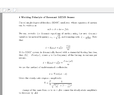
 
$\omega_n=\sqrt(k/m)$ is also mass-dependent. Thank you for your reply.
 
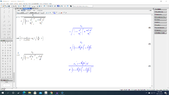
i try on Maple get this.
 
Attachments
  • Screenshot (61).png
    Screenshot (61).png
    59 KB · Views: 154
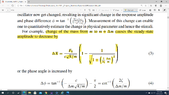
According to an article, $\Delta X$ on taking mass $m+\Delta m$ is :
 
Attachments
  • Screenshot (56).png
    Screenshot (56).png
    83.8 KB · Views: 159