Does it make sense to say that something is almost infinite?

  • Context: High School 
  • Thread starter Thread starter SSG-E
  • Start date Start date
  • Tags Tags
    Infinite
Click For Summary

Discussion Overview

The discussion centers around the concept of "almost infinite," exploring its meaning and implications within mathematical contexts, particularly in relation to infinity, large numbers, and topology. Participants examine whether the term can be formally defined or if it is merely a colloquial expression for very large quantities.

Discussion Character

  • Debate/contested
  • Conceptual clarification
  • Mathematical reasoning

Main Points Raised

  • Some participants express skepticism about the term "almost infinite," suggesting it lacks formal meaning and arguing that something is either finite or infinite.
  • Others propose that "almost infinite" could be interpreted informally as a very large number, potentially one that is impractical to express numerically.
  • A participant references ordinal numbers, specifically the first infinite ordinal ##\omega##, to illustrate that there are no predecessors to infinity, questioning the appropriateness of using "almost infinite" in mathematical contexts.
  • Some participants argue that informal explanations, such as those found in videos, should not be expected to provide rigorous definitions, emphasizing the need for intuitive understanding rather than strict formalism.
  • One participant suggests a topological approach to "almost infinite," proposing a metric that relates finite numbers to infinity in a compactified space, thus introducing a potential mathematical framework for the concept.

Areas of Agreement / Disagreement

Participants generally disagree on the validity and utility of the term "almost infinite." While some see it as nonsensical or informal, others explore its potential mathematical interpretations, indicating that the discussion remains unresolved.

Contextual Notes

Limitations include the lack of formal definitions for "almost infinite," dependence on informal language, and the challenge of reconciling intuitive concepts with rigorous mathematical frameworks.

SSG-E
Messages
60
Reaction score
12
TL;DR
Does it make sense to say that something is almost infinite? If yes, then why?
I remember hearing someone say "almost infinite" in this video. As someone who hasn't studied very much math, "almost infinite" sounds like nonsense. Either something ends or it doesn't, there really isn't a spectrum of unending-ness. In this video he says that ''almost infinite'' pieces of vertical lines are placed along X length. Why not infinit?
 
Mathematics news on Phys.org
No I'm not aware of any sense in which 'almost infinite' makes formal sense. In practise, I guess it means "a very large number".

From a context of ordinal numbers, the first infinite ordinal ##\omega## has no predecessor, that is there is no ordinal ##\eta## such that ##\omega = \eta +1##. One says that ##\omega## is a limit ordinal.
 
  • Like
Likes   Reactions: Adesh and etotheipi
Math_QED said:
No I'm not aware of any sense in which 'almost infinite' makes sense.

From a context of ordinal numbers, the first infinite ordinal ##\omega## has no predecessor, that is there is no ordinal ##\eta## such that ##\omega = \eta +1##. One says that ##\omega## is a limit ordinal.
Then is it correct to say infinite pieces instead of almost infinite pieces in that video?
 
SSG-E said:
Then is it correct to say infinite pieces instead of almost infinite pieces in that video?

I did not say something like that. This video tries to intuitively explain what dimension is. You shouldn't be looking for rigorous explanations in videos like that, but just to get a 'feeling' for the subject.

Infinite dimensional just means NOT finite dimensional (in the context of vector spaces at least).
 
Math_QED said:
I did not say something like that. This video tries to intuitively explain what dimension is. You shouldn't be looking for rigorous explanations in videos like that, but just to get a 'feeling' for the subject.

Infinite dimensional just means NOT finite dimensional (in the context of vector spaces at least).
I don't get it
 
Things are either finite or infinite. There is no formal definition for almost infinite. Informally as @Math_QED said it means a really large number likely a number you can't write down in a reasonable amount of time.

Some famous cases of numbers are:

  • googol =
    10^{{100}}.
  • centillion =
    10^{303}
    or
    10^{600}
    , depending on number naming system.
  • millillion =
    {\displaystyle 10^{3003}}
    or
    {\displaystyle 10^{6000}}
    , depending on number naming system.
  • micrillion =
    {\displaystyle 10^{3000003}}
    or
    {\displaystyle 10^{6000000}}
    , depending on number naming system.
  • The largest known Smith number = (101031−1) × (104594 + 3×102297 + 1)1476 ×103913210.
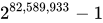
  • The largest known Mersenne prime =
    {\displaystyle 2^{82,589,933}-1}
    (as of December 21, 2018),
  • googolplex =
    10^{\text{googol}}=10^{10^{100}}
    .
  • Skewes' numbers: the first is approximately
    10^{10^{10^{34}}}
    , the second
    10^{10^{10^{964}}}
    ,
  • googolplexian =
    {\displaystyle 10^{\text{googolplex}}=10^{10^{\text{googol}}}=10^{10^{10^{100}}}}
    .
  • Graham's number, larger than what can be represented even using power towers (tetration). However, it can be represented using Knuth's up-arrow notation.
  • Rayo's number is a large number named after Agustín Rayo which has been claimed to be the largest named number. It was originally defined in a "big number duel" at MIT on 26 January 2007.

https://en.wikipedia.org/wiki/Large_numbers

It's like games of chance where people like to say they almost won. They either won or they lost there is nothing in between. You either won the money or lost the money but almost won sounds better especially when talking to your spouse.
 
  • Like
Likes   Reactions: Adesh, etotheipi, SSG-E and 1 other person
One could come up with a topological notion of "almost infinite". Consider, for instance the real number line compactified into a circle by adjoining a point at +/- infinity. Impose a topology on this circle by considering that the distance (metric) between a point x and infinity is given by ##\frac{1}{\text{max}(1,|x|)}##

[I suspect one might have to juice up this metric a bit to make sure it obeys the triangle inequality. The easy way is to use the induced metric from the circle. Now all you have to do is map real values plus infinity to a circle -- something like arc-tangent]

Now you have a notion of "almost infinite" -- 1,000,000 is only 1/1,000,000 away from infinity.
 
  • Informative
Likes   Reactions: etotheipi
jbriggs444 said:
Consider, for instance the real number line compactified into a circle by adjoining a point at +/- infinity
Or even map all complex numbers onto a sphere (the Riemann sphere):
1591811906765.png
 
  • Like
Likes   Reactions: sysprog and etotheipi

Similar threads

  • · Replies 5 ·
Replies
5
Views
2K
  • · Replies 5 ·
Replies
5
Views
2K
  • · Replies 5 ·
Replies
5
Views
4K
  • · Replies 31 ·
2
Replies
31
Views
5K
  • · Replies 24 ·
Replies
24
Views
7K
  • · Replies 5 ·
Replies
5
Views
3K
  • · Replies 5 ·
Replies
5
Views
16K
  • · Replies 9 ·
Replies
9
Views
2K
  • · Replies 16 ·
Replies
16
Views
3K
  • · Replies 24 ·
Replies
24
Views
4K