Does this dynamic model complement the Balloon Analogy?

Click For Summary

Discussion Overview

The discussion revolves around the comparison of a dynamic model of cosmological limits presented in a Wikipedia illustration and the well-known balloon analogy used to explain cosmic expansion. Participants explore whether the dynamic model complements the balloon analogy and discuss its attributes, weaknesses, and potential for educational use.

Discussion Character

  • Exploratory
  • Technical explanation
  • Conceptual clarification
  • Debate/contested

Main Points Raised

  • Some participants express admiration for the dynamic illustration of cosmological limits, noting its potential to enhance understanding of concepts like the particle horizon and event horizon.
  • Questions arise about the significance of the vertical units on the right side of the graph, with some participants seeking clarification on their purpose.
  • There is a suggestion that the dynamic model could be beneficial for a more advanced audience compared to the balloon analogy, which is aimed at beginners.
  • Some participants propose creating a tutorial on reading cosmological lightcone graphs to aid understanding, while others express uncertainty about their own ability to contribute effectively.
  • Concerns are raised about the need for clear labeling and explanations of static plots and animations to make them accessible to a broader audience.
  • Participants discuss the concept of "faster than light" expansion and its relation to the Hubble radius, with differing interpretations of what this means in the context of the dynamic model.
  • There is a suggestion to provide multiple levels of descriptive detail for animations to cater to different audience knowledge levels.

Areas of Agreement / Disagreement

Participants generally agree that the dynamic model has merits and may complement the balloon analogy, but there is no consensus on its effectiveness or the specific ways it does so. Multiple competing views regarding the interpretation of the illustrations and their educational value remain present.

Contextual Notes

Some participants note limitations in understanding due to missing labels and explanations in the dynamic illustrations. There are also unresolved questions about the implications of certain cosmological concepts, such as the relationship between the particle horizon and event horizon.

Who May Find This Useful

This discussion may be of interest to those studying cosmology, educators looking for teaching resources, and individuals seeking to deepen their understanding of cosmic expansion models and their visual representations.

alw34
Messages
220
Reaction score
55
This is a kind of cooperative problem solving post. But don't be too terribly 'focused' because likely I have missed important issues. I had not seen a dynamic illustration like this before: maybe I am over impressed, weak-kneed, like seeing Kate Hudson the first time??

In Wikipedia at

https://en.wikipedia.org/wiki/Comoving_distance#Uses_of_the_proper_distance
220px-Expansion_of_the_universe%2C_proper_distances_%28Animation%29.gif


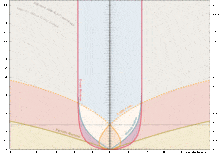
is a dynamic illustration of some cosmological limits. Clicking on the Wikipedia illustration activates the dynamic rendering, and an observer ascends vertically along the black line in time as the yellow light cone for the observer does also and approaches the dark red event horizon. No explanation of what's happening given in Wikipedia. So sad.

Given all the attention that has been justly paid to the balloon analogy [say by phinds and in Brian Powell's new "Inflationary Misconceptions and the Basics of Cosmological Horizons"
Reference https://www.physicsforums.com/insights/inflationary-misconceptions-basics-cosmological-horizons/]
is it worthwhile to focus attention on the attributes and weakness of this illustration?
Does it complement the balloon analogy in enough worthwhile respects to warrant attention? Interesting/Insightful enough for a FAQ?

Some thoughts:
I like how the particle horizon is inside the event horizon early in the universe, and then passes outside as expansion slows. Doesn't that illustrate "faster than light" expansion? When did that end? Maybe be nice to label that event with values using the Jorrie Calculator.

Maybe label a few other events? Which ones? Like the Hubble radius value today. Maybe when the Hubble radius hits 99% of the event horizon?? [light blue Hubble curve gets lost in the vertical red even horizon]
Also, obvious that the thin black horizontal line is today at about 13.8B yrs of age, and the vertically ascending event horizon is approaching the 17.3B LY that Powell mentions. How to best take advantage of the time dimension in the illustration despite being limited to only one space dimension in explanations? Can we pick out anything valuable about a[t] and H[t]?? I can't. Lastly, how does the comoving dynamic view complement this one?
 
Last edited by a moderator:
  • Like
Likes   Reactions: marcus and Bandersnatch
Space news on Phys.org
I forgot to ask: If the left hand vertical units are billions of years, what are the right hand vertical units...why bother with them??
 
I was just thinking how nice it would be to have an animated lightcone graph(s) when you posted it. In fact, for a while there I used to daydream about finally mustering enough resolve to pick up some javascript and concoct one myself - luckily, somebody else has done it already (not that I believed I'd ever get around to it).

Following the name on the graph, you can find other animations and graphs by the same author:
http://yukterez.net/
The graphs featured in the wiki article are (obviously) in the cosmology section. The 'early universe' animation is likewise highly recommended, as it shows the various distances and horizons evolve in two spatial dimensions - the description in in German, but labels on the graph are in English.

Putting together a tutorial on reading cosmological lightcone graphs could be worthwile, maybe as an insight article with some intro on what a lightcone actually is. I'm not sure I'd be up for it myself - I'm really only good at mansplaining the basics.

There's always the Davis & Lineweaver paper on misconceptions regarding cosmological horizons, which features three lightcone graphs with ample discussion:
http://arxiv.org/abs/astro-ph/0310808
(fig.1)

alw34 said:
what are the right hand vertical units...why bother with them??
That's the scale factor. Shows how big the universe was at a given time, as a fraction of its current size. A rather useful measure, and widely employed in cosmology. It's especially useful to have when looking at graphs with comoving distance units, as it allows for relatively easy transformation into proper distance.

alw34 said:
I like how the particle horizon is inside the event horizon early in the universe, and then passes outside as expansion slows. Doesn't that illustrate "faster than light" expansion?
That's certainly not the 'faster than light' expansion - that's what the Hubble radius tracks. Everything beyond ##H_R## recedes at ##V_R>c##
The particle horizon shows how far, in terms of proper distance, the farthest objects whose light is observed have managed to recede since emission.
I actually need to think some more about what the intersection means, as I don't want to say something silly here.

@marcus @Jorrie - you may want to have a look at those animations.
 
  • Like
Likes   Reactions: marcus
Bandersnatch said:
@marcus @Jorrie - you may want to have a look at those animations.
Yes, this is a cool animation and does compliment the balloon analogy rather nicely, although the values depicted are for a more advanced readership than the target audience of the balloon analogy. It is essentially the top panel of the "Davis Three-panel graphs" linked to in my sig below, just with Time_now being animated from the distant past to the far future.

LightCone7's charts depict more or less the same values statically, just rotated by 90 degrees.

Some of the questions that alw34 has asked are answered in the latest tutorial on LightCone7.
 
Bandersnatch said:
I was just thinking how nice it would be to have an animated lightcone graph(s) when you posted it.

You reminded me:
If anyone does decide to post, copy or create any animations, another thought would be to provide perhaps two or even three levels of descriptive detail. Like a beginner, intermediate and advanced level. Examples would be the Scientific American article from Lineweaver and Davis being an accessible intermediate [?] read, while their ARXIV paper was too detailed for most beginners. I don't think I ever got through all that one.

I am checking http://yukterez.net/ as suggested but I am too dumb to know what some of the static plots represent without a line or two of explanation. Graphs need to be labelled.

This one is nice, http://yukterez.net/forum/viewtopic.php?f=3&t=61/, but how does one get the translation to again appear...mine Deutch iss not so goot! Oh, if you refresh the link, the translation offer reappears.

It would be nice to be able to halt the animation at points of interest. This plot does not show the lightcone reaching the event horizon, a nice feature of his plot in Wikipedia.

Also, I forgot to ask in my initial post: For consideration, for what purposes would you experts recommend using the proper distance plot animation I posted here versus the 'coordinate distance' plot which also appears in Wikipedia? Are there some worthwhile contrasts/comparisons to be made??

As a reminder, because I always forget to look myself, for newcomers,
check out 'SIMILAR DISCUSSIONS' which appears automatically with your posts, below.
 

Similar threads

  • · Replies 1 ·
Replies
1
Views
3K
  • · Replies 548 ·
19
Replies
548
Views
222K
  • · Replies 7 ·
Replies
7
Views
3K
  • · Replies 4 ·
Replies
4
Views
7K
  • · Replies 62 ·
3
Replies
62
Views
12K
  • · Replies 5 ·
Replies
5
Views
3K
  • · Replies 2 ·
Replies
2
Views
3K
  • · Replies 24 ·
Replies
24
Views
6K
  • · Replies 7 ·
Replies
7
Views
10K
  • · Replies 4 ·
Replies
4
Views
5K