Doppler effect derivation for moving observer and stationary source

  • Thread starter Thread starter member 731016
  • Start date Start date
  • Tags Tags
    Derivation Doppler
Join the discussion
Ask a follow-up here, or get your own question answered by working scientists, mathematicians and engineers — people, not an autocomplete.
Real named experts · corrections over time · the nuance an AI answer skips
7 replies · 3K views
member 731016
Homework Statement
Please see below
Relevant Equations
Please see below
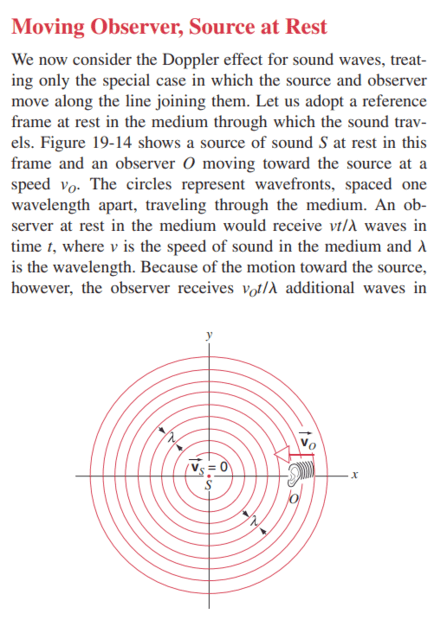
For this,
1685399033768.png

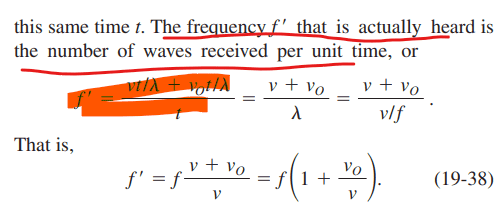
1685399385710.png

Does someone please know where they got that ##f'## is number of waves fronts received per unit time from? Also could we write the equation highlighted as ##f' = \frac{n\lambda}{t}## where ##n## is the number of wavefronts in a time ##t##?

I derived that from ##\frac{vt}{\lambda} = n## and ##v = f\lambda##

Many thanks!
 
Physics news on Phys.org
You have two velocities to consider:
- Propagation of the waves.
- Observer O.

While the observer approaches the non-moving source of sound waves, both velocities have opposite directions, producing a net velocity (which can be converted to a frequency).

While the observer moves away from the source, both velocities have the same direction, producing a net velocity (which can also be converted to another frequency).

Approaching frequency > Distancing frequency
 
Reply
  • Like
Likes   Reactions: member 731016
Lnewqban said:
You have two velocities to consider:
- Propagation of the waves.
- Observer O.

While the observer approaches the non-moving source of sound waves, both velocities have opposite directions, producing a net velocity (which can be converted to a frequency).

While the observer moves away from the source, both velocities have the same direction, producing a net velocity (which can also be converted to another frequency).

Approaching frequency > Distancing frequency
Thank you for your reply @Lnewqban!

Good idea to think about it as a resultant velocity (I guess relative to the air)? The textbook says assumes that the body air is the reference frame.

Many thanks!
 
Reply
  • Like
Likes   Reactions: Lnewqban
ChiralSuperfields said:
Does someone please know where they got that f′ is number of waves fronts received per unit time from?
It's definitional. The frequency observed by a receiver is the rate at which whole cycles are received.
ChiralSuperfields said:
could we write the equation highlighted as ##f' = \frac{n\lambda}{t}## where ##n## is the number of wavefronts in a time ##t##?

I derived that from ##\frac{vt}{\lambda} = n## and ##v = f\lambda##
No, you can’t write it like that for the excellent reason that it is dimensionally inconsistent. The LHS has dimension ##T^{-1}##, while the RHS has dimension ##LT^{-1}##. You could not have derived it correctly from those other two equations because they are consistent.
 
Reply
  • Like
Likes   Reactions: member 731016
haruspex said:
It's definitional. The frequency observed by a receiver is the rate at which whole cycles are received.

No, you can’t write it like that for the excellent reason that it is dimensionally inconsistent. The LHS has dimension ##T^{-1}##, while the RHS has dimension ##LT^{-1}##. You could not have derived it correctly from those other two equations because they are consistent.
Thank you for your replies @haruspex and @Lnewqban !

Yeah, I can't find where they the textbook where they define frequency as number of wavelengths per unit time ##f' = \frac{n}{t}## where ##n## is the number of wave fronts in a time internal ##t##. I can only find definition ##f = \frac{1}{T}## where the wave speed v is eliminated from ##v = f\lambda## and ##v = \frac{\lambda}{T}## to get the result.

However, using our definition, ##f' = \frac{n}{T}## and comparing with the equation highlighted I get:
##n = \frac{vt}{\lambda} + \frac{v_Ot}{\lambda}##.

I think ##n = \frac{vt}{\lambda} + \frac{v_Ot}{\lambda}## could be rewritten more succinctly as,

##n = \frac{n_1\lambda}{\lambda} + \frac{n_2\lambda}{\lambda}##
##n = n_1 + n_2##

Where, ##n_1## is a positive integer multiple of wavelengths to pass an stationary observer fixed to the frame of the medium and ##n_2## is a positive integer multiple of wavelengths to pass a the observer while they are moving towards the source.

I also tried rewriting it another way,

##n = \frac{d}{\lambda} + \frac{d_O}{\lambda}##

which is also dimensionally consistent and I'm still thinking about

Many thanks!
 
ChiralSuperfields said:
##n = n_1 + n_2##

Where, ##n_1## is a positive integer multiple of wavelengths to pass an stationary observer fixed to the frame of the medium and ##n_2## is a positive integer multiple of wavelengths to pass a the observer while they are moving towards the source.
Yes, if you mean "… ##n_2## is the positive integer multiple of wavelengths the observer would pass while moving towards the source if the waves were stationary"
 
Reply
  • Like
Likes   Reactions: member 731016
haruspex said:
Yes, if you mean "… ##n_2## is the positive integer multiple of wavelengths the observer would pass while moving towards the source if the waves were stationary"
Thank you for catching my mistake there @haruspex!
 
Last edited by a moderator: