[Dot Product] Vector Proection

4 replies · 2K views · last reply
Highway
Messages
349
Reaction score
1
[Dot Product] Vector Projection

Homework Statement


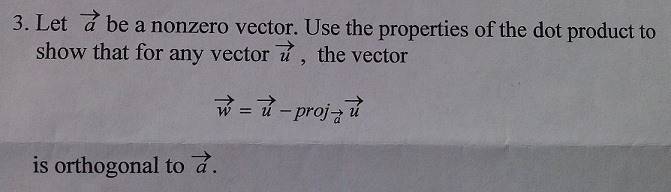
Printed problem 3: Let vector a be a nonzero vector. Use the properties of the dot product to show that for any vector u, the vector w = u − proj_a u is orthogonal to a.


Homework Equations


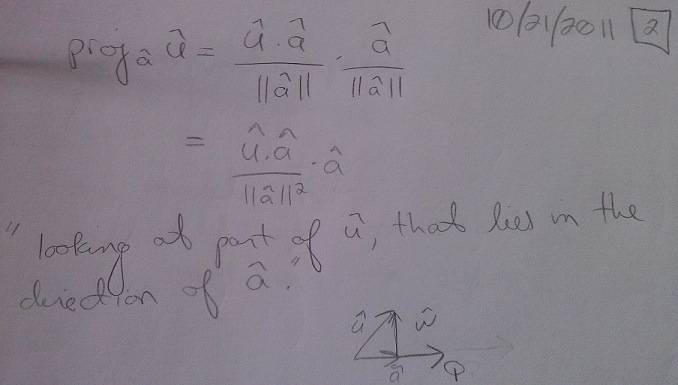
Handwritten derivation of the vector projection of u onto a, with the formula proj_a u = (u . a)/||a||^2 a, the caption "looking at part of u that lies in the direction of a", and a small diagram of vectors a, u and a projected onto a line.


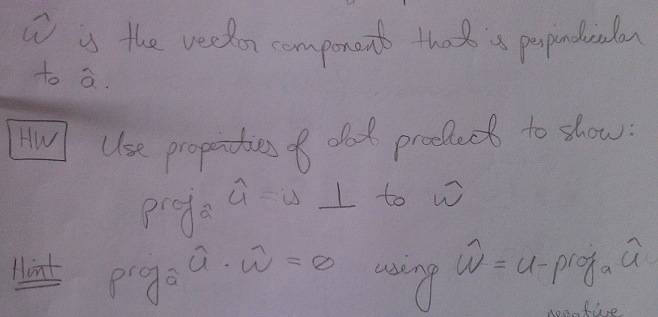
Handwritten note: w is the vector component that is perpendicular to a. HW: Use properties of dot product to show proj_a u = w ⊥ to w. Hint: proj_a u · w = 0 using w = u - proj_a u.


The Attempt at a Solution


I am not sure what to do here -- I know that the projection of u onto a "dotted" with w = 0 by definition, but I don't know how to show this.
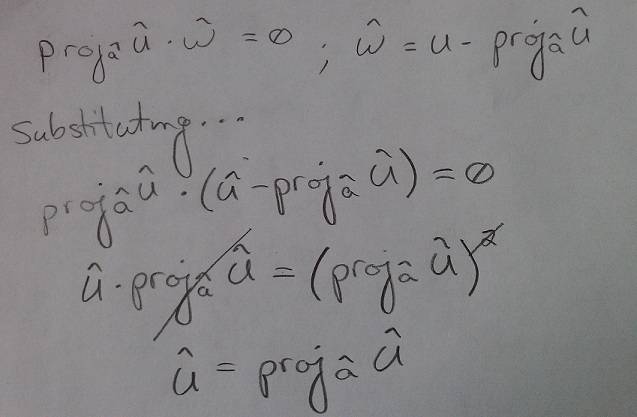
Handwritten derivation: proj_â û · ŵ = 0 with ŵ = û − proj_â û; substituting gives proj_â û · (û − proj_â û) = 0, then û · proj_â û = (proj_â û)², then û = proj_â û.


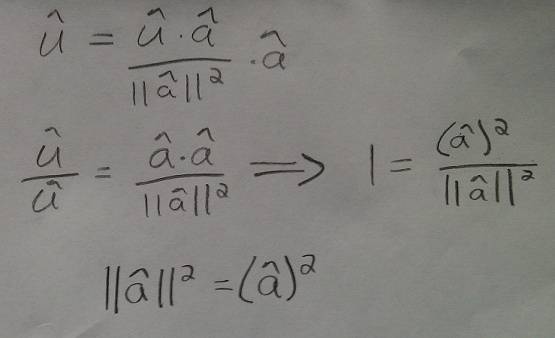
Handwritten derivation of the vector projection formula: u-hat equals (u-hat dot a-hat) over the squared norm of a-hat, times a-hat, followed by steps simplifying to 1 = (a-hat)^2 over the squared norm of a-hat, and ||a-hat||^2 = (a-hat)^2.


added this second part after plugging in for the definition of the projection we derived in class, then simplified. . .
 
Last edited:
Hi Highway! :smile:

You have an expression for the projection.
Can you substitute that (and only that) in the formula you have for w?

To show that 2 vectors are orthogonal, you need to show that their dot product is zero. That is, that [itex]\vec a \cdot \vec w = 0[/itex].

What you need to know, is that there are calculation rules for dot products.
For instance [itex]\vec a \cdot (\vec b+\vec c) = \vec a \cdot \vec b + \vec a \cdot \vec c[/itex].

Can you simplify the expression for [itex]\vec a \cdot \vec w = 0[/itex]?
 
I like Serena said:
Hi Highway! :smile:

You have an expression for the projection.
Can you substitute that (and only that) in the formula you have for w?

To show that 2 vectors are orthogonal, you need to show that their dot product is zero. That is, that [itex]\vec a \cdot \vec w = 0[/itex].

What you need to know, is that there are calculation rules for dot products.
For instance [itex]\vec a \cdot (\vec b+\vec c) = \vec a \cdot \vec b + \vec a \cdot \vec c[/itex].

Can you simplify the expression for [itex]\vec a \cdot \vec w = 0[/itex]?

Thanks! I got it figured out :P

Handwritten derivation showing w-hat = u-hat minus proj of a-hat onto u-hat, then a-hat dot w-hat = 0, expanded step by step to a-hat dot a-hat minus a-hat dot a-hat times 1 = 0, ending with 0 = 0.