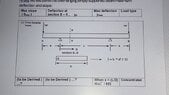
Double overhanging beam deflection

Click For Summary
SUMMARY

The discussion centers on calculating the maximum slope and deflection of a double overhanging beam using the singularity function method. Participants emphasize the importance of correctly applying boundary conditions at points \(x = a\) and \(x = L-a\) to derive the moment function \(M(x)\) from the shear function \(V(x)\). The integration constants \(C_\theta\) and \(C_y\) must be determined through continuity conditions, ensuring no discontinuities in slope between beam segments. A recommended resource for further understanding is the "Deflection of Beams - Geometric Methods" section from the LibreTexts Engineering library.

PREREQUISITES
  • Understanding of beam deflection theory
  • Familiarity with singularity functions in structural analysis
  • Knowledge of boundary conditions in mechanical systems
  • Proficiency in integration techniques for differential equations
NEXT STEPS
  • Study the "Deflection of Beams - Geometric Methods" from the LibreTexts Engineering library
  • Learn about the application of singularity functions in structural analysis
  • Review boundary condition applications in beam theory
  • Practice integration of moment functions to determine deflection
USEFUL FOR

Mechanical engineers, civil engineers, and students studying structural analysis who are focused on beam deflection calculations and the application of singularity functions.

Mohmmad Maaitah
Messages
90
Reaction score
20
Homework Statement
Derive an expression for the slope and deflection for the beam
Relevant Equations
Deflection of beams
Please help me finding the max slope and deflection im stuck on this problem for two weeks.
I can't get anywhere with the boundary and continutiy conditions
The problem and what I've d one:
4585801D-87F3-45E4-888E-127D4A0C447C.jpg

WhatsApp Image 2024-12-13 at 16.43.30_b1c68ee2.jpg
WhatsApp Image 2024-12-13 at 16.43.30_57b16c10.jpg

4585801D-87F3-45E4-888E-127D4A0C447C.jpg
 
  • Like
Likes   Reactions: WWGD
Physics news on Phys.org
The shear ##V(x)## can be represented with the singularity function:

$$V(x) = -P+P\langle x - a \rangle^0 +P\langle x - (L-a) \rangle^0 $$

Then you can integrate that to get ##M(x)##

Then apply ## EI \frac{d^2y}{dx^2} = M(x) ##.

The boundary conditions on ##y## at ##x=a## and ##x = L-a## give you two equations and two unknowns to determine the integration constants ##C_\theta, C_y##
 
erobz said:
The shear ##V(x)## can be represented with the singularity function:

$$V(x) = -P+P\langle x - a \rangle^0 +P\langle x - (L-a) \rangle^0 $$

Then you can integrate that to get ##M(x)##

Then apply ## EI \frac{d^2y}{dx^2} = M(x) ##.

The boundary conditions on ##y## at ##x=a## and ##x = L-a## give you two equations and two unknowns to determine the integration constants ##C_\theta, C_y##
Thanks for the answer, how is it possible with the normal integration as I'm not familiar with the singularity method.
 
Mohmmad Maaitah said:
Thanks for the answer, how is it possible with the normal integration as I'm not familiar with the singularity method.
Its messy, but the idea is the same. You will have a bunch of integration constants to figure out. The is a distinct moment curve for each region of the beam between point loads with its own constants of integration in the deflection integration. They have to be all matched up with the boundary conditions on ##y## at a particular point and use the fact that we are not to have discontinuous slope between the segments.

I suggest you see this:

https://eng.libretexts.org/Bookshelves/Mechanical_Engineering/Introduction_to_Aerospace_Structures_and_Materials_(Alderliesten)/02:_Analysis_of_Statically_Determinate_Structures/07:_Deflection_of_Beams-_Geometric_Methods/7.04:_Deflection_by_Method_of_Singularity_Function
 
Mohmmad Maaitah said:
Homework Statement: Derive an expression for the slope and deflection for the beam
Relevant Equations: Deflection of beams

Please help me finding the max slope and deflection im stuck on this problem for two weeks.
I can't get anywhere with the boundary and continutiy conditions
The problem and what I've d one:
View attachment 354449
View attachment 354450View attachment 354451
View attachment 354449
I think you are going wrong in evaluating the slope at the first support. You apparently have ##x_2 = a ## in the equation? ##x_2## should not be referenced from the free end ( where ##x_1## is referenced), it should be referenced from the beginning of the segment under consideration. So when you are equating ##EI \theta_1 = EI \theta_2 ## be wary of that (pay attention to the value ##x_2## should take in the ##\theta_2## equation at the first support).
 

Similar threads

  • · Replies 8 ·
Replies
8
Views
2K
Replies
1
Views
2K
  • · Replies 10 ·
Replies
10
Views
4K
  • · Replies 2 ·
Replies
2
Views
1K
  • · Replies 1 ·
Replies
1
Views
2K
  • · Replies 3 ·
Replies
3
Views
3K
  • · Replies 1 ·
Replies
1
Views
2K
  • · Replies 1 ·
Replies
1
Views
20K
  • · Replies 2 ·
Replies
2
Views
3K
  • · Replies 6 ·
Replies
6
Views
2K