Drawing triangles given sides and angles

  • Thread starter Thread starter Redinorun
  • Start date Start date
  • Tags Tags
    Drawing Triangles
Join the discussion
Registration is free. Start your own thread to ask a follow-up.
15 replies · 3K views · last reply
Redinorun
Messages
18
Reaction score
0
Hello, I would need some help with drawing these 3 triangles for my homework.
Would be nice if you could just help me to start drawing (what to do first) the right way. Thanks.

Homework Statement


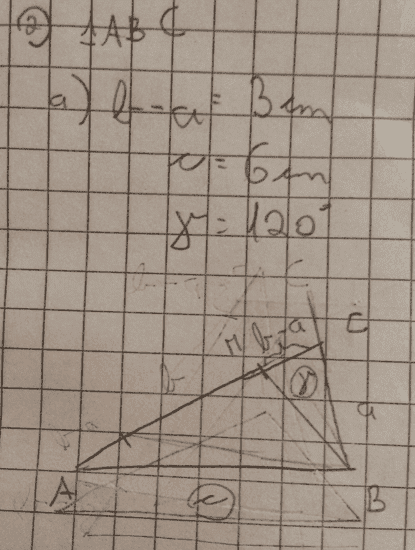
a) Regular triangle:
b - a = 3cm
c = 6cm
γ = 120°

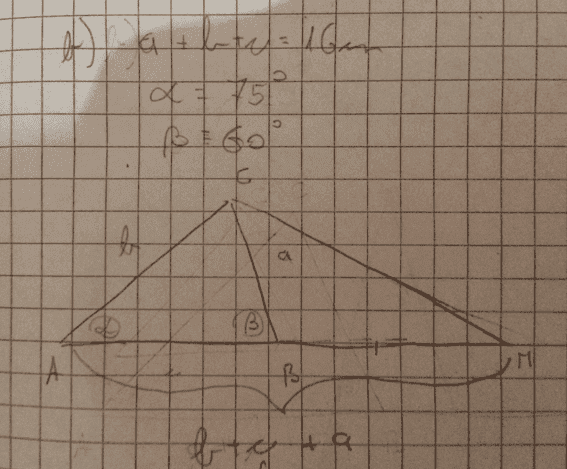
b) Regular triangle:
a + b + c = 16cm
α = 75°
β = 60°

c) Isosceles triangle:
a + h = 8cm
γ = 30°

Homework Equations


/

The Attempt at a Solution


a)
Handwritten notes on squared paper: "1) ABC a) b - a = 3 cm, c = 6 cm, γ = 120°", above a hand-drawn triangle ABC with side labels a, b, c and angle γ marked at vertex C.


b)
Handwritten sketch on grid paper of a triangle ABC with a + b + c = 16 cm, angle alpha = 75 degrees at A and beta = 60 degrees at B, with a height line from C and the side lengths b, c and a labelled.


c) I found out that on hand of that we know that α = β = 75°
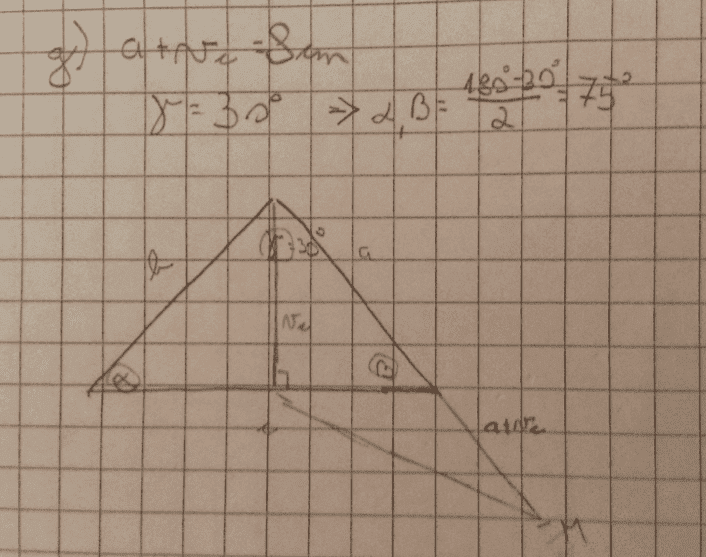
Handwritten construction of an isosceles triangle with apex angle γ = 30°, base angles α and β, height h drawn from the apex, and side a labelled, with a + h = 8 cm written above and a dashed line extended from the base to a point labelled A.
 
Physics news on Phys.org
I am afraid you will be needing some relevant equations to complete these triangles. Which ones could be useful here ?
 
We didn't use any equations at school. We just drew them. :(
 
Starting with a): Do you know the theorem that from any chord, the angles on the circumference are equal? See picture:

Given b-a, gamma and c. You can determine the angle delta. With delta, draw the yellow triangle, starting with the segment b-a. To c, draw the circle where the point C is positioned: c is the cord, from where the angle on the circumference is the given gamma.

Geometry diagram of a triangle ABC inscribed in a circle, with side c as the base AB, side a as BC, side b as AC, and point D on AC with segment AD labeled b-a. Angles gamma at C and phi at D and B are marked, and angle delta at A is shaded; a yellow triangle ABD and a cyan triangle DBC are highlighted.
 
ehild said:
Starting with a): Do you know the theorem that from any chord, the angles on the circumference are equal? See picture:

Given b-a, gamma and c. You can determine the angle delta. With delta, draw the yellow triangle, starting with the segment b-a. To c, draw the circle where the point C is positioned: c is the cord, from where the angle on the circumference is the given gamma.

View attachment 73839

Got that one. Basically after I saw your picture. I realized that both sides of your blue triangle are the same length (because b-a leaves you with a, right?) So I could calculate delta is 30, and on hand of that, that the pink marked corner is 150. That makes it fairly easy to draw the triangle. Thank you. :)
 
Redinorun said:
Got that one. Basically after I saw your picture. I realized that both sides of your blue triangle are the same length (because b-a leaves you with a, right?) So I could calculate delta is 30, and on hand of that, that the pink marked corner is 150. That makes it fairly easy to draw the triangle. Thank you. :)

It is right, and you do not even need the circle...What about b) can you draw it?

ehild
 
ehild said:
A little help to b) See picture.

View attachment 73844
I actually made it. Thanks! Your pictures actually really help. The blue corner is 37,5 and the pink one is 30. At the top when the lines meet at C you just draw the same corners again, but down (because again, we have a, a and b, b) and that's it! Thanks!
 
Redinorun said:
I actually made it. Thanks! Your pictures actually really help. The blue corner is 37,5 and the pink one is 30. At the top when the lines meet at C you just draw the same corners again, but down (because again, we have a, a and b, b) and that's it! Thanks!
Good! What about the third triangle? I do not understand the problem text. Is a the base or one of the equal sides? Does h belong to a or to the other side? Which angle is given?

ehild
 
ehild said:
Good! What about the third triangle? I do not understand the problem text. Is a the base or one of the equal sides? Does h belong to a or to the other side? Which angle is given?

ehild
"a" is one of the equal sides (just like usual). (c is the base) "h" is the height of the triangle. The angle gamma (by the point C) is given 30. So the thing also given is one of the equal sides + the height (a + h).
 
A picture of the problem.
 
Attachments
  • Hand-drawn triangle with vertex C at the top, a red altitude h dropped vertically to the base, and the right side labelled a. A blue angle at C is labelled gamma = 30°. Red text below reads a + h = 8 cm.
    Triangle.jpg
    18.9 KB · Views: 532
This is very similar to the second one. You can draw the big right triangle...

Hand-drawn geometry sketch: a black-outlined triangle with a vertex C, an orange large right triangle, a red altitude h dropped to the base with a right-angle mark, a side labelled a, angle γ = 30° at C, and the note a + h = 8 cm.
 
ehild said:
This is very similar to the second one. You can draw the big right triangle...

View attachment 73847
Oh, how did I not see that?! But wait... ugh... I can't figure out the angles on this one. Nor the length of a.
 
The leg of the right triangle is a+h. The blue angle on it is 90°, and you can determine the pink one from gamma. gamma/2 is the exterior angle of the yellow isosceles triangle.
 
Attachments
  • Geometry diagram of a triangle with a vertical line dropped from the apex to a right-angle mark at the base, with the label h on that altitude, a labelled a on the upper segment and a on one side, a labelled γ/2 at the apex, and a magenta right triangle and yellow shaded region overlaid.
    triiso.JPG
    10.3 KB · Views: 581
ehild said:
The leg of the right triangle is a+h. The blue angle on it is 90°, and you can determine the pink one from gamma. gamma/2 is the exterior angle of the yellow isosceles triangle.
Oh, right, right right! I got stuck on the pink one, for some reason I couldn't figure out that I had to gamma/2, to get the top of the yellow one. Got it now. It's very "slim".
Now I know, always look for isosceles triangles and similar.

Thanks again for taking the time to help me. :)