JVDC
- 2
- 0
- Homework Statement
- Calculate the torque (Moment around joint in middle of foot) at which the robot starts tipping over its front foot.
- Relevant Equations
- Newton
Hello everyone.
I'm stuck on my robotics homework. Can anyone help me?
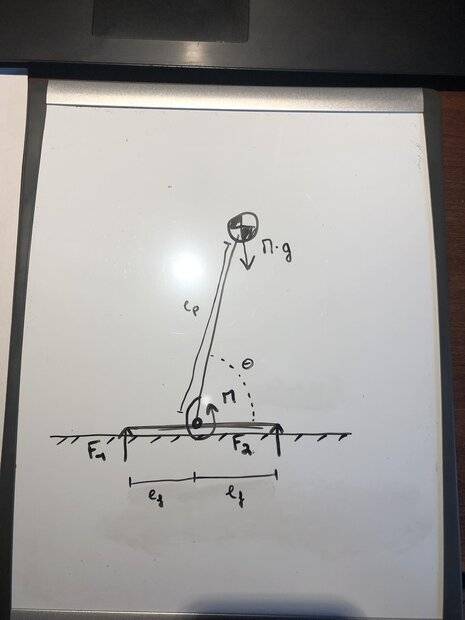
I have a stick with a certain mass on it. This stick is like an inverted pendulum. It can rotate around an ankle joint in the middle of the foot. The foot is placed on the ground. Suppose the stick to have no mass. There is a figure attached to be more clear.
If I push the stick forwards, a moment will act on it in the joint that is linear with Θ. Its equation is M = k2 * re2 * (90° - Θ - ΔΘ). It is a spring that is unidirectional, so its moment can never be negative. So, it is logical to assume that the robot will never tip around the rear of the foot, as no moment can 'lock' the foot.
The forces F1 and F2 can also never be negative, as the foot does not stick on the ground. So, the robot tips around the front of the foot when F1 = 0. The system is dynamic, so the stick can already rotate with a certain velocity.
Now, how can I calculate at which ankle moment the robot tips?
I already have the following equations.
F1 + F2 = M*g
I * Θ'' = -M*g*lp * cosΘ + k2 * re2 * (90° - Θ - ΔΘ) - F1*lf + F2*lf
What other equations can I use?
I'm stuck on my robotics homework. Can anyone help me?
I have a stick with a certain mass on it. This stick is like an inverted pendulum. It can rotate around an ankle joint in the middle of the foot. The foot is placed on the ground. Suppose the stick to have no mass. There is a figure attached to be more clear.
If I push the stick forwards, a moment will act on it in the joint that is linear with Θ. Its equation is M = k2 * re2 * (90° - Θ - ΔΘ). It is a spring that is unidirectional, so its moment can never be negative. So, it is logical to assume that the robot will never tip around the rear of the foot, as no moment can 'lock' the foot.
The forces F1 and F2 can also never be negative, as the foot does not stick on the ground. So, the robot tips around the front of the foot when F1 = 0. The system is dynamic, so the stick can already rotate with a certain velocity.
Now, how can I calculate at which ankle moment the robot tips?
I already have the following equations.
F1 + F2 = M*g
I * Θ'' = -M*g*lp * cosΘ + k2 * re2 * (90° - Θ - ΔΘ) - F1*lf + F2*lf
What other equations can I use?