Undergrad Effect of inserting an analyzer loop in the EPR experiment

Click For Summary
Inserting an analyzer loop, consisting of a polarizer and its inverse, into an EPR experiment like Alain Aspect's 1982 test does not affect the non-local correlations observed between entangled photons. The analysis suggests that the presence of the analyzer loop maintains the Bell violation, indicating that non-locality remains observable. However, there is currently no known experimental demonstration of this modification. Participants express interest in seeing such an experiment conducted. Overall, the discussion confirms that the theoretical framework supports continued non-local correlations despite the addition of the analyzer loop.
kurt101
Messages
285
Reaction score
35
TL;DR
Does inserting an analyzer loop in the EPR experiment with photons affect the non-local correlation in this experiment?
Given an EPR experiment such as the Alain Aspect 1982 test of non-locality using photons; if you modified the experiment so that the entangled photons first go through a analyzer loop (polarizer + inverse polarizer) before going to the polarizers in the experiment would you still see a non-local correlation between the entangled photons in this experiment?

A loop analyzer is a polarizer and its inverse polarizer that does not change the polarization as show in the following diagram:
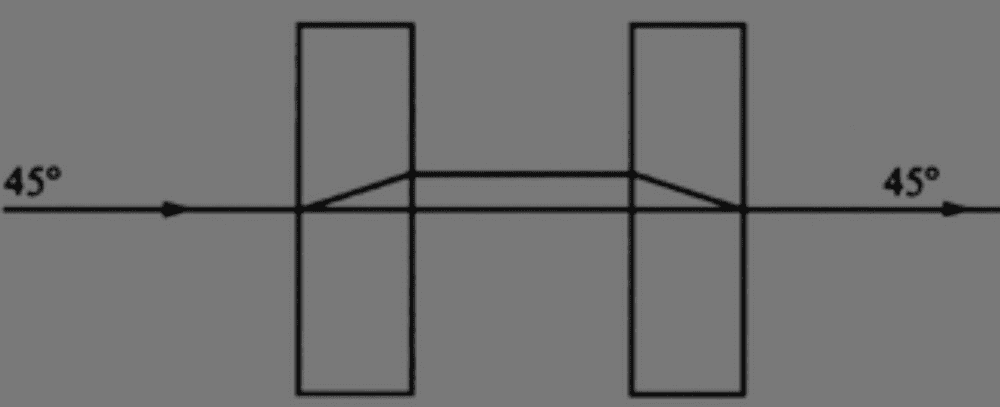
loop-analyzer.png
 
Physics news on Phys.org
DrChinese said:
According to this analysis, it would:
"It would" what? I did a first read through the thought experiment you posted and my understanding is that an analyzer loop that looks like:
loop-analyzer2.PNG

has no effect on the outcome and you still get the Bell violation whether it is there or not. Am I misunderstanding?

Thanks
 

Attachments

  • loop-analyzer2.PNG
    loop-analyzer2.PNG
    1.2 KB · Views: 149
Sorry, I wasn't clear: "Would you still see a non-local correlation between the entangled photons in this experiment?"

Yes, you would. The only issue is that I am not aware of an experimental demonstration of this. But maybe someone else knows... :smile: and I would love to see that.
 
  • Like
Likes kurt101
Time reversal invariant Hamiltonians must satisfy ##[H,\Theta]=0## where ##\Theta## is time reversal operator. However, in some texts (for example see Many-body Quantum Theory in Condensed Matter Physics an introduction, HENRIK BRUUS and KARSTEN FLENSBERG, Corrected version: 14 January 2016, section 7.1.4) the time reversal invariant condition is introduced as ##H=H^*##. How these two conditions are identical?

Similar threads

Replies
11
Views
2K
  • · Replies 4 ·
Replies
4
Views
1K
  • · Replies 29 ·
Replies
29
Views
3K
  • · Replies 41 ·
2
Replies
41
Views
6K
  • · Replies 225 ·
8
Replies
225
Views
15K
  • · Replies 58 ·
2
Replies
58
Views
5K
  • · Replies 61 ·
3
Replies
61
Views
4K
  • · Replies 27 ·
Replies
27
Views
3K
  • · Replies 2 ·
Replies
2
Views
2K
  • · Replies 8 ·
Replies
8
Views
2K