laser1
- 167
- 23
- Homework Statement
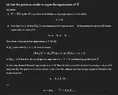
- Part d) in image below
- Relevant Equations
- N/A
in a) I evaluated that the commutator is ##4\hat{b}##.
in b) I deduced that as ##\hat{N} \hat{b} = \hat{b} \hat{N} - 4\hat{b}## so the eigenvalues of this is ##n-4##.
in c) it was that by using the norm that ##g=1/\sqrt{n}##.
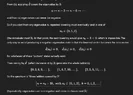
so in d), by applying repeated ##\hat{b}## gives eigenvalues 4 less than the previous one. Similarly, one can apply the b dagger operator to give eigenvalue 4 more than the previous one. I was checking my answers with ChatGPT (usually it is quite accurate and good, but I think because this is a non standard textbook problem, it struggles) and it gives different answers when I ask it the same question, so I wanted to ask here for help. In case anyone is curious, I have attached its answers here (one was for [b, b hermitian] = 3, but it's the exact same question other than that).
1) The smallest eigenvalue is 0 because repeatedly applying ##\hat{b}## will keep going until I get a negative number, which contradicts the property that the eigenvalue must be ##\geq 0## by the equation that ##||\hat{N} \phi || \geq 0##. So then the only possible eigenvalues are 0, 4, 8, ...
2) As equation b) is only valid for ##n \geq 4##, then I can start from e.g. ##7## and then stop when it hits ##3## as the equation doesn't apply again. So then the solutions are also 3, 7, 11, ... And the same logic can be applied to 1, 5, 9,... and 2, 6, 10,... which means that the eigenvalues are 0, 1, 2, 3, ...
To clarify, this question is from a past exam paper, and the physics department has a policy for professors to not give solutions for past exam papers. And I want to ensure I have the correct reasoning if a similar question appears. Thanks