Einstein summation convention with matrix and vector products

Join the discussion
Registration is free. Start your own thread to ask a follow-up.
4 replies · 12K views · last reply
Dafe
Messages
144
Reaction score
0
1. The problem statement and attempt at solution

Given the matrix S_ij and a_i evaluate a),b),c),d) and e)
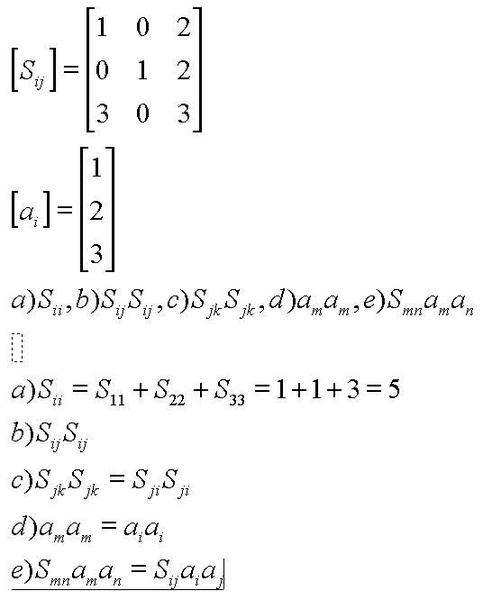
Handwritten-style typeset worked example: 3x3 matrix S_ij with rows (1, 0, 2), (0, 1, 2), (3, 0, 3); 3x1 vector a_i with entries 1, 2, 3; then the expressions a) S_ii, b) S_ij S_ij, c) S_jk S_jk, d) a_m a_m, e) S_mn a_m a_n, with partial solutions shown.


For a) I think i use Einsteins convention.
b) I just first sum on i, and then on j giving me 9 terms. The answer I get is 24.

d) can i change m with i since they are both dummy indexes?

e) the same problem as d I guess, is this allowed?

I'm trying to learn continuum mechanics by my self, and this is the first step.

Thank you.
 
Physics news on Phys.org
Dafe said:
1. The problem statement and attempt at solution

Given the matrix S_ij and a_i evaluate a),b),c),d) and e)

Handwritten-style typeset working: matrix S_ij with rows (1,0,2), (0,1,2), (3,0,3); column vector a_i with entries 1, 2, 3; then expressions a) S_ii, b) S_ij S_ij, c) S_jk S_jk, d) a_m a_m, e) S_mn a_m a_n, with evaluations S_ii = 1+1+3 = 5 and identities for b to e.


For a) I think i use Einsteins convention.
Yes, that is the sum of numbers on the main diagonal, also called the "trace".

b) I just first sum on i, and then on j giving me 9 terms. The answer I get is 24
?? I get 28, the sum of the squares of all terms. And, of course, (c) is exactly the same as (b).

d) can i change m with i since they are both dummy indexes?
Yes, but why would you want to? In any case this is the sum of the squares of the elements of a, 1+ 4+ 9.

e) the same problem as d I guess, is this allowed?
No, this is not at all the same problem as (d)! (d) was amam which is, as I said, the sum of the squares of the elements of a: the same as the 'dot product' of a with itself. In particular, there is no "S" in (d). (e) is Smnaman. Multiply the "matrix" S with the column vector a, then take the dot product of that with a.

I'm trying to learn continuum mechanics by my self, and this is the first step.

Thank you.[/QUOTE]
 
I didn't mean that e) was the same problem as d), I just wondered if I could change the indices from m to i and so on... You've answered that though, thank you very much!
 
I'll post some more questions here so I don't spam the forums, hope that's alright.

1. The problem statement and attempt at solution:

Handwritten-style typeset derivation: given T_ij = 2μE_ij + λ(E_kk)δ_ij, show W = ½T_ij E_ij = μE_ij E_ij + (λ/2)(E_kk)^2; an attempted solution gives ½T_ij E_ij = μE_ij E_ij + (λ/2)(E_kk)E_ij δ_ij, asking whether E_ij δ_ij = E_ij.


As I see it E_kk is a first order tensor and E_ij is a second order one. How do I go from E_ij to E_kk?

Thank you.
 
Try to find out what kronecker delta is! Then you will get the answer.