* * Elastic potential energy with box going up an incline.

Click For Summary

Homework Help Overview

The discussion revolves around a problem involving elastic potential energy, a spring, and a mass moving up an inclined plane. The scenario includes a spring with a specified force constant, a mass placed on it, and a coefficient of kinetic friction. Participants are tasked with determining the speed of the mass after it moves a certain distance up the incline, considering the effects of friction and gravitational forces.

Discussion Character

  • Exploratory, Assumption checking, Problem interpretation

Approaches and Questions Raised

  • Participants discuss the interpretation of the distance the mass moves, questioning whether the total distance includes the spring's compression. They explore the implications of this interpretation on the calculations and results.

Discussion Status

There is ongoing exploration of the problem's setup, with participants noting potential ambiguities in the question. Some suggest that the modified problem may not yield physically plausible results, while others propose alternative calculations to assess the maximum distance the mass could travel up the incline.

Contextual Notes

Participants mention that the original problem involved different values and a downward incline, which worked out correctly, suggesting that the modifications made by the teacher may have introduced inconsistencies or errors.

Swan
Messages
16
Reaction score
0
*URGENT* Elastic potential energy with box going up an incline.

Homework Statement


A spring having a force constant of 240 \frac{N}{m} is placed on a plane inclined at 67° to the horizontal. The spring is compressed 0.40 m and a 2.0 kg mass is placed on it. The coefficient of kinetic friction along the inclined surface is 0.53. Find the speed of the mass after it moves 1.3 m up the plane (above the completely extended spring).

Diagram
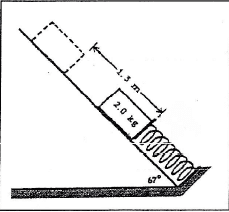
04.22.2012-09.05.56.png


Homework Equations


FN = m*g*cosθ
Ff = μ*FN
W = F*Δd
ET1 - Wf = ET2
Let H represent the height off the ground. Let h represent height between the boxes.

The Attempt at a Solution


V1 = 0. So initial kinetic energy is negligible.
h = (sin67°)(1.3m + 0.4m)
Wf = Ff * (1.3m + 0.4m)
Wf = 6.9J

ET1 - Wf = ET2
mgH + \frac{1}{2}k*x2 - Wf = mg(h+H) + \frac{1}{2}mV22
mgH + \frac{1}{2}k*x2 - Wf = mgH + mgh + \frac{1}{2}mV22
**Both mgH cancel out on each sides**
\frac{1}{2}(240\frac{N}{m})(0.4m)2 - 6.9J = [(2kg)(9.8m/s2)(sin67°)(1.3m + 0.4m)]+ \frac{1}{2}(2kg)V22

I worked it out but I'm receiving an error. What am I doing wrong?
 
Physics news on Phys.org


Swan said:
I worked it out but I'm receiving an error. What am I doing wrong?
Looks OK to me. But that diagram is a bit ambiguous about the meaning of the 1.3 m distance. (It doesn't reference the compression and seems to imply that the total distance moved is 1.3 m.)


Doc Al said:
Looks OK to me. But that diagram is a bit ambiguous about the meaning of the 1.3 m distance. (It doesn't reference the compression and seems to imply that the total distance moved is 1.3 m.)
Firstly, thank you so much for replying quickly :).

In the question it says "(above the completely extended spring)" meaning the the box has to move 1.3m after full extension. At the moment the box is on the spring, it is compressed 0.4m and therefore total distance becomes (1.3m + 0.4m = 1.7m). This was the way I interpreted it. When I carry out the solution, it won't work because of the negative and square root result in error.

Now to work out the whole equation.

ET1 - Wf = ET2
mgH + \frac{1}{2}k*x2 - Wf = mg(h+H) + \frac{1}{2}mV22
mgH + \frac{1}{2}k*x2 - Wf = mgH + mgh + \frac{1}{2}mV22
**Both mgH cancel out on each sides**
\frac{1}{2}(240\frac{N}{m})(0.4m)2 - 6.9J = [(2kg)(9.8m/s2)(sin67°)(1.3m + 0.4m)]+ \frac{1}{2}(2kg)V22
12.3J = 30.67J + \frac{1}{2}(2kg)V2
-18.39J = \frac{1}{2}(2kg)V2

Resulting in error.


Swan said:
In the question it says "(above the completely extended spring)" meaning the the box has to move 1.3m after full extension. At the moment the box is on the spring, it is compressed 0.4m and therefore total distance becomes (1.3m + 0.4m = 1.7m). This was the way I interpreted it.
I understand.
When I carry out the solution, it won't work because of the negative and square root result in error.
Yes. Obviously the data is bogus, given that interpretation of the problem. Try solving it where 1.3 m is the total distance traveled up the ramp. (See if that at least presents possible data.)


Doc Al said:
I understand.

Yes. Obviously the data is bogus, given that interpretation of the problem. Try solving it where 1.3 m is the total distance traveled up the ramp. (See if that at least presents possible data.)

I tried it. It still yields a negative which will result in a error through square root. Is there any error in the derivation of my equation?


Swan said:
I tried it. It still yields a negative which will result in a error through square root.
Yep.
Is there any error in the derivation of my equation?
No. Looks like the problem is bogus.

What book is it from?


Doc Al said:
Yep.

No. Looks like the problem is bogus.

What book is it from?

Its from the Nelson Physics 12 but I think the question was modified by the teacher.


Swan said:
Its from the Nelson Physics 12 but I think the question was modified by the teacher.
Hmm... how is the problem stated in the book? Perhaps your teacher made an error when modifying it.


Doc Al said:
Hmm... how is the problem stated in the book? Perhaps your teacher made an error when modifying it.

The original question with different values was going down the incline in which all worked out. But then when teacher modified when making it go up the incline, I'm getting an error.
 
  • #10


Swan said:
The original question with different values was going down the incline in which all worked out. But then when teacher modified when making it go up the incline, I'm getting an error.
Yes. The modified problem statement is bogus. The data represents a physically impossible situation.
 
  • #11


Doc Al said:
Yes. The modified problem statement is bogus. The data represents a physically impossible situation.

Ok, thank you.
 
  • #12


Just for fun, why not try calculating the maximum distance up the incline the mass will reach? (Using the given compression, spring constant, and μ.) See if that at least gives a sensible answer.
 
  • #13


Doc Al said:
Just for fun, why not try calculating the maximum distance up the incline the mass will reach? (Using the given compression, spring constant, and μ.) See if that at least gives a sensible answer.

I would let the system have 0 kinetic energy at the top to reach its max height.
 
  • #14


Swan said:
I would let the system have 0 kinetic energy at the top to reach its max height.
Sure.
 

Similar threads

Replies
11
Views
1K
  • · Replies 6 ·
Replies
6
Views
2K
  • · Replies 12 ·
Replies
12
Views
3K
Replies
2
Views
1K
  • · Replies 14 ·
Replies
14
Views
4K
Replies
7
Views
4K
Replies
1
Views
1K
  • · Replies 1 ·
Replies
1
Views
3K
  • · Replies 21 ·
Replies
21
Views
2K
Replies
44
Views
7K