Electric Field and Potential Change in a System with Equipotential Surfaces

Click For Summary
SUMMARY

The discussion focuses on calculating the electric field and potential change in a system with equipotential surfaces, specifically with a potential difference of Vo = 12.0 V. The electric field (E) is determined using the formula E = -V/r, where r is the distance between equipotential lines. The correct distance was found to be 1.78885 m, leading to an electric field value of 670.82 V/m at an angle of 243 degrees counterclockwise from the +x axis. The participant successfully solved both parts of the problem with the assistance of forum members.

PREREQUISITES
  • Understanding of electric fields and equipotential surfaces
  • Familiarity with the formula E = -V/r
  • Basic trigonometry for calculating distances and angles
  • Knowledge of unit conversions (e.g., cm to m)
NEXT STEPS
  • Study the relationship between electric field and potential difference in electrostatics
  • Learn how to calculate electric fields from equipotential surfaces
  • Explore the concept of potential energy in electric fields
  • Investigate the applications of electric fields in real-world scenarios
USEFUL FOR

Students in physics, electrical engineers, and anyone studying electrostatics or preparing for exams involving electric fields and potential differences.

FlipStyle1308
Messages
264
Reaction score
0
Problem:

A given system has the equipotential surfaces shown below, where Vo = 12.0 V.
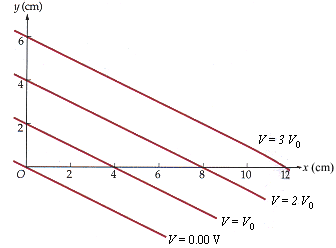
20-26alt.gif


(a) What are the magnitude and direction of the electric field?
(b) What is the shortest distance one can move to undergo a change in potential of 5.00 V?

I am not too sure on what equations I can use to solve this, but I have a feeling one of them will be delta V = -W/qo, and I have no other ideas on how to approach this problem.
 
Physics news on Phys.org
You need trig to figure out the distance between the equipotentials. The electric field is always going to be orthogonal to equipotential surfaces. Do you know the relationship between E, V and r? Use that to find E, then use the E that you got from part a) for the last part.
 
Okay, so for part (a), I use E = - V/r = - 12/4 = -3? Did I interpret your post correctly?
 
Not quite, you need the distance between two equipotential lines, which would be along a line perpendicular to them. I think you've gone along the x axis, which is at an angle to the red lines. Use the triangle formed by the x and y axes and the line V=V0, split it into two smaller right angled triangles and look for similar angles.
 
Okay, I determined how to split the triangle into two smaller right triangles and found the smiliar angles, but what exactly is this telling me?
 
You should be able to get the distance between the equipotentials, which is your r in E=-V/r. Also, one of the angles gives you the direction of the E field.
 
Oh, okay, so the distance between the lines is 1.78885 m, so this is my r. So plugging this into E = -V/r = -12/1.78885 = -6.7082 V/m?

Edit: I just tried submitting this answer (both negative and positive), and both were incorrect.
 
Last edited:
That's odd, that's the answer I got. Have you added the direction? Does it say how many s.f. to give?
 
I found my mistake. The units in the chart are in cm, so I converted all values into m. This gave me a value of 670.82, which is a correct answer. I also calculated the correct answer for the direction, which is 243 degrees counterclockwise from the +x axis. I also solved part (b). Thank you for your help!
 
Last edited:

Similar threads

  • · Replies 3 ·
Replies
3
Views
2K
  • · Replies 25 ·
Replies
25
Views
4K
Replies
6
Views
3K
  • · Replies 4 ·
Replies
4
Views
2K
Replies
12
Views
2K
  • · Replies 3 ·
Replies
3
Views
2K
  • · Replies 8 ·
Replies
8
Views
2K
Replies
19
Views
3K
Replies
2
Views
3K
  • · Replies 1 ·
Replies
1
Views
4K