Electron scattering off of a nucleus

Click For Summary
SUMMARY

The discussion centers on the implications of electron scattering off a nucleus and the relationship between bremsstrahlung radiation and the electron's momentum change. Participants assert that the infinite range of electromagnetic (EM) forces means that an electron is always accelerating, making it impossible to define a specific time interval for acceleration based on photon frequency. The conversation highlights selection rules for orbital transitions, emphasizing that transitions from a 100s orbital can only occur to certain p orbitals, and clarifies that both photon emission and electron momentum changes do not have well-defined durations. Ultimately, the discussion concludes that classical interpretations of these processes lead to confusion and do not accurately reflect quantum behavior.

PREREQUISITES
  • Understanding of bremsstrahlung radiation and its implications in quantum mechanics.
  • Familiarity with selection rules for orbital transitions in quantum physics.
  • Knowledge of classical versus quantum descriptions of particle interactions.
  • Basic principles of electron scattering and momentum vector changes.
NEXT STEPS
  • Study the principles of quantum mechanics related to bremsstrahlung radiation.
  • Research selection rules for orbital transitions in atomic physics.
  • Explore classical and quantum descriptions of electron scattering events.
  • Investigate the implications of photon absorption and emission in quantum electrodynamics.
USEFUL FOR

Physicists, quantum mechanics students, and researchers interested in the behavior of electrons in atomic interactions and the nuances of bremsstrahlung radiation.
metastable
Messages
514
Reaction score
53
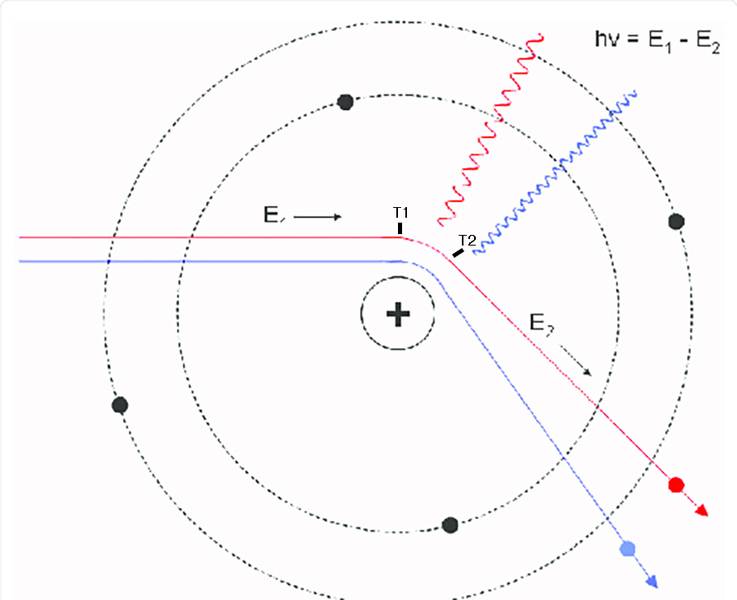
If I'm scattering electrons off of an atomic nucleus, can I infer any information about the duration of time the electron was accelerating by looking at the wavelength of the emitted bremsstrahlung radiation? I am wondering if it would be possible to derive a time interval between electron acceleration start (T1) and acceleration end (T2) by looking at the bremsstrahlung photon frequency.

bremsstrahlung2.jpg
 

Attachments

  • bremsstrahlung.jpg
    bremsstrahlung.jpg
    25.1 KB · Views: 550
  • bremsstrahlung2.jpg
    bremsstrahlung2.jpg
    25.7 KB · Views: 953
Physics news on Phys.org
No. Sinjce the EM force is infinite in range, the electron is always accelerating.
 
Can I derive the duration of time it took for the electron to substantially change its momentum vector as a result of the scattering (rather than duration of acceleration since the EM range is infinite)?
 
Even classically, there is no time interval. The curvature is continuous.

Then again, the curvature is concentrated in a definable timescale around the closest approach.

Suppose that the electron is initially "at rest" - at apoapse of a bound orbit passing close to the nucleus. Such as 100s orbital - principal quantum number 100, orbital quantum number 0.
What are legal results of bremsstrahlung?
Orbital quantum number must change by 1 by a selection rule. Therefore, 100s electron can go to some p orbital. Not 1p (no such orbital) and not 100p (no transition - same energy as 100s) - but 2p, 3p...99p are all options and all of them will happen, in some ratio.
If there is a transition to 1s, it immediately tells you that the initial orbital was some p orbital (all others are forbidden to transition to s). If there is a transition to 3, but no transition to any orbital 2, you can immediately tell that 2p was forbidden by a selection rule, 3d allowed - therefore the initial orbital was a f one.
Does the selection rule of orbital angular momentum only changing by 1 also apply to unbound orbits? And in case of unbound-unbound transitions, does it constrain energies of radiation emitted?
 
Can I define a period of time during which the electron's rate of momentum vector change is greater than a defined value, such a 1/1000th rad/sec, then correlate the measured time between T1 and T2 with the photon wavelength?
 
metastable said:
Can I define a period of time during which the electron's rate of momentum vector change is greater than a defined value, such a 1/1000th rad/sec
If you treat the electron as classical particle you can, but then you won't get a good description of what is going on.
 
Can I examine an electron-proton scattering event from detectors substantially in the center of mass rest frame, then calculate the inverse of the frequency of the emitted bremsstrahlung photon (1/hz -- seconds/cycle instead of cycles/second), then prove this isn't substantially the same time interval as the electron's flight time between points T1 and T2 (these points being defined by some momentum vector change rate threshold which is greater than XX.XXXrad/sec)?
 
Didn't we discuss this already? Do you expect the answers to be different just because you ask the same question in a different thread?

No you cannot.
 
I’m confused because you said treating the electron classically I can define a period of time (T1 -> T2) in the electron’s trajectory during which the rate of mometum vector change is greater than xx.xxx rad/sec.

But then you’ve said I cannot find a consistent vector change limit of xx.xxx rad/sec where duration T1 -> T2 = 1/hz of the emitted bremsstrahlung photon.

So If the bremsstrahlung photon is emitted “instantaneously” (ie no emission duration) but the duration of electron vector change which is > xx.xxx rad/sec = T2 - T1, are you saying that there are durations of time during T1->T2 where the electron’s momentum vector is continuously changing while no radiation is produced?

Or if you’re saying both the electron momentum vector change and the photon emission are instantaneous, how can I change the vector of an object with mass instantly without requiring infinite power? My confusion only deepens...

Or looking at the bremsstrahlung equation E1 - E2 = hv are you suggesting the E1 - E2 side of the equation takes a duration of time (Duration T1 -> T2 >xx.xxx rad/sec momentum vector change rate) but the hv side of the equation is instantaneous?

Or if the energy/momentum vector of the electron continues changing after the photon is emitted, but E1 - E2 = hv — wouldn’t the electron’s change in energy/momentum occurring after the emission of the photon somehow need to be transmitted backwards in time to the region of the photon emission to satisfy E1 - E2 = hv ?
 
Last edited:
  • #10
If you treat things classically that you shouldn't you can calculate a lot of things that all have little to nothing to do with reality.
 
  • #11
Does it then follow that an electron also can absorb a photon with no absorption duration — instantly — in other words absorption occurs in less time than the photon takes to traverse its wave-length in a vacuum (wavelength meters/c)?
 
  • #12
There is no well-defined duration for such a process and a free electron cannot absorb a photon (without also emitting one) anyway.
 
  • #13
Are both of these (seemingly contradictory) statements true in the same context:

“A free electron can absorb and also re-emit a photon in less time than it takes for the photon to traverse its wave-length in a vacuum (wavelength meters/c), such as in the process of compton scattering or inverse compton scattering.”

“Information cannot travel faster than the speed of light in a vacuum”
 
Last edited:
  • #14
The second is true, the first is ill-defined.

As there is no point in repeating the same question and answer over and over again I closed this thread.
 

Similar threads

  • · Replies 17 ·
Replies
17
Views
4K
  • · Replies 5 ·
Replies
5
Views
2K
  • · Replies 4 ·
Replies
4
Views
2K
Replies
3
Views
2K
  • · Replies 10 ·
Replies
10
Views
2K
  • · Replies 1 ·
Replies
1
Views
1K
  • · Replies 1 ·
Replies
1
Views
2K
  • · Replies 6 ·
Replies
6
Views
3K
Replies
1
Views
2K
  • · Replies 8 ·
Replies
8
Views
3K