Equation 16: Missing dt Term Without f(t)?

  • Context: Undergrad 
  • Thread starter Thread starter theycallmevirgo
  • Start date Start date
Join the discussion
Ask a follow-up here, or get your own question answered by working scientists, mathematicians and engineers — people, not an autocomplete.
Real named experts · corrections over time · the nuance an AI answer skips
8 replies · 1K views
theycallmevirgo
Messages
108
Reaction score
25
TL;DR
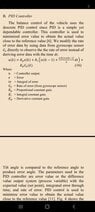
How can an equation contain a time derivative without any f(t)?
In equation 16 they seem to have a dt term without f(t). Am I missing something?
 

Attachments

  • Screenshot_20211013-131215_ReadEra.jpg
    Screenshot_20211013-131215_ReadEra.jpg
    28.7 KB · Views: 156
Physics news on Phys.org
theycallmevirgo said:
Summary:: How can an equation contain a time derivative without any f(t)?

In equation 16 they seem to have a dt term without f(t). Am I missing something?
Context is everything here. It looks more like there's an integral with respect to time in there, but it's highly contextual notation.
 
  • Like
Likes   Reactions: theycallmevirgo and ergospherical
PeroK said:
Context is everything here. It looks more like there's an integral with respect to time in there, but it's highly contextual notation.
fwiw I'm assuming the formula in the picture is the same one as (or a variation of) this here:
https://en.wikipedia.org/wiki/PID_controller#Controller_theory

the bit in the brackets in the picture corresponding to ##\int e(\tau) d\tau## on the wiki version
 
  • Like
Likes   Reactions: theycallmevirgo, DaveE and PeroK
PeroK said:
Well, I guess if you don't need to put the range on an integral, why bother with the integral sign at all?
Yes, I agree their notation sucks.
In dynamic systems (control systems) it is common to leave the range out, with an assumption it's "all relevant history". This is because most of the interest is in the behavior (stability, etc.), not the actual operating points. One of the cheats you get from linear systems, the integral can be treated like an operator; it might not matter what the actual value is.
 
  • Informative
  • Like
Likes   Reactions: theycallmevirgo and PeroK
WWGD said:
Don't we just assume ## f(t)== 1 ##? I mean, we have ##\int dt =t ##
That's exactly what I thought, originally. But if so, why include it at all?
 
theycallmevirgo said:
That's exactly what I thought, originally. But if so, why include it at all?
Because the result is not necessarily " neutral" when computed. You will not just ( necessarily) get a 1 multiplying . Edit: On my phone, will give you more thorough answer tmw when I get to my pc.