Equation of motion for a driving wheel

Click For Summary

Discussion Overview

The discussion revolves around the equations of motion for a driving wheel, focusing on the dynamics of traction force, rolling resistance, and their effects on angular velocity and linear velocity. Participants explore the implications of their calculations and the relationships between various forces and torques acting on the wheel.

Discussion Character

  • Technical explanation
  • Debate/contested
  • Mathematical reasoning

Main Points Raised

  • One participant presents equations of motion for a driving wheel, questioning the occurrence of negative angular velocity and positive linear velocity.
  • Another participant suggests that a positive angular velocity might correspond to a counterclockwise direction, while also expressing skepticism about the high values of angular velocity.
  • Concerns are raised about the dimensional consistency of the equations, particularly regarding the relationship between momentum and force.
  • Participants discuss the roles of traction force and rolling resistance, with one participant referencing external sources to clarify the assumptions made about these forces.
  • There is a suggestion that the equations only consider accelerations and that the values of angular velocity and linear velocity may not be directly related in the context of the equations presented.
  • Another participant mentions that negative values for angular velocity can be acceptable under certain conditions, such as when external forces are present.

Areas of Agreement / Disagreement

Participants express differing views on the validity of the equations and the interpretation of the results. There is no consensus on the correctness of the assumptions or the implications of the negative angular velocity.

Contextual Notes

Participants highlight potential limitations in their equations, including assumptions about the forces involved and the conditions under which the equations are applied. The discussion reflects uncertainty regarding the relationship between the forces and the resulting motion of the wheel.

Who May Find This Useful

This discussion may be of interest to those studying dynamics, mechanical engineering, or anyone involved in modeling vehicle motion and forces acting on wheels.

Payam30
Messages
44
Reaction score
1
Hi,
I have a Driving wheel for which I'm trying to make an observer for. The abserver works very well however , since I don't have my background in mechanics something strange happens. I have to say that I don't know why I think it's strange and that's why I put my question here.
Lets assume we have a driving wheel. The traction force is in the direction of motion and so is the rolling resistance since we have a driving wheel.
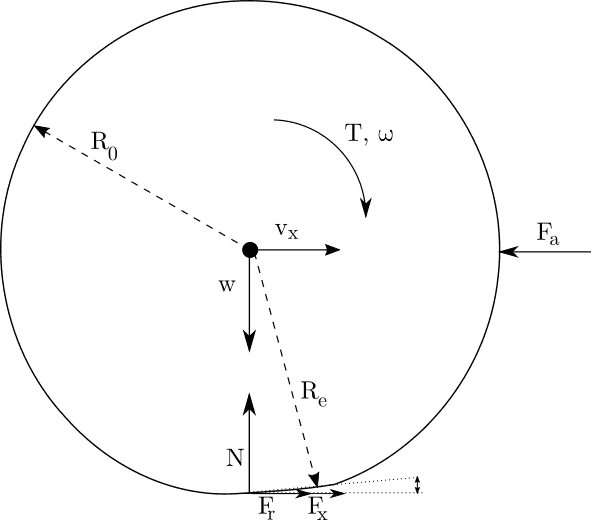
kmbdcD3.png

The EOM would be
J \dot{\omega} = T- F_r R_e - F_x R_e
m \dot{v} = F_x + F_r
here we assume that the values of F_s are neglectable.
In the figure N,W, R_e, F_r, F_x, F_a, T, \omega, R_0 are Normal force, weight, effective radius, Rolling resistance, traction force, aerodynamic force, torque, angular velocity, and nominal tire radius.
When I try to solve for \omega for this system with, T = 100-400 Nm, F_x = 0.6*700*9.81 N, F_r = 127- 173 N, J = 25.1 , m = 700 kg, R_e = 0,72 m, F_a = 0 N I get negative values for \omega =0:-550 rad/s and velocity to v = 0-32 m/s. how can it be possible? where am I doing wrong? why is \omega negative and translation velocity positive?
 
Engineering news on Phys.org
Hi,
Could it be as simple as: a positive ##\omega## is counterclockwise ? (and a positive torque ##T## as well...)
 
I have
BvU said:
Hi,
Could it be as simple as: a positive ##\omega## is counterclockwise ? (and a positive torque ##T## as well...)
no idea. However 400 rad/s is very high. ##\omega ## should the sam direction as torque
 
Payam30 said:
However 400 rad/s is very high
I agree. So is -550.
But, just like the other numbers, to me they come out of the blue sky.

If they come from your second relevant formula, however, they are definitiely wrong: there is no way a momentum and a force can be equal. They simply don't have the same dimension. What is it you mean to say with ##m \dot{v} = F_x + F_r## ?

[edit]Sorry, missed the dot.

In your first formula you write ##T## and ##F_x\,R_e## on one side with opposite signs. You sure this is the equation of motion ? Aren't ##T## and ##F_x\,R_e## one and the same ?
Same formula: ##F_r## is the sum of a positive and a negative part ?

And where does ##F_x = 0.6*700*9.81## N come from ? You sure it applies ?
 
Payam30 said:
##\omega ## should the sam direction as torque
I don't see ##\omega## appearing anywhere.
 
BvU said:
I agree. So is -550.
But, just like the other numbers, to me they come out of the blue sky.

If they come from your second relevant formula, however, they are definitiely wrong: there is no way a momentum and a force can be equal. They simply don't have the same dimension. What is it you mean to say with ##m \dot{v} = F_x + F_r## ?

[edit]Sorry, missed the dot.

In your first formula you write ##T## and ##F_x\,R_e## on one side with opposite signs. You sure this is the equation of motion ? Aren't ##T## and ##F_x\,R_e## one and the same ?
Same formula: ##F_r## is the sum of a positive and a negative part ?

And where does ##F_x = 0.6*700*9.81## N come from ? You sure it applies ?
Now I'm confused, look at the reference here.
https://theses.lib.vt.edu/theses/available/etd-5440202339731121/unrestricted/CHAP3_DOC.pdf
From the figure and in order to have balance you have to have a ## T## and #Fx# is the traction force that is a function of ##\mu## that is the friction coefficient that is in turn a function of longitudinal slip ##\lambda##. No we consider ##\mu## to be constant. ##F_r## is rolling resistance force. The refence above in page 35 eliminates ##F_r## by some reason. According to https://link.springer.com/chapter/10.1007/0-387-28823-6_4 ##F_r## does not give any moment about wheel centrum and is acting on the centrum of tire. but on EOM (equation of motion) it is considered negative. but it contradicts the first reference wher equation of interia and angular acceleration states the contribution of Fr is ##-F_R *R_e## thus ##F_r## and ##F_x## should in same direction.

##\mu = 0.6## and ##m = 700## and ##J=25.1## is assumed. ##F_x = 0.6*700*9.81=\mu*g*m## where ##g = 9.81##.
 
Payam30 said:
When I try to solve for ω for this system
How can you do that? ##\omega## and ##v## have nothing to do with your equations. The equations only (correctly) consider accelerations. They can be true at any value of ##\omega##.
 
  • Like
Likes   Reactions: BvU
jack action said:
How can you do that? ##\omega## and ##v## have nothing to do with your equations. The equations only (correctly) consider accelerations. They can be true at any value of ##\omega##.
I only integrate the \dot{\omega}. can you explain more. Do you think negative values of ##\omega## are okej? I tried with higher torque and it worked. The problem is Matlab or any programming language doesn't know where it exists any forces. For example when the vehicle is standing still, there arent any forces or if that is they have to lead to a stationary state.
 
Show us the equations and the values used for integration then. Your equations for force and acceleration are good.

Of course, negative values are acceptable. For example, if the input torque is zero and you have a headwind, the wheel will back up and you will have a negative velocity. I suspect the answer to your problem lies in the values (limits and conditions) you used with your integration, more than your equations themselves.
 

Similar threads

  • · Replies 8 ·
Replies
8
Views
7K
  • · Replies 59 ·
2
Replies
59
Views
5K
  • · Replies 4 ·
Replies
4
Views
2K
  • · Replies 47 ·
2
Replies
47
Views
7K
  • · Replies 11 ·
Replies
11
Views
2K
  • · Replies 15 ·
Replies
15
Views
1K
  • · Replies 2 ·
Replies
2
Views
3K
  • · Replies 1 ·
Replies
1
Views
2K
  • · Replies 23 ·
Replies
23
Views
5K
  • · Replies 10 ·
Replies
10
Views
9K