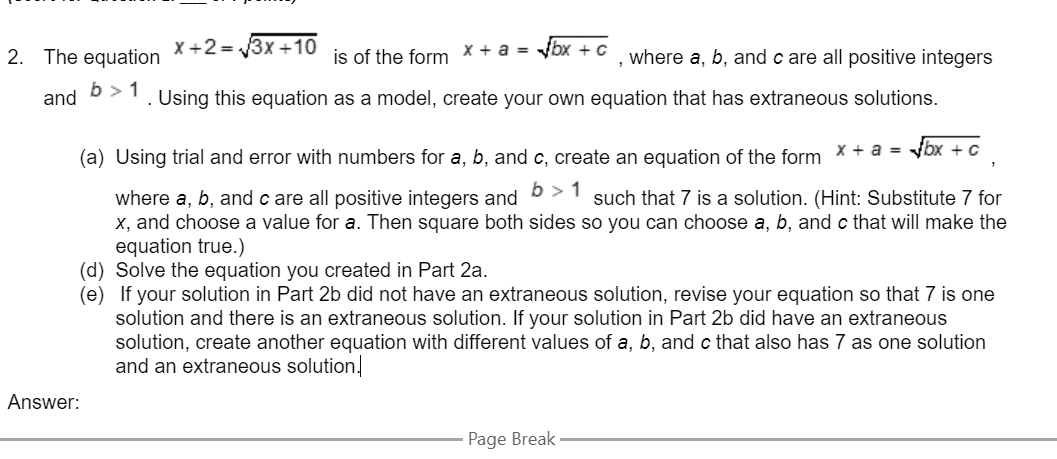
Equation of the form x+a=√(bx+c)

  • Context: MHB 
  • Thread starter Thread starter jennyyyyyy
  • Start date Start date
  • Tags Tags
    Form
Click For Summary
SUMMARY

The discussion revolves around solving the equation of the form x + a = √(bx + c). Initially, for x = 7 and a = 2, participants determine that b = 2 and c = 67, leading to the equation x + 2 = √(2x + 67). The solution process involves squaring both sides, resulting in the quadratic equation x² + 2x - 63 = 0. The final solutions derived are x = 7 and x = -9, confirming the correctness of the approach taken.

PREREQUISITES
  • Understanding of algebraic equations
  • Familiarity with square roots and squaring both sides of an equation
  • Knowledge of solving quadratic equations
  • Basic skills in manipulating algebraic expressions
NEXT STEPS
  • Study the quadratic formula for solving equations of the form ax² + bx + c = 0
  • Learn about the properties of square roots and their implications in equations
  • Explore methods for factoring quadratic equations
  • Investigate real-world applications of quadratic equations in physics and engineering
USEFUL FOR

Students learning algebra, educators teaching quadratic equations, and anyone interested in enhancing their problem-solving skills in mathematics.

jennyyyyyy
Messages
4
Reaction score
0
i have been stuck
Screenshot (242).png
this problem for a few days now. could somebody help me please?
 
Mathematics news on Phys.org
Hi Jenny! Welcome to MHB!

For part a, let's say for $x=7$ and we set $a=2$, we know $\sqrt{bx+c}$ must be in the form $\sqrt{81}$ so that $7+2=9=\sqrt{81}$.

Since $b>1$, we can let $b$ to be a small positive number, says, $b=2$. The value of $c$ can be found out by doing the following:

$\begin{align*}2(7)+c&=81\\14+c&=81\\ \therefore c &=81-14\\&=67\end{align*}$

Can you answer part b of the question if the equation we just set up is $x+2=\sqrt{2x+67}$?

Don't worry, we can guide you through all parts of the problem, just that we need to work together so you can understand the problem better, okay?
 
anemone said:
Hi Jenny! Welcome to MHB!

For part a, let's say for $x=7$ and we set $a=2$, we know $\sqrt{bx+c}$ must be in the form $\sqrt{81}$ so that $7+2=9=\sqrt{81}$.

Since $b>1$, we can let $b$ to be a small positive number, says, $b=2$. The value of $c$ can be found out by doing the following:

$\begin{align*}2(7)+c&=81\\14+c\\&=81\\ \therefore c\\&=81-14\\&=67\end{align*}$

Can you answer part b of the question if the equation we just set up is $x+2=\sqrt{2x+67}$?

Don't worry, we can guide you through all parts of the problem, just that we need to work together so you can understand the problem better, okay?
thank you so much! we just need to do the same step as a right?
 
Not really, solving means you need to solve for the value(s) of $x$, based on the values of $a,\,b$ and $c$ we got...

Can you solve $x+2=\sqrt{2x+67}$? You need to square both sides of the equation for a start...
 
anemone said:
Hi Jenny! Welcome to MHB!

For part a, let's say for $x=7$ and we set $a=2$, we know $\sqrt{bx+c}$ must be in the form $\sqrt{81}$ so that $7+2=9=\sqrt{81}$.

Since $b>1$, we can let $b$ to be a small positive number, says, $b=2$. The value of $c$ can be found out by doing the following:

$\begin{align*}2(7)+c&=81\\14+c\\&=81\\ \therefore c\\&=81-14\\&=67\end{align*}$

Can you answer part b of the question if the equation we just set up is $x+2=\sqrt{2x+67}$?

Don't worry, we can guide you through all parts of the problem, just that we need to work together so you can understand the problem better, okay?
wait wait, i get it. sorry, i got confused a bit xD
(x+2)^2 = (√ 2x+67)^2
x^2 + 4x +4 = 2x+67
is it correct so far?
 
Well done!

What would you do next?
 
anemone said:
Well done!

What would you do next?

(x+2)^2 = (√ 2x+67)^2
x^2 + 4x +4 = 2x+67
X^2 + 4x + 4 – 67 = 2x+67 –67
X^2+ 4x – 63 = 2x
X^2 + 4x – 63 – 2x = 2x – 2x
X^2 +2x – 63 = 0
X^2 + 9x – 7x – 63 = 0
X(x+9)-7(x+9)=0
(x+9) = 0
X-7= 0
X=-9
X=7

i solved it. i don't know if this correct though
 
Very good job! So, that is the answer for part b of the problem.

Moving on to part c, can you answer it now?
 

Similar threads

  • · Replies 2 ·
Replies
2
Views
1K
  • · Replies 9 ·
Replies
9
Views
2K
  • · Replies 3 ·
Replies
3
Views
2K
  • · Replies 6 ·
Replies
6
Views
2K
  • · Replies 6 ·
Replies
6
Views
2K
  • · Replies 1 ·
Replies
1
Views
2K
  • · Replies 1 ·
Replies
1
Views
1K
  • · Replies 3 ·
Replies
3
Views
952
  • · Replies 5 ·
Replies
5
Views
2K
  • · Replies 2 ·
Replies
2
Views
2K