Equation to find an unknown point on a graph

  • Context:
  • Thread starter Thread starter Jazoar
  • Start date Start date
  • Tags Tags
    Graph Point
Join the discussion
Ask a follow-up here, or get your own question answered by working scientists, mathematicians and engineers — people, not an autocomplete.
Real named experts · corrections over time · the nuance an AI answer skips
1 reply · 2K views
Jazoar
Messages
1
Reaction score
0
Hi All,

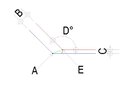
I need help to find an equation that will give me the location of 'E' in the image below.

'A' is the starting point on a graph.

All values from 'B' to 'D' are known values.

Currently, 'B' = 50, 'C' = 20, & 'D' = 135° - but I need an equation that will find 'E' no matter what these values are.

View attachment 7931

Any help would be greatly appreciated!

- Jazoar
 

Attachments
  • Math Problem.JPG
    Math Problem.JPG
    13.8 KB · Views: 151
Mathematics news on Phys.org
Jazoar said:
Hi All,

I need help to find an equation that will give me the location of 'E' in the image below.

'A' is the starting point on a graph.

All values from 'B' to 'D' are known values.

Currently, 'B' = 50, 'C' = 20, & 'D' = 135° - but I need an equation that will find 'E' no matter what these values are.
Any help would be greatly appreciated!

- Jazoar
Hi Jazoar, and welcome to MHB!

I found your diagram difficult to follow, because the letters A, B, C, D and E are being used to describe different things. If I understand it correctly, A and E are points, B and C are distances, and D is an angle. So I shall change the notation, keeping $A$ and $E$ as points but writing the distances as $b$ and $c$, and the angle as $\delta.$

I think the easiest way to solve the problem is to use coordinate geometry, taking $A$ as the origin, and the horizontal blue line as the $x$-axis. The horizontal red line then has the equation $y=c$, and the sloping red line has equation $-y\cos\delta + x\sin\delta = b.$ Those two lines meet at the point $E$, whose coordinates are $\left(\frac{b+c\cos\delta}{\sin\delta},c\right).$

From that, you can calculate that the distance from $A$ to $E$ is $$\frac{\sqrt{b^2+c^2 + 2bc\cos\delta}}{\sin\delta},$$ and if the line $AE$ makes an angle $\theta$ with the horizontal then $\theta$ is given by $$\tan\theta = \frac{c\sin\delta}{b+c\cos\delta}.$$ In the case when $b=50$, $c=20$ and $\delta = 135^\circ$, those formulas give $AE \approx 54.5$ and $\theta \approx 21.5^\circ.$
 
Last edited: