MHB Equivalence Relations: Solving & Proving Reflexivity, Symmetry & Transitivity

Click For Summary
SUMMARY

The discussion centers on proving that two specific relations are equivalence relations by demonstrating reflexivity, symmetry, and transitivity. The first relation, defined by \( mEn \) where \( 4|m - n \), is shown to be reflexive and symmetric, with transitivity established through integer manipulation. The second relation, \( mRn \) where \( 2|7m - 5n \), is similarly proven reflexive and symmetric, with transitivity confirmed by analyzing the parities of \( m \) and \( n \). Participants provided detailed proofs and guidance on how to approach these properties effectively.

PREREQUISITES
  • Understanding of equivalence relations in mathematics
  • Familiarity with reflexivity, symmetry, and transitivity properties
  • Basic knowledge of integer divisibility and parity
  • Ability to manipulate algebraic expressions
NEXT STEPS
  • Study the formal definitions of equivalence relations in set theory
  • Learn how to prove symmetry and transitivity in mathematical relations
  • Explore examples of equivalence classes and their applications
  • Practice problems involving divisibility and parity in algebraic contexts
USEFUL FOR

Students of mathematics, educators teaching abstract algebra, and anyone interested in understanding equivalence relations and their properties.

Lancelot1
Messages
26
Reaction score
0
Dear All,

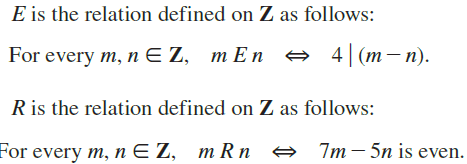
I am trying to solve the attached two questions.

In both I need to determine if the relation is an equivalence relation, to prove it if so, and to find the equivalence classes.

In both cases it is an equivalence relation, and I managed to prove both relations are reflexive. Now I am with symmetry and transitivity. In the first case, it is obviously symmetric, but how do I prove it ? Same for the second relation, I find it hard to prove and also to prove transitivity.
1659787389283.png


For reflexivity, m-m = 0 which is dividable by 4. Also 7m-5m=2m, which is dividable by 2 and therefore even.

Thank you !
 
Physics news on Phys.org
Lancelot said:
Dear All,

I am trying to solve the attached two questions.

In both I need to determine if the relation is an equivalence relation, to prove it if so, and to find the equivalence classes.

In both cases it is an equivalence relation, and I managed to prove both relations are reflexive. Now I am with symmetry and transitivity. In the first case, it is obviously symmetric, but how do I prove it ? Same for the second relation, I find it hard to prove and also to prove transitivity.

View attachment 11885

For reflexivity, m-m = 0 which is dividable by 4. Also 7m-5m=2m, which is dividable by 2 and therefore even.

Thank you !
Some pointers.

For the first problem. Look at it this way. If mEn then 4|m - n. That means m - n = 4k, where k is some integer. If this is true then can you find such a k' for n - m? Any integer k' will do. Transitivity works on the same model.

For the second we have a similar idea. If mRn then 2|7m - 5n. So 7m - 5n = 2k. What can we say about the parities of m and n here? (ie. are they odd/even?) When this is true what can we say about 7n - 5m? Transitivity here isn't too bad. If we have mRn and nRp then we know that 7m - 5n = 2j and 7n - 5p = 2k. So again, what is the parity of m and n? Of n and p? So then what are the parities of m and p? So then what can we say about 7m - 5p?

Give it a go and if you are still having problems come back and show us what you've been able to do with it.

-Dan
 
Yes, you have shown that both are 'reflexive', mEm and mRm.

An "equivalence relation" must also be symmetric. We need to show that "if mEn then nEm" and "if mRn the nRm".
If mEn then 4 divides m- n so m- n= 4k for some integer k. Now n- m= -(m- n)= -4k= 4j where j=-k.
If mRn 7m- 5n is even so 7m- 5n= 2k for some integer k. 7m= 2k- 5n so that 7n- 5m= (7m- 5n)- (12m- 2n)= 2k- 2(6m- n)= 2(k- 6m+ n) an even number.

An "equivalence relation" must also be "transitive"- if mEn and nEp then mEp and if mRn and nRp then mRp.
If mEn then 4 divides m- n so m- n= 4k for some integer k.
If nEp then 4 divides n- p so n- p= 4k' for some integer k'.
m- p= (m- n)- (n- p)= 4k- 4k'= 4(k- k) so 4 divides m- p.

If mRn then 7m- 5n= 2k for some integer k.
If nRp then 7n- 5p= 2k' for some integer k'.
7m- 5p= (7m- 5n)+ (7n- 5p)- 2n= 2k+ 2k'- 2n= 2(k+ k'- 1) so is even.
 

Similar threads

  • · Replies 2 ·
Replies
2
Views
2K
  • · Replies 10 ·
Replies
10
Views
2K
Replies
1
Views
2K
  • · Replies 1 ·
Replies
1
Views
1K
Replies
3
Views
3K
  • · Replies 7 ·
Replies
7
Views
1K
Replies
3
Views
2K
  • · Replies 1 ·
Replies
1
Views
2K
  • · Replies 1 ·
Replies
1
Views
2K
Replies
3
Views
2K