Estimating oil molecule diameter

Join the discussion
Ask a follow-up here, or get your own question answered by working scientists, mathematicians and engineers — people, not an autocomplete.
Real named experts · corrections over time · the nuance an AI answer skips
6 replies · 2K views
Bolter
Messages
262
Reaction score
31
Homework Statement
Working out an estimation of molecule's diameter
Relevant Equations
V = 4/3*pi*r^3
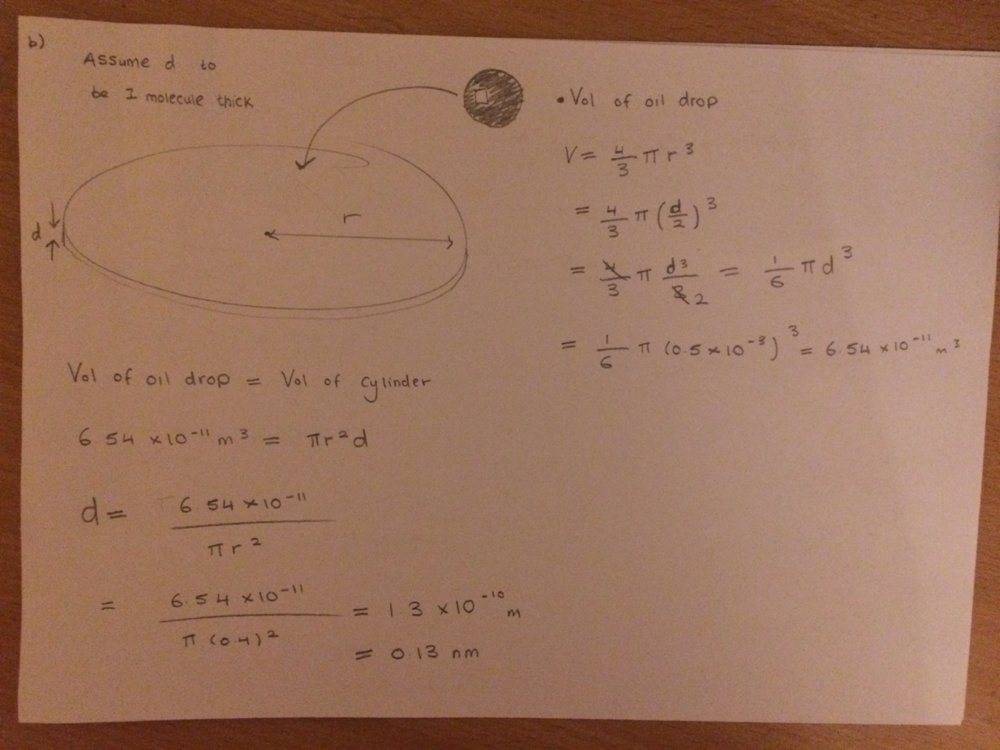
Can anyone help me in what assumptions I can make and how to justify them for when working out diameter of the molecule in part b) of this question? You can see the method that I have used in my workings but how would I explain it in words?

I obtained the diameter to be 0.13 nano metres which seems like a sensible length for a molecules diameter?
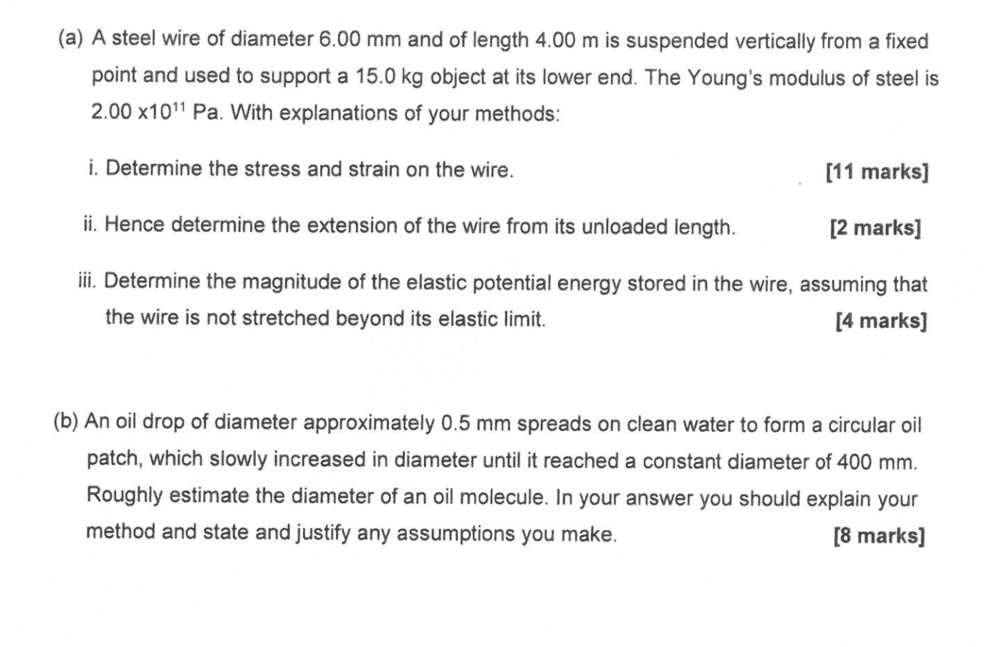
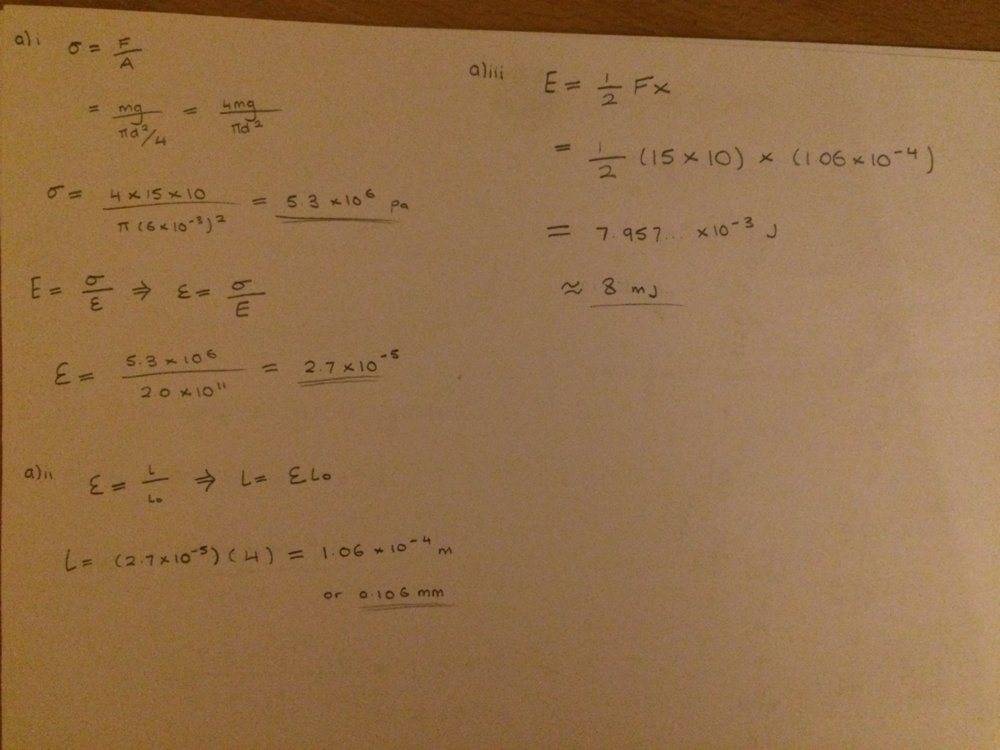
Screenshot 2019-12-21 at 21.51.25.png


IMG_3539.JPG


IMG_3540.JPG


Thanks for any help! :)
 
Physics news on Phys.org
How did you arrive at the radius of the cylinder being 0.4 (presumably meters)?

1576969893051.png
 
gneill said:
How did you arrive at the radius of the cylinder being 0.4 (presumably meters)?

View attachment 254528

I made a silly mistake and used the diameter's length in metres and not the radius length. So it should have read 0.2m instead.

I have changed from 0.4 to 0.2 and get the thickness of d to be 0.521 nano metres now

IMG_3541.JPG
 
gneill said:
Yes, that looks better!

Ok so the only assumption that I have made in this problem is that the cylinder thickness is 1 molecule's diameter thick. How do I justify such an assumption?
 
Bolter said:
Ok so the only assumption that I have made in this problem is that the cylinder thickness is 1 molecule's diameter thick. How do I justify such an assumption?
Perhaps look into surface tension.
 
gneill said:
Perhaps look into surface tension.

Possibly.
I think I'll need to look into that more myself before I make my own justification as I'm a bit hazy over that. But thank you :)
 
  • Like
Likes   Reactions: gneill