Even with a whimsical mathematical usage, solutions are obtained!

5 replies · 2K views · last reply
Z-10-46
Messages
1
Reaction score
0
TL;DR
Even with a whimsical mathematical usage, coherent solutions are obtained!
Hello everyone,
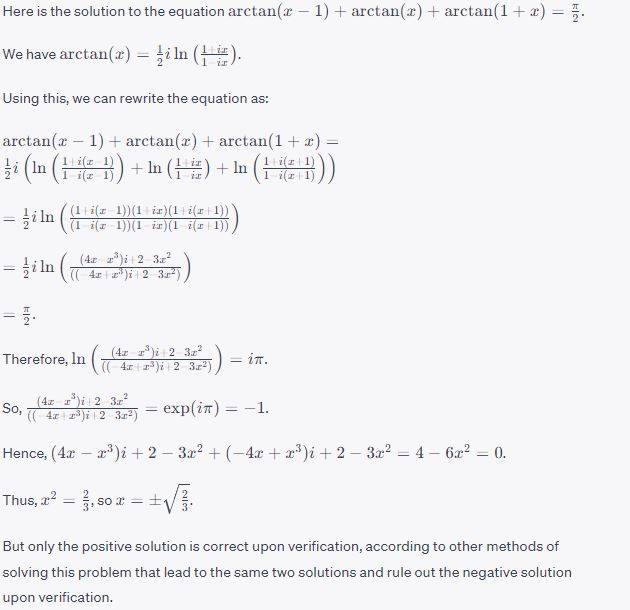
Handwritten-style typeset derivation solving arctan(x-1) + arctan(x) + arctan(1+x) = pi/2 by rewriting each arctan as (i/2) ln((1+ix)/(1-ix)), combining the logarithms, and arriving at x = ±sqrt(2/3).

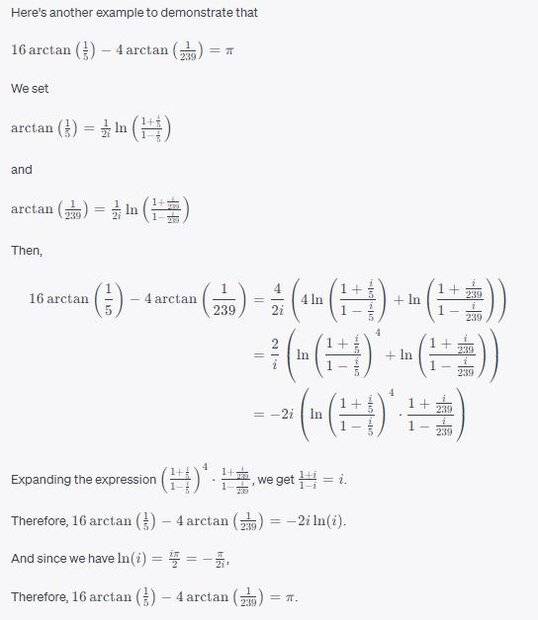
Handwritten-style typeset derivation showing 16 arctan(1/5) - 4 arctan(1/239) = pi, using arctan(x) = (1/2i) ln((1+ix)/(1-ix)) and combining logarithms to reach -2i ln(i) = pi.

Here, we observe that the familiar properties of the real logarithm hold true for the complex logarithm in these examples.

So why does a whimsical mathematical use of real logarithm properties yield coherent solutions even in the case of complex logarithm?
 
Attachments
  • Typeset equations showing the relativistic mass M = m0 / sqrt(1 - v^2/c^2) rewritten with v = c, leading to a divergent sum M = M1 + M2 + M3 + ... = infinity, followed by plain text notes.
    Vitesse de la lumiere 1.JPG
    55.9 KB · Views: 170
As long as you are dealing with analytic functions, the real function is just a restriction of the complex analytic function. Two analytic functions can only be identical on the real line if they are identical.
 
  • Like
Likes   Reactions: PeroK and fresh_42
FactChecker said:
As long as you are dealing with analytic functions, the real function is just a restriction of the complex analytic function. Two analytic functions can only be identical on the real line if they are identical.
The term analytical is very interesting. It is reserved for functions that have an expression as a series. And that was how mathematicians regarded all functions for a long time, as series.
 
fresh_42 said:
The term analytical is very interesting. It is reserved for functions that have an expression as a series. And that was how mathematicians regarded all functions for a long time, as series.
When I studied complex analysis, "analytical" and "holomorphic" were assumed to mean more or less the same thing.
 
Svein said:
When I studied complex analysis, "analytical" and "holomorphic" were assumed to mean more or less the same thing.
Isn't that still the case?
 
fresh_42 said:
Isn't that still the case?
I certainly hope so. But the definition used to be "functions that satisfy the Cauchy-Riemann equations".