Expectation Values and Operators

Click For Summary

Discussion Overview

The discussion revolves around the calculation of expectation values in quantum mechanics, specifically using a linear combination of wavefunctions and an operator. Participants explore the mathematical steps involved in substituting wavefunctions into the integral for expectation values, addressing LaTeX formatting issues and clarifying notation.

Discussion Character

  • Technical explanation
  • Mathematical reasoning
  • Homework-related

Main Points Raised

  • One participant requests a step-by-step guide for calculating expectation values using a specific wavefunction and operator.
  • Another participant suggests substituting the entire wavefunction and its conjugate into the integral without multiplying out the products initially.
  • There are discussions about the correct representation of subscripts in LaTeX and how to format equations properly.
  • Participants clarify that the expectation value can be expressed as an integral involving the wavefunctions and the operator.
  • One participant emphasizes the importance of using different indices for summation to avoid confusion.
  • Another participant notes the elegance of using the absolute value of complex conjugates in the calculations.
  • There is a discussion about the representation of eigenvalues associated with the operator and their relation to the wavefunctions.

Areas of Agreement / Disagreement

Participants generally agree on the steps to calculate expectation values, but there are variations in notation and some uncertainty regarding the simplification of expressions. The discussion remains unresolved on certain aspects of the mathematical steps and notation.

Contextual Notes

Participants express confusion over specific mathematical steps and LaTeX formatting, indicating that some assumptions about notation and simplification may not be universally understood.

Nezva
Messages
46
Reaction score
0
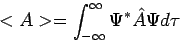
I've never seen an expectation value taken and would greatly appreciate seeing a step by step of how it is done. Feel free to use any wavefunction, this is the one I've been trying to do:

In the case of \Psi=c1\Psi1+ c2\Psi2+ ... + cn\Psin

And the operator A(hat) => A(hat)\Psi1 = a1\Psi1; A(hat)\Psi2 = a2\Psi2; A(hat)\Psin = an\Psin

Calculate: \left\langle\Psi\left|A(hat)\right|\right\Psi\rangle

img286.png
 
Physics news on Phys.org
First step: substitute your formula for \Psi into the integral, for \Psi^* as well as for \Psi. Don't multiply out the "products" yet. Use parentheses to keep things together.
 
\int c*n\Psin\left| A(hat) \right| cn\Psin

I'm having trouble putting subscript into the LaTex format, is there a way to do this without breaking pup the tex formatting?
 
c^*_n gives you c^*_n
 
Nezva said:
\int c*n\Psin\left| A(hat) \right| cn\Psin

You didn't substitute the entire \Psi^* and \Psi:

\Psi = c_1 \Psi_1 + c_2 \Psi_2 + \ldots + c_n \Psi_n

\Psi^* = c_1^* \Psi_1^* + c_2^* \Psi_2^* + \ldots + c_n^* \Psi_n^*

Like I said, use parentheses as necessary.

By the way, you can see the LaTeX code for an equation by clicking on it. (I use a Mac, so I don't know whether it's left-click or right-click under Windows.) Here's your original integral to use as a model:

\langle A \rangle = \int^{+\infty}_{-\infty} {\Psi^* \hat A \Psi d\tau}
 
Last edited:
What do you mean by substitute the 'entire' \Psi and \Psi*, simply that I didn't denote the first wavefunction with asterisks fully? Or do you mean literally put in c21, c2, c3, etc.?

Anyways here was an attempt at this.

\int(c^*_n\Psi^*_n\hat A)(\hat Ac_n\Psi_n)

c^*_n c_n\int(a^*_n\Psi^*_n)(a_n\Psi_n)

c^*_n c_n a^*_n a_n\int(\Psi^*_n)(\Psi_n)

The constants don't pull through like that but how do I simplify this equation? I'm so lost on this.
 
Nezva said:
What do you mean by substitute the 'entire' \Psi and \Psi*

I mean "replace \Psi with c_1 \Psi_1 + c_2 \Psi_2 + \ldots + c_n \Psi_n" and similarly for \Psi^*. Like this:

\langle A \rangle = \int^{+\infty}_{-\infty} {\Psi^* \hat A \Psi d\tau}

\langle A \rangle = \int^{+\infty}_{-\infty}<br /> {(c_1^* \Psi_1^* + c_2^* \Psi_2^* + \ldots + c_n^* \Psi_n^*) \hat A (c_1 \Psi_1 + c_2 \Psi_2 + \ldots + c_n \Psi_n) d\tau}

Now move the operator \hat A inside the parentheses on the right, and apply it to each term in the sum.
 
You should use two different letters for the indices since there are two different sums. And I don't know where that extra A came from in your last post.

\langle A\rangle_\psi=\langle \psi,A\psi\rangle=\langle\sum_n c_n\psi_n,A\sum_m c_m \psi_m\rangle=\sum_n\sum_m c_n^*c_m\langle\psi_n,A\psi_m\rangle

=\sum_n\sum_m c_n^*c_m a_m\langle\psi_n,\psi_m\rangle=\sum_n|c_n|^2 a_n

D'oh, I'm too slow. Jtbell beat me too it, but now at least you get to see it in a different notation.
 
Thank you both for the contrasting notations. Is there anything I can do to return the help?

=\sum_n\sum_m c_n^*c_m a_m\langle\psi_n,\psi_m\rangle=\sum_n|c_n|^2 a_n


Very elegant. The absolute value of the complex conjugates is a clever touch. I've not used complex number enough to recognize to do that.

The an is still representing the eigenvalues of the A operator, am, right? You simply changed the notation to show that it is the same as if the operator were applied to the \psi_n ?
 
Last edited:
  • #10
Nezva said:
The an is still representing the eigenvalues of the A operator, am, right?
Yes, I skipped a step or two. It's \langle\psi_n,A\psi_m\rangle=\langle\psi_n,a_m\psi_m\rangle=A_m\langle\psi_n,\psi_m\rangle=A_m\delta_{nm}.
 

Similar threads

  • · Replies 2 ·
Replies
2
Views
2K
  • · Replies 8 ·
Replies
8
Views
2K
  • · Replies 10 ·
Replies
10
Views
2K
  • · Replies 15 ·
Replies
15
Views
2K
  • · Replies 13 ·
Replies
13
Views
3K
  • · Replies 6 ·
Replies
6
Views
2K
  • · Replies 4 ·
Replies
4
Views
2K
  • · Replies 14 ·
Replies
14
Views
3K
  • · Replies 21 ·
Replies
21
Views
4K
  • · Replies 11 ·
Replies
11
Views
3K