Explanation from Part of Griffith's text (Differential Equation)

Click For Summary
The discussion focuses on solving a second-order ordinary differential equation (ODE) related to the harmonic oscillator as presented in Griffith's text. The suggested approach involves using an "ansatz" or educated guess to find an approximate solution, particularly for large values of the variable ξ. The ladder operator formalism is highlighted as a more intuitive method for solving the harmonic oscillator, often preferred over the analytic method. Participants note that while the analytic approach can be complex, the Gaussian function is a logical starting point for finding solutions due to its properties. Overall, the conversation emphasizes the importance of understanding both methods for a comprehensive grasp of the topic.
tylerscott
Messages
28
Reaction score
0
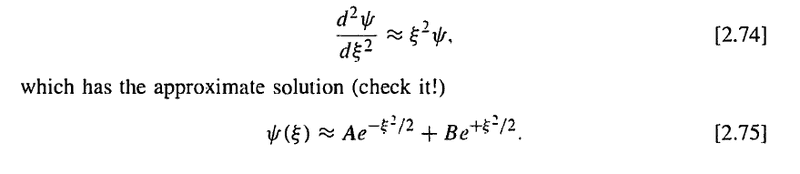
This is from section 2.3 in Griffith's book on the harmonic oscillator, and apparently this differential equation should be obvious (to move on in my reading, I need to understand this first). I'm not quite sure how to solve a second order ODE without constant coefficients, so help to get to the given solution of the equation would be more than welcome.
Here is a grab of it:
ZhjKN.png
 
Physics news on Phys.org
Oftentimes, the best way to solve these sorts of equations is just by the time-honored technique of taking an informed guess (a procedure which you justify by giving it the official-sounding name of "ansatz" :smile:), and then checking whether it works. In this case, it's fairly straightforward to check that

\frac{d^2}{d\xi^2} (A e^{-\xi^2/2} + B e^{\xi^2/2}) = A(\xi^2-1)e^{-\xi^2/2} + B(\xi^2+1)e^{\xi^2/2}

Which is an approximate solution to the equation as long as \xi is large.

P.S. I wouldn't worry too much about this approximate solution for anything past a general characterization of the solutions. You're almost certainly going to turn around in the very next section and redo the whole problem using the ladder operator formalism, which allows you to convert the problem into a much simpler first-order equation that you can solve exactly.
 
Last edited:
Actually, Griffiths solves the harmonic oscillator using the algebraic method (ladder operators) first, before describing the analytic method that is being discussed here. Unless he's switched them around for the second edition; I have only the first edition at hand.
 
jtbell said:
Actually, Griffiths solves the harmonic oscillator using the algebraic method (ladder operators) first, before describing the analytic method that is being discussed here. Unless he's switched them around for the second edition; I have only the first edition at hand.

Yeah, you're correct. The ladder operator formalism makes more sense to me than the analytic method.
 
Ah, my bad. I've actually never read Griffiths (blasphemy, I know!) Most of the texts I've seen have started with the analytic method, slogged through it for a while, and then gone "man, that was hard. Hey, let's check out these nifty ladder operators instead--isn't that nicer?"

In any case, since you're only calculating an approximation here, it's difficult to provide any hard and fast rules about how to come up with solutions to the equation. Intuitively, though, you know that the harmonic oscillator is a potential well, so you know the solution is going to be some sort of peaked waveform. The simplest peaked waveform which still tends towards 0 at infinity (so that it's normalizable) is the Gaussian, so something with that form is a logical place to start. Then you just plug it in, and see if it works.
 
Ok, that makes sense. Thanks
 
Time reversal invariant Hamiltonians must satisfy ##[H,\Theta]=0## where ##\Theta## is time reversal operator. However, in some texts (for example see Many-body Quantum Theory in Condensed Matter Physics an introduction, HENRIK BRUUS and KARSTEN FLENSBERG, Corrected version: 14 January 2016, section 7.1.4) the time reversal invariant condition is introduced as ##H=H^*##. How these two conditions are identical?

Similar threads

  • · Replies 5 ·
Replies
5
Views
2K
  • · Replies 1 ·
Replies
1
Views
1K
  • · Replies 3 ·
Replies
3
Views
1K
  • · Replies 3 ·
Replies
3
Views
1K
Replies
1
Views
2K
  • · Replies 8 ·
Replies
8
Views
2K
  • · Replies 32 ·
2
Replies
32
Views
2K
  • · Replies 8 ·
Replies
8
Views
2K
  • · Replies 2 ·
Replies
2
Views
4K
  • · Replies 1 ·
Replies
1
Views
1K