Extended Faraday Disk: How is Energy Conserved?

  • Context: Graduate 
  • Thread starter Thread starter Samson4
  • Start date Start date
  • Tags Tags
    Disk Faraday
Join the discussion
Ask a follow-up here, or get your own question answered by working scientists, mathematicians and engineers — people, not an autocomplete.
Real named experts · corrections over time · the nuance an AI answer skips
7 replies · 2K views
Samson4
Messages
242
Reaction score
15
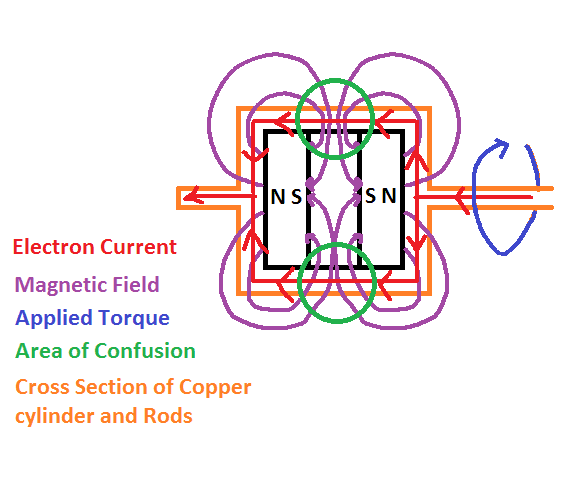
In the diagram, I am focusing on the area in the green circle.
So this is basically 2 Faraday disk with the magnets opposing and concealed in a copper cylinder. Now if we spin the cylinder a current is generated such as the current following the red arrows.

My Confusion: As the current passes between the magnets, a torque is also produced. The force should be in the same direction as the torque that created the current. Seeing as how most of the lines of flux coming from the north face of the magnets are parallel to the cylinder walls and perpendicular to the disks; shouldn't there be a current generated and a torque. How is energy conserved?
Question.png
 
Physics news on Phys.org
You have closed the “purple” magnetic circuit, but not the “red” electron current circuit.
I can see no path for the current to close the loop, so a voltage will be generated without current.
Are you sure you have the correct magnet polarity?
 
Baluncore said:
You have closed the “purple” magnetic circuit, but not the “red” electron current circuit.
I can see no path for the current to close the loop, so a voltage will be generated without current.
Are you sure you have the correct magnet polarity?

It would have brushes just like a regular faraday disk. I didn't want to add anymore junk to such a mess of color. A brush would be present on the rods on both sides of the cylinder.
 
Any purple flux that passes through a copper disk must also pass back through the copper cylinder.
Will all axial currents not cancel to zero?
The copper is never subjected to a changing magnetic flux since the field and copper are axially symmetrical.
 
There is a counter torque, because the electrons that form the current feel a Lorentz force, and then somehow that force is transmitted to the whole disk. Maybe the force is transmitted by resistance. Does Faraday disk work if the disk is superconducting?
 
Baluncore said:
Any purple flux that passes through a copper disk must also pass back through the copper cylinder.
Will all axial currents not cancel to zero?
The copper is never subjected to a changing magnetic flux since the field and copper are axially symmetrical.

So far that's the only solution I can think of. So there should be no current flow from 1 rod to the other.
I don't understand what you mean with the second part of your post.
 
jartsa said:
There is a counter torque, because the electrons that form the current feel a Lorentz force, and then somehow that force is transmitted to the whole disk. Maybe the force is transmitted by resistance. Does Faraday disk work if the disk is superconducting?

If torque is generated it does not oppose the applied torque.
 
On a related note, which path do you think the electrons will follow in this image? All the blocks are the same conductive material. The black circles are connections at a dc power source.
path.png