swissgirl1999 Refer
- 20
- 6
- TL;DR
- Simple experiments about the volume expansion of freezing water inside different materials — why plastic containers can change the intrinsic water's chemistry mediated volume expansion of ice formation?
The standard physical chemistry and thermodynamics literature states that water expands upon freezing due to the crystalline structure of ice (hexagonal ice I_h), which occupies approximately 9% more volume than liquid water at the same mass. This expansion is treated as an intrinsic property of the water molecule's phase transition, independent of the container material.
As stated in typical references:
The density of liquid water at 0°C is approximately 999.8 kg/m³.
The density of ice at 0°C is approximately 916.8 kg/m³.
This density difference corresponds to a volume increase of about 9.05% upon freezing. The crystallization pressure of ice is approximately 300 atm (about 30 MPa), which is why it can shatter glass and deform metal containers. These values are presented as universal constants for pure water, independent of the container material. The phase transition is described as a property of the water itself, not of the water-container system.
So far so good — nothing out of the ordinary yet.
My curiosity began after I had forgotten a full plastic bottle of water in the freezer and noticed that instead of the expected increase in volume, it had shrunk.
So I decided to run some simple experiments.
First, I tragically lost my copper bottle, which I had left half-full and open, the same way I did with the glass bottle, which I assumed would break anyway. Even with the cap open and only half-full, the glass broke and the copper was torn, while the plastic bottle — with its cap on — collapsed inward during freezing, giving the appearance that the water/ice system occupied less external volume than before.
One might think that the air inside the plastic bottle shrank, but where it really shrank was exactly where the ice was (as in the picture below):
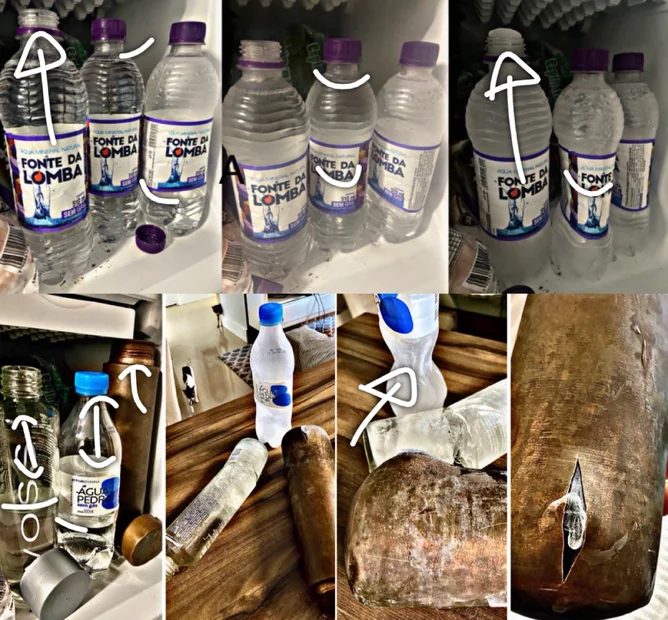
One might also think that the ice forms on top first and then the rest of the ice formation can't push the already-formed ice upward. However, that's not the case inside the plastic bottle: in this case, the ice pushes the already-formed ice upward and still cannot deform the plastic bottle (as in the picture above).
One might also think that the plastic is more elastic, so it does not tear due to deformation. However, the plastic does not deform by expanding its volume — it shrinks.
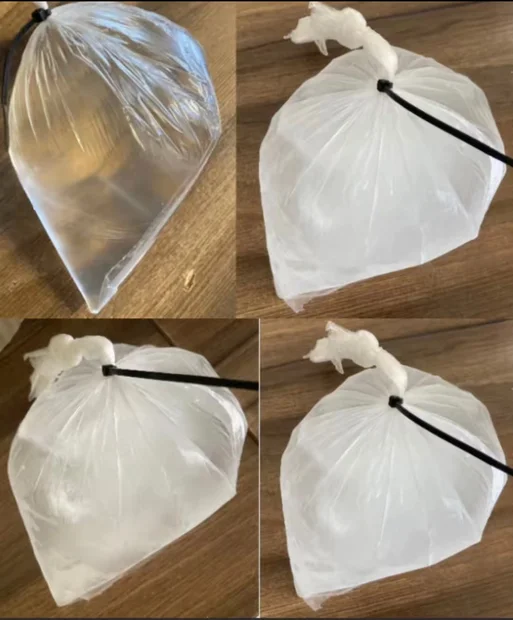
So I took the most fragile plastic bag I could find, filled it to capacity with water, and sealed it with a cable tie, with no air left inside (as in the picture below).
The volume of the water shrank and kept shrinking over the days.
While examining the frozen plastic bottle, I noticed something else that seemed unusual: even gas bubbles inside the plastic bottle did not disappear upon freezing (as in the picture below).
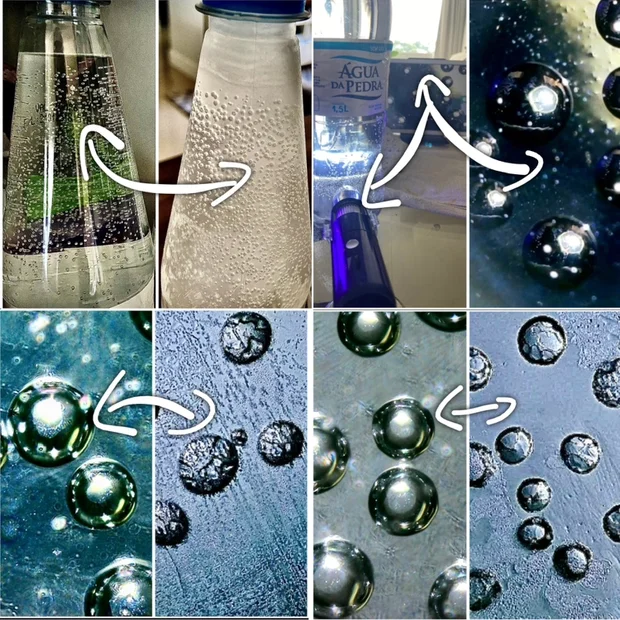
To better understand what was happening inside the ice, I examined them under a microscope, using only refracted light (as in the picture above).
Before freezing, they appeared to have internal structure; after freezing, the internal structures appeared fractured (as in the picture above).
If the volume expansion of ice formation is intrinsic to the water's chemistry, why does it behave differently inside plastic containers?
A final reminder to whom might think these experiments lack rigorous control — the only really important variable here is the discrepancy in behave of water freezing inside plastic containers.
Anyone curious enough has only to put a plastic bag and/or bottle of water to freeze and see for yourself, which I strongly recommend in doing so before dismissing the question.
Thanks in advance.
As stated in typical references:
The density of liquid water at 0°C is approximately 999.8 kg/m³.
The density of ice at 0°C is approximately 916.8 kg/m³.
This density difference corresponds to a volume increase of about 9.05% upon freezing. The crystallization pressure of ice is approximately 300 atm (about 30 MPa), which is why it can shatter glass and deform metal containers. These values are presented as universal constants for pure water, independent of the container material. The phase transition is described as a property of the water itself, not of the water-container system.
So far so good — nothing out of the ordinary yet.
My curiosity began after I had forgotten a full plastic bottle of water in the freezer and noticed that instead of the expected increase in volume, it had shrunk.
So I decided to run some simple experiments.
First, I tragically lost my copper bottle, which I had left half-full and open, the same way I did with the glass bottle, which I assumed would break anyway. Even with the cap open and only half-full, the glass broke and the copper was torn, while the plastic bottle — with its cap on — collapsed inward during freezing, giving the appearance that the water/ice system occupied less external volume than before.
One might think that the air inside the plastic bottle shrank, but where it really shrank was exactly where the ice was (as in the picture below):
One might also think that the ice forms on top first and then the rest of the ice formation can't push the already-formed ice upward. However, that's not the case inside the plastic bottle: in this case, the ice pushes the already-formed ice upward and still cannot deform the plastic bottle (as in the picture above).
One might also think that the plastic is more elastic, so it does not tear due to deformation. However, the plastic does not deform by expanding its volume — it shrinks.
So I took the most fragile plastic bag I could find, filled it to capacity with water, and sealed it with a cable tie, with no air left inside (as in the picture below).
The volume of the water shrank and kept shrinking over the days.
While examining the frozen plastic bottle, I noticed something else that seemed unusual: even gas bubbles inside the plastic bottle did not disappear upon freezing (as in the picture below).
To better understand what was happening inside the ice, I examined them under a microscope, using only refracted light (as in the picture above).
Before freezing, they appeared to have internal structure; after freezing, the internal structures appeared fractured (as in the picture above).
If the volume expansion of ice formation is intrinsic to the water's chemistry, why does it behave differently inside plastic containers?
A final reminder to whom might think these experiments lack rigorous control — the only really important variable here is the discrepancy in behave of water freezing inside plastic containers.
Anyone curious enough has only to put a plastic bag and/or bottle of water to freeze and see for yourself, which I strongly recommend in doing so before dismissing the question.
Thanks in advance.
Last edited: