Extending a transformation from a curve to the whole space

Click For Summary
SUMMARY

This discussion focuses on extending the deformation of a non-self-intersecting curve, represented as \vec{f}(s,t) in \Re^{3}, to a continuous transformation of the surrounding space, denoted as \vec{g}(\vec{x},t). The proposed method involves restricting the curve to straight line segments and utilizing a cubic lattice of grid points to ensure that each point's position averages the positions of its neighbors, thereby preventing overlaps. The transformation aims to solve "tanglement puzzles" by providing a general method for manipulating flexible loops of string. The discussion emphasizes the need for a construction method rather than merely proving existence.

PREREQUISITES
  • Understanding of vector calculus and transformations in \Re^{3}
  • Familiarity with cubic lattices and grid point averaging techniques
  • Knowledge of boundary conditions in mathematical modeling
  • Experience with numerical methods for solving differential equations, specifically the vector Laplace equation
NEXT STEPS
  • Research cubic lattice structures and their applications in spatial transformations
  • Study the vector Laplace equation and its numerical solutions
  • Explore methods for calculating Green's functions in various coordinate systems
  • Investigate linear interpolation techniques and their effectiveness in preventing overlaps in transformations
USEFUL FOR

Mathematicians, physicists, and computer scientists interested in geometric transformations, spatial modeling, and solving complex tanglement puzzles involving flexible structures.

maze
Messages
661
Reaction score
4
Supposing I have a curve, \vec{f}\left(s,t\right) that lives in \Re^{3} and is deforming over time but never intersecting itself (s is the curve parameter and t is time). I would like to extend the deformation of the curve to the entire space around the curve, creating a transformation of the whole space \vec{g}\left(\vec{x},t\right) that is continuous and doesn't overlap itself.

It would be fine to restrict the curve to a series of connected straight line segments, if that would make it easier.

If I can construct such a function, g, I believe I can use it to create a very general method of solving "tanglement puzzles", where the object is to remove a flexible loop of string from a metal contraption.

Here are some pictures that describe what I am taking about.
Here is the function I start with:
http://img381.imageshack.us/img381/1968/pathcurvingsmww1.png

and here is the function I want to construct:
http://img162.imageshack.us/img162/7487/pathcurvingcoordssmcz2.png

And here are a couple examples of "remove the string" tanglement puzzles:
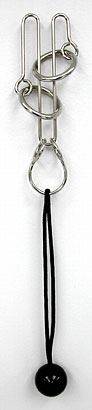
xtripwire_l.jpg

http://www.puzzles.ca/puzzle_data_3/xastroknot_l.jpg
 
Last edited by a moderator:
Mathematics news on Phys.org
There are an infinite number of ways of doing that. What additional restrictions do you want to add in order to make that problem unique?
 
Yes definitely, there are infinitely many legit possibilities for such transformations. Any will do, so long as I can construct it for any curve. I'm interested in a construction, not an existence proof! The simpler or easier to compute, the better.

I was running through some simple ideas such as linear interpolation with tetrahedra, distance weighting, and so forth, but my constructions keep having problems with overlapping for certain curves.
 
Ahh, I believe I may have a way to do this.

Restrict the curves in question to those that consist of straight line segments, as that is acceptable for my purposes. Next create a cubic lattice of gridpoints in the space. Then, using the curve and a bounding box as boundary conditions, force each grid point position to be the average of the position of all it's neighbors.

I think this should work, though I am not 100% sure and will need to prove it...
 
Last edited:
Or more generally where the curve isn't straight lines, g is given by the vector laplace equation in each coordinate, using the transform on the curve, f, as a boundary condition. Now I will need to review how to calculate greens functions numerically...
 

Similar threads

  • · Replies 20 ·
Replies
20
Views
2K
Replies
4
Views
2K
  • · Replies 6 ·
Replies
6
Views
5K
  • · Replies 2 ·
Replies
2
Views
3K
  • · Replies 27 ·
Replies
27
Views
4K
  • · Replies 1 ·
Replies
1
Views
3K
  • · Replies 4 ·
Replies
4
Views
3K
  • · Replies 1 ·
Replies
1
Views
2K
  • · Replies 17 ·
Replies
17
Views
4K
Replies
9
Views
2K