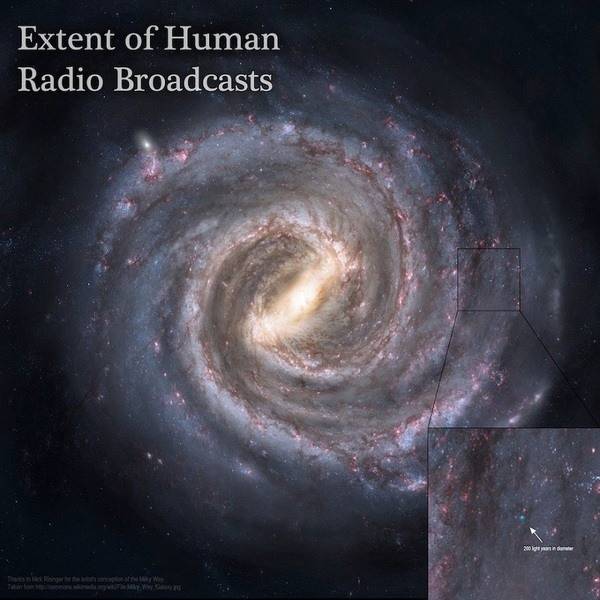
Extent of human radio broadcasts photo

Click For Summary

Discussion Overview

The discussion revolves around the extent of human radio broadcasts as depicted in a photo relative to the Milky Way Galaxy. Participants explore the representation of this extent, the implications of the distances involved, and the feasibility of capturing images of the Milky Way from various perspectives.

Discussion Character

  • Exploratory
  • Debate/contested
  • Conceptual clarification
  • Technical explanation

Main Points Raised

  • Some participants suggest that the extent of radio broadcasts should be represented as a sphere rather than a square, indicating a preference for a more accurate depiction.
  • There is confusion regarding the blue circle's representation, with some believing it indicates the extent of broadcasts while others argue it is merely highlighted by the square inset.
  • One participant clarifies that the blue dot in the inset photo represents the 200 light-year zone of radio transmissions from Earth, emphasizing its insignificance compared to the Milky Way's size.
  • Several participants humorously acknowledge the limitations of human radio broadcasts, noting that transmissions have not yet reached 200 light-years due to the relatively short history of radio technology.
  • Questions arise about the feasibility of capturing a direct image of the Milky Way, with some participants referencing concept art and discussing the challenges of obtaining such images from a specific angle.
  • There is speculation about the time it would take to send a probe to capture images of the Milky Way, with some participants expressing skepticism about current technology's capabilities.
  • Participants debate the practicality of achieving speeds necessary for intergalactic travel, with some suggesting that time dilation could allow for faster travel without exceeding the speed of light.
  • Concerns are raised about the limitations of current propulsion technologies, with references to ion drives and the challenges of reaching distant celestial bodies.

Areas of Agreement / Disagreement

Participants express a range of views on the representation of radio broadcast extent, the feasibility of capturing images of the Milky Way, and the practicality of advanced space travel technologies. No consensus is reached, and multiple competing perspectives remain throughout the discussion.

Contextual Notes

Participants highlight limitations in understanding the distances involved and the technological challenges of space exploration. There is an acknowledgment of the assumptions underlying discussions about speed and the capabilities of current technology.
MathJakob
Messages
161
Reaction score
5
Let me remind you all how small we are :D not that most of you need to be told :P
YGjfCJZ.jpg


Credit for the photo belongs to Nick Risinger. Website credits in the bottom left hand side of the picture.
 
Physics news on Phys.org
I'm sure the extent of our radio broadcasts should be shown as a circle (sphere, really) NOT a square, but it is interesting to see the extent relative to the Milky Way Galaxy.
 
phinds said:
I'm sure the extent of our radio broadcasts should be shown as a circle (sphere, really) NOT a square, but it is interesting to see the extent relative to the Milky Way Galaxy.
I thought the size of the blue circle *was* the extent and the box was just to highlight.
 
I think the rectangular inset in the lower RH corner is just a blow-up of the region indicated in the larger photo.
The 200 LY zone which would be the extent of radio transmissions from Earth is indicated by the arrow pointing at the light blue dot in the inset photo. The galaxy shown (which is an artist's conception of the Milky Way) would have a diameter on order of 100,000 LY, and 200 LY is a speck on a speck in this sand pile.
 
phinds said:
I'm sure the extent of our radio broadcasts should be shown as a circle (sphere, really) NOT a square, but it is interesting to see the extent relative to the Milky Way Galaxy.

How could you have missed that! Look at the blown up square, that little blue dot is the area, the square is just the blown up section
 
and of course our transmissions haven't gone 200 yl's yet. man hasn't been transmitting for 200 years quite yet LOL

Dave
 
evo said:
i thought the size of the blue circle *was* the extent and the box was just to highlight.

doh !
 
davenn said:
and of course our transmissions haven't gone 200 yl's yet. man hasn't been transmitting for 200 years quite yet LOL

Dave

The diameter of the circle is 200 LY, meaning the radius is 100 LY, more or less the age of radio and wireless transmission.
 
  • #10
davenn said:
and of course our transmissions haven't gone 200 yl's yet. man hasn't been transmitting for 200 years quite yet LOL

Dave
Yeah, so true. A bit of nonsense.
 
  • #11
SteamKing said:
The diameter of the circle is 200 LY, meaning the radius is 100 LY, more or less the age of radio and wireless transmission.

doh, yeah that's true ... just a "brain fart" haha :wink:
that didn't even occur to me at the time

Dave
 
  • #12
davenn said:
doh, yeah that's true ... just a "brain fart" haha :wink:
that didn't even occur to me at the time

Dave
shhhhh

I'm too tired, So I'm going with 200ly radius, cause I'm tired. :devil:

I don't care if it's wrong. (be quiet Steamking, we know you're right)
 
  • #13
davenn said:
and of course our transmissions haven't gone 200 yl's yet. man hasn't been transmitting for 200 years quite yet LOL
Radio came about concurrent with the pyramids, due to ancient aliens.
 
  • #14
I wonder how they took that picture of the milky way...
 
  • #15
micromass said:
I wonder how they took that picture of the milky way...

Are you serious?

read what's written in the lower left corner of the picture. It's just a concept art of the Milky Way.
 
  • #16
Abstr7ct said:
Are you serious?

read what's written in the lower left corner of the picture. It's just a concept art of the Milky Way.

Oh, that explains it! Thanks a lot for clearing that up!

But I do wonder why they would bother with some concept art when they just could have snapped a picture of the Milky Way...
 
Last edited:
  • #17
Well, they asked some guys in Andromeda to take a picture of the Milky Way, but the phone call to there takes 2 million years, and then you have to wait another 2 million years for the picture to return. The roaming charges for the call are astronomical. Then, when you print the picture, you are probably going to run out of black ink, so it's another hour to go to the store to get another ink cartridge, but they'll probably be out of your model and have to re-order. Since it was coming up against a deadline, they just chucked the whole thing into an artist's lap. Galaxies: seen one, seen them all.
 
  • #18
Is it even possible to get a direct picture picture of the Milky Way from that angle? I looked for an answer and found this link:

http://curious.astro.cornell.edu/question.php?number=435

It explains it well.
 
  • #19
Abstr7ct said:
Is it even possible to get a direct picture picture of the Milky Way from that angle? I looked for an answer and found this link:

http://curious.astro.cornell.edu/question.php?number=435

It explains it well.

Why couldn't we take a picture from that angle? I mean, we have all these probes which take highly accurate pictures of Jupiter, Saturn and other stars. Why couldn't we send out a probe that takes pictures of the Milky Way?
 
  • #20
With the current technology we have, how many years would it take to send a probe to reach that position given that the diameter of the Milky Way is hundred of thousands light years? Even if we are able to send a probe to a place outside our Milky Way, how would we be able to obtain a picture of the galaxy if our radio broadcast is only 200 light years in diameter according to the picture?
 
  • #21
Abstr7ct said:
With the current technology we have, how many years would it take to send a probe to reach that position given that the diameter of the Milky Way is hundred of thousands light years? Even if we are able to send a probe to a place outside our Milky Way, how would we be able to obtain a picture of the galaxy if our radio broadcast is only 200 light years in diameter according to the picture?

But our current technology is so advanced. I'm sure we can easily develop a probe that does that distance in a few years. How hard can it be?
 
  • #22
How is our technology so advanced given that Curiosity took 9 months to land on Jupiter and it's less than a light year away from earth? we talk about hundred of thousands light years away to have a full picture of the Milky Way.
 
  • #23
Abstr7ct said:
How is our technology so advanced given that Curiosity took 9 months to land on Jupiter and it's less than a light year away from earth? we talk about hundred of thousands light years away to have a full picture of the Milky Way.

Enough of our taxes already go to NASA. They're the brilliant scientists, so they should figure it out. But if they can land Curiosity on the surface of Jupiter, then I'm sure they can easily develop a spacecraft that goes fast enough to travel the required distance in mere minutes (where time is measured according to the spacecraft ).
 
  • #24
In this case, we need a probe that can travel at a speed >= the speed of light. How can this be achieved practically?
 
  • #25
Abstr7ct said:
In this case, we need a probe that can travel at a speed >= the speed of light. How can this be achieved practically?

We don't need to travel at the speed of light or greater (which is impossible). We just need to travel fast enough and we can reach our destination in mere minutes due to time dilation.

I don't know how to achieve it practically, but I'm no engineer. They're paid to do this kind of stuff.
 
  • #26
either micromass is trolling hard or someone is using his account... I don't expect such stupid questions from you :P For a start they could have just used this image but it isn't nearly as HD and as impressive looking
lDexX5b.jpg
Secondly, money isn't really the biggest problem. Even if we had a trillion dollars to spend on a single probe and somehow managed to send it at 100,000mph it would still only cover 1/6706th the distance light could cover. To take man to europa and other moons in our galaxy we really need an alternative propultion system. I read once about ION drives but I don't know how much a reality they are, apparently there are already probes which use the technology but I've only just woken up so I cba to search for links.
 
  • #27
micromass said:
Oh, that explains it! Thanks a lot for clearing that up!

Funny. It is of course a real galaxy. Spiral-barred I believe. Would be nice anyway to know which one. And we can actually construct a picture of what the Milky-way looks like from afar. Would have been better I suppose to have used that one so no . . . explanations would be necessary.

Bet if you posted that galaxy picture in the Astronomy forum and asked which one it is without looking it up, there are some there that would know.
 
Last edited:
  • #28
I interpreted it to mean how far from the Earth can our radio signals be detected, whether or not they have already traveled that far.

The distance a signal can be transmitted through space is affected by a number of factors such as:
* transmitting power.
* gain of the transmitting antenna
* frequency - the transmission will go a lot farther if the frequency is not on one of the spectral lines of the more common elements. The path loss is also proportional to the square of the frequency.
* receiver antenna gain
* receiver noise level or sensitivity
 
  • #29
SteamKing said:
Well, they asked some guys in Andromeda to take a picture of the Milky Way, but the phone call to there takes 2 million years, and then you have to wait another 2 million years for the picture to return.

Of course, by that time, the whole point of the picture would have become moot anyway, because the "radio sphere" would have expanded to 8 million light years in diameter. :-p
 
  • #30
micromass said:
Oh, that explains it! Thanks a lot for clearing that up!

But I do wonder why they would bother with some concept art when they just could have snapped a picture of the Milky Way...

snapped? You mean like break the image of our galazy?
 

Similar threads

Replies
4
Views
4K
  • · Replies 2 ·
Replies
2
Views
2K
  • · Replies 7 ·
Replies
7
Views
2K
Replies
2
Views
1K
Replies
10
Views
5K
  • · Replies 16 ·
Replies
16
Views
3K
  • · Replies 2 ·
Replies
2
Views
2K
Replies
4
Views
3K
  • · Replies 6 ·
Replies
6
Views
9K
  • · Replies 22 ·
Replies
22
Views
4K