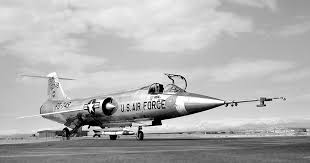
F-104 Starfighter Flight Envelope (contains envelope page image)

  • Thread starter Thread starter chr2021
  • Start date Start date
  • Tags Tags
    Flight Image
Click For Summary
SUMMARY

The discussion centers on the flight envelope of the F-104 Starfighter, specifically regarding the performance of its -19 turbojet engine and the afterburner. It is established that afterburner thrust is less affected by altitude compared to basic engine thrust, with afterburners providing a thrust increase of up to 100% at high altitudes. The conversation highlights the impact of air temperature and density on engine performance and discusses the historical context of the F-104's design and testing, including insights from General Charles Yeager's experiences.

PREREQUISITES
  • Understanding of turbojet engine mechanics
  • Familiarity with flight envelope concepts
  • Knowledge of aerodynamics principles
  • Awareness of military aviation history, particularly the F-104 Starfighter
NEXT STEPS
  • Research the mechanics of afterburners in turbojet engines
  • Study the aerodynamics of high-altitude flight
  • Explore advancements in materials for jet engine construction
  • Investigate the historical significance of General Charles Yeager's test flights
USEFUL FOR

Aerospace engineers, aviation enthusiasts, military historians, and anyone interested in the technical aspects of jet propulsion and flight dynamics.

chr2021
Messages
1
Reaction score
0
Hello to all forum members,

1610174055648.jpeg


Here is a page from the F-104 flight manual. It shows the flight envelope for the F-104 Starfighter with the powerful -19 turbojet engine:

F-104%20FLIGHT%20ENVELOPE%20-19.jpg


I have a question regarding the shape of the afterburner envelope.

In Aerodynamics for Naval Aviators, published in 1965, the author, Hugh Harrison Hurt, Jr., states:

"The thrust added by the afterburner of a turbojet engine is not affected so greatly by altitude as the basic engine thrust. The use of afterburner may provide a thrust increase of 50 percent at low altitude or as much as 100 percent at high altitude."

Why is military thrust (basic engine thrust) greatly impacted by altitude, and afterburner thrust is not?

Thanks,

Chris
 
Last edited:
Physics news on Phys.org
Afterburner dumps a lot of fuel in which provides a certain amount of additional mass regardless of how much mass is in the air. Also, notice that the statement is in terms of the percentage increase that afterburner provides. At a higher altitude, that percentage represents less additional thrust than the same percentage would represent at a lower altitude.
 
  • Like
Likes   Reactions: jedishrfu
The OP invited all members (with knowledge) to respond. Several technological advances led to the F-104 design. From the ground defense radar perspective, the appearance of enemy aerial inflight refueling aircraft presaged enemy fighter aircraft transitions from 'military' to 'maximum' power characteristics; that is, firing afterburners to zip away from detection and otherwise modify position.

Running afterburners to improve thrust requires massive fuel expenditures largely supplied by drop tanks on some models and multi-use aerial tanker aircraft connected with, but outside, the 'forward edge of the battle area'. I will not comment on altitude questions other than to note that the F-104 was designed to achieve and sustain high altitude flight.

For an interesting informal perspective of F-104 design tests pushing the military flight envelope, General Charles Yeager USAF wrote or co-wrote several declassified papers and popular books describing test flying Starfighter variants. The late pilot was a master of overcoming flat spins induced in fighter aircraft based on extensive aerodynamic knowledge and experience.
 
Klystron said:
For an interesting informal perspective of F-104 design tests pushing the military flight envelope, General Charles Yeager USAF wrote or co-wrote several declassified papers and popular books describing test flying Starfighter variants. The late pilot was a master of overcoming flat spins induced in fighter aircraft based on extensive aerodynamic knowledge and experience.
Well, there was that one flat spin in an F-104 that Chuck was not able to overcome... :wink:

http://www.check-six.com/Crash_Sites/NF-104A_crash_site.htm

“On December 10, 1963, while testing an NF-104A rocket-augmented aerospace trainer, he narrowly escaped death when his aircraft went out of control at 108,700 feet (nearly 21 miles up) and crashed. He parachuted to safety at 8,500 feet after vainly battling to gain control of the powerless, rapidly falling craft. In this incident he became the first pilot to make an emergency ejection in the full pressure suit needed for high altitude flights.” (from the biography of Gen. Yeager click here).

1610488043261.png


[EDIT] Oh jeeze, I did not know until just now that the stuntman playing Yeager in the movie reenactment of the ejection died...:frown:

1610488239467.png
 
  • Sad
Likes   Reactions: Klystron
chr2021 said:
Here is a page from the F-104 flight manual. It shows the flight envelope for the F-104 Starfighter with the powerful -19 turbojet engine:

F-104%20FLIGHT%20ENVELOPE%20-19.jpg


I have a question regarding the shape of the afterburner envelope.
I cannot see an image. Here is another performance envelope.
http://www.starfighter.no/envel-e.html
jedishrfu said:
Best guess is the temperature and density of air at higher altitudes that the first engine must overcome that the afterburner doesn’t have to deal with.
And probably the speed at which the aircraft flies, which can increase with altitude due to lower density. The air is then rammed into the intake, and with colder air, the compressor would be more efficient.

Some other interesting information.

Engine performance has improved with the development of higher strength materials with more creep resistance. http://www.phase-trans.msm.cam.ac.uk/2003/Superalloys/coatings/index.html

In addition, compressors have become more efficient as well as other parts of the engine.
http://cfd2012.com/ansys-cfx-gas-turbine-combustor.html
 
  • Like
Likes   Reactions: jedishrfu