physicsdude30
- 14
- 0
How important is "falsification in Science"?What separates Physics from everyone else
Many here are quite fascinated by Science, or at least I'd think that's why you signed up for PhysicsForums. One topic many are interested in is: What separates Physics from the other Sciences?
Something which has been on my mind for a while is how much does falsification differ among the Sciences; how much of an impact does it have individually? Just some background knowledge for those who aren't familar (if you already know what falsification is skip to the next paragraph): Karl Popper pointed out that Albert Einstein put his ideas out in the open by suggesting how they could be tested and possibly shown false if by any chance they were, as a safety mechanism for finding truth within Science. Then Popper said pseudo-sciences do just the opposite of this, no matter the outcome they'll say “This shows that my idea is true”, "Oh, a different outcome. Well that must also mean my idea is true." Karl Popper continued that Science requires strict falsification to be scientific. However, I’m curious to what extent that plays a role among the individual Sciences themselves? I’ve heard various physicists say they believe degree of falsification is also what separates Physics from the rest of the Sciences, and so on down the Hierarchy of Sciences: Physics -> Chemistry -> Biology -> Social Sciences. Many will say the "softer" the discipline, the more researchers are biased in setting up their studies so that the outcome turns out a certain way.
As far as useful knowledge, furthering this line of reasoning of falsification what would you say about making the “level of falsification among the Sciences” itself testable? As you are all aware, scientists post their studies in peer-review journals. As far as what you can actually observe and make quantitative, it can be seen whether researchers say “our hypothesis was supported by our study” versus “it wasn’t supported by our study”. You can then graph out the percentage of “supported” versus “not”, then compare the various disciplines against each other. I actually found that such a study was done at the INNOGEN and ISSTI-Institute for the Study of Science, Technology & Innovation.
By looking at the graphs below, it appears that the physical sciences are statistically significant from the biological which are then again from the social sciences. However, although they’re statistically significant it looks like they are “only different by matter of degree”. So the purpose of this post is I’m extremely curious what input others from PF may have: Is falsification the variable which separates the Sciences, or is there another underlying cause and falsification just being a symptom? For a long time I’ve been quite intrigued by what separates the Sciences, which could turn out to be useful knowledge.
Graphs from Study:
Consider the Hard versus Soft Sciences (Also adding in the dimension of Pure versus Applied research)
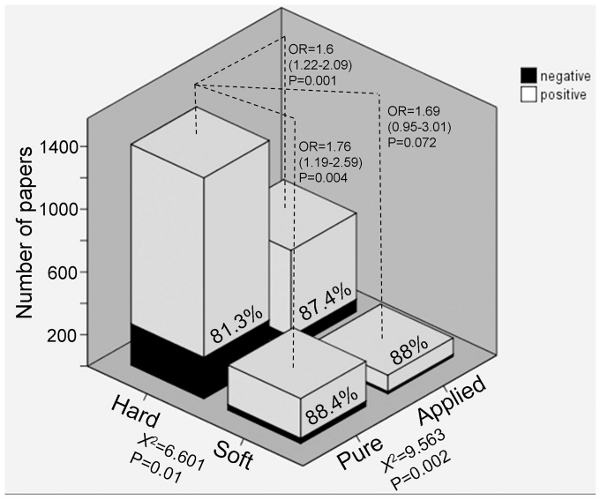
"Number of papers with studies which supported (white) or failed to support (black) a tested hypothesis"
Consider the Individual Disciplines themselves

Consider the Physical versus Biological versus Social Sciences

Copyright from this peer-review journal gives permission to distribute parts of study as long as it’s cited, so:
Fanelli D (2010) “Positive” Results Increase Down the Hierarchy of the Sciences. PLoS ONE 5(4): e10068. doi:10.1371/journal.pone.0010068
Study available online at http://www.plosone.org/article/info:doi%2F10.1371%2Fjournal.pone.0010068"
Many here are quite fascinated by Science, or at least I'd think that's why you signed up for PhysicsForums. One topic many are interested in is: What separates Physics from the other Sciences?
Something which has been on my mind for a while is how much does falsification differ among the Sciences; how much of an impact does it have individually? Just some background knowledge for those who aren't familar (if you already know what falsification is skip to the next paragraph): Karl Popper pointed out that Albert Einstein put his ideas out in the open by suggesting how they could be tested and possibly shown false if by any chance they were, as a safety mechanism for finding truth within Science. Then Popper said pseudo-sciences do just the opposite of this, no matter the outcome they'll say “This shows that my idea is true”, "Oh, a different outcome. Well that must also mean my idea is true." Karl Popper continued that Science requires strict falsification to be scientific. However, I’m curious to what extent that plays a role among the individual Sciences themselves? I’ve heard various physicists say they believe degree of falsification is also what separates Physics from the rest of the Sciences, and so on down the Hierarchy of Sciences: Physics -> Chemistry -> Biology -> Social Sciences. Many will say the "softer" the discipline, the more researchers are biased in setting up their studies so that the outcome turns out a certain way.
As far as useful knowledge, furthering this line of reasoning of falsification what would you say about making the “level of falsification among the Sciences” itself testable? As you are all aware, scientists post their studies in peer-review journals. As far as what you can actually observe and make quantitative, it can be seen whether researchers say “our hypothesis was supported by our study” versus “it wasn’t supported by our study”. You can then graph out the percentage of “supported” versus “not”, then compare the various disciplines against each other. I actually found that such a study was done at the INNOGEN and ISSTI-Institute for the Study of Science, Technology & Innovation.
By looking at the graphs below, it appears that the physical sciences are statistically significant from the biological which are then again from the social sciences. However, although they’re statistically significant it looks like they are “only different by matter of degree”. So the purpose of this post is I’m extremely curious what input others from PF may have: Is falsification the variable which separates the Sciences, or is there another underlying cause and falsification just being a symptom? For a long time I’ve been quite intrigued by what separates the Sciences, which could turn out to be useful knowledge.
Graphs from Study:
Consider the Hard versus Soft Sciences (Also adding in the dimension of Pure versus Applied research)
"Number of papers with studies which supported (white) or failed to support (black) a tested hypothesis"
Consider the Individual Disciplines themselves
Consider the Physical versus Biological versus Social Sciences
Copyright from this peer-review journal gives permission to distribute parts of study as long as it’s cited, so:
Fanelli D (2010) “Positive” Results Increase Down the Hierarchy of the Sciences. PLoS ONE 5(4): e10068. doi:10.1371/journal.pone.0010068
Study available online at http://www.plosone.org/article/info:doi%2F10.1371%2Fjournal.pone.0010068"
Last edited by a moderator: