Fast algorithm for polygon/line intersects

  • Context:
  • Thread starter Thread starter Joppy
  • Start date Start date
  • Tags Tags
    Algorithm
Join the discussion
Ask a follow-up here, or get your own question answered by working scientists, mathematicians and engineers — people, not an autocomplete.
Real named experts · corrections over time · the nuance an AI answer skips
3 replies · 2K views
Joppy
MHB
Messages
282
Reaction score
22
If we define our polygons as a collection of lines, then each polygon has slopes $\vec{m}$ and y-intercepts $\vec{c}$. For a single line in the plane $y = ax + b$ amounts to finding $x = \dfrac{b - \vec{c}}{\vec{m} - a}$, which is fine. But then we need to sift through the solution vector $x$ and remove any points not on the polygon. This is a trivial operation but costly when the number of polygons is large. What is a faster way to do this?
 
Physics news on Phys.org
Joppy said:
If we define our polygons as a collection of lines, then each polygon has slopes $\vec{m}$ and y-intercepts $\vec{c}$. For a single line in the plane $y = ax + b$ amounts to finding $x = \dfrac{b - \vec{c}}{\vec{m} - a}$, which is fine. But then we need to sift through the solution vector $x$ and remove any points not on the polygon. This is a trivial operation but costly when the number of polygons is large. What is a faster way to do this?

Hey Joppy,

Here's an article that outlines algorithms for polygon intersections.

A classical approach is a so called sweep-line algorithm.
We sort the edges on the highest y-coordinate, and we sweep a horizontal line through them from top to bottom.
The sweep iterates through new edges coming in range, and through intersections of the edges on the corresponding active list.

Another unmentioned approach is to divide into sub problems.
That is, if 2 polygons have a distance to each other that is greater than their size, they won't have intersections.
 
I like Serena said:
Hey Joppy,

Here's an article that outlines algorithms for polygon intersections.

A classical approach is a so called sweep-line algorithm.
We sort the edges on the highest y-coordinate, and we sweep a horizontal line through them from top to bottom.
The sweep iterates through new edges coming in range, and through intersections of the edges on the corresponding active list.

Another unmentioned approach is to divide into sub problems.
That is, if 2 polygons have a distance to each other that is greater than their size, they won't have intersections.

Thanks! I think google is broken, I searched for some time and didn't find anything even remotely on these lines (pun intended).

edit: Hmm wait a minute.. Maybe I'm not understanding the routine highlighted there, but is this method just finding all the roots, or is it finding only those roots lying on say a closed polygon?
 
Last edited:
Joppy said:
Thanks! I think google is broken, I searched for some time and didn't find anything even remotely on these lines (pun intended).

edit: Hmm wait a minute.. Maybe I'm not understanding the routine highlighted there, but is this method just finding all the roots, or is it finding only those roots lying on say a closed polygon?

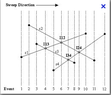
The Bentley-Ottmann Algorithm finds all intersections of an arbitrary set of line segments.
View attachment 7992
In this example the sweep is with a vertical line from left to right over arbitrary line segments.
 

Attachments

  • 1348015188_9174.png
    1348015188_9174.png
    10.2 KB · Views: 162