Feynman experiment with bullets

  • Context: High School 
  • Thread starter Thread starter Z3kr0m
  • Start date Start date
  • Tags Tags
    Experiment Feynman
Click For Summary
SUMMARY

The discussion centers on Richard Feynman's experiment with bullets as described in his lectures, specifically in volume I, chapter 37-2. A discrepancy is noted between the graphical representation of the experiment in the book and the live recorded lectures. The primary focus is on the absence of an interference pattern, regardless of the visual differences, emphasizing that the experiment serves to illustrate the concept of no interference rather than precise graphical accuracy.

PREREQUISITES
  • Understanding of Feynman's lectures, particularly volume I, chapter 37-2
  • Familiarity with basic principles of wave-particle duality
  • Knowledge of interference patterns in physics
  • Ability to analyze graphical representations in scientific literature
NEXT STEPS
  • Review Feynman Lectures on Physics, Volume I, Chapter 37-2 for detailed context
  • Study wave-particle duality and its implications in quantum mechanics
  • Examine examples of interference patterns in various physical experiments
  • Analyze graphical representations of scientific experiments for accuracy and clarity
USEFUL FOR

Students of physics, educators teaching quantum mechanics, and anyone interested in the interpretation of Feynman's work and the principles of wave-particle duality.

Z3kr0m
Messages
19
Reaction score
0
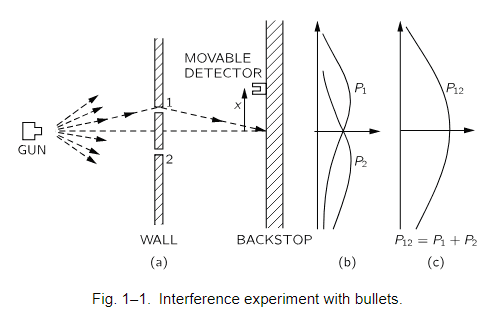
Hello, I have a question. In Feynman lectures vol. I, in chapter 37-2, Feynman has an experiment with bullets.
wwiC7XV.png

*Copyright http://www.feynmanlectures.caltech.edu/III_01.html
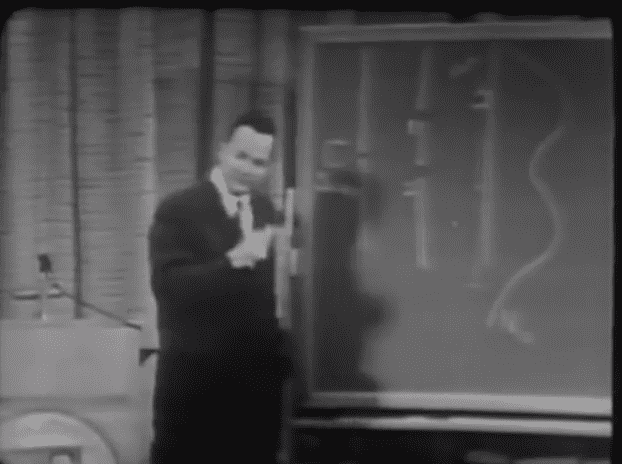
But the curve for ##P_{12}## looks in the picture is different from his live recorded lectures.
7FQAmlI.png

*YouTube -

Is the difference because of the first hole (in video) right after bullet source? If it's that close to source it should shoot bullets to all sides like in the book, or not? Thanks for answers.
 

Attachments

  • wwiC7XV.png
    wwiC7XV.png
    8.3 KB · Views: 1,323
  • 7FQAmlI.png
    7FQAmlI.png
    41 KB · Views: 650
Physics news on Phys.org
It looks different because it is just a sloppy illustration. The point is that there is no interference pattern. We don't really care if there is one maximum in the middle or two maxima on either side. In either case, it is just an example of no interference. I can't say if the diagram in the book is sloppy, or if the diagram in the lecture is sloppy, because it is just a hypothetical situation with no hard numbers.
 
  • Like
Likes   Reactions: Z3kr0m

Similar threads

  • · Replies 23 ·
Replies
23
Views
2K
  • · Replies 5 ·
Replies
5
Views
1K
  • · Replies 2 ·
Replies
2
Views
2K
  • · Replies 4 ·
Replies
4
Views
5K
  • · Replies 6 ·
Replies
6
Views
3K
  • · Replies 9 ·
Replies
9
Views
2K
Replies
1
Views
4K
  • · Replies 28 ·
Replies
28
Views
4K
  • · Replies 6 ·
Replies
6
Views
5K
  • · Replies 4 ·
Replies
4
Views
3K